Bangladesh must implement policies that support the growth of a circular economy in order to maintain exports of ready-made clothing to EU nations and get ready for upcoming challenges in this area, said Ferdaus Ara Begum, chief executive officer of the Business Initiative Leading Development (BUILD).
She claimed that the EU has started the process of creating a supply chain that is carbon neutral on Saturday, the second day of the Bangladesh Economic Association’s biennial conference. They intend to levy carbon taxes on a range of products in keeping with this objective.
She also mentioned the new laws they have proposed, like the Eco-design for Sustainable Products Regulation and the Digital Product Passport (DPP) under the EU Green Deal.
Bangladesh’s major export product, apparel, is currently not on the risk list but it could be included at any time. The country should prepare to address any challenges in this regard, Ferdaus Ara said during a presentation on Circularity in the Textile and RMG Sector of Bangladesh.
“Of the US $ 47 billion of our RMG exports, about US $ 37 billion is exported to the EU. Now they are giving various regulations on the issue of circularity. EU’s green deal, ecological design issues are now getting attention. Therefore, Bangladesh has to prepare from now to face possible future situations,” she said.
According to the presentation, between 2000 and 2015, the world’s textile manufacturing nearly doubled. According to the European Environment Agency (EEA) in 2019, the consumption of apparel and footwear is projected to rise by 63 per cent by 2030, from 62 million tonnes at present to 102 million tonnes in 2030.
In the EU, 5.8 million tonnes of textiles are thrown away annually, or around 11 kg per person. In addition, a truckload of textiles is burned or landfilled somewhere in the world every second.
Aiming for climate-neutral textile development that is energy and resource efficient and created in peace with nature, the EU is pursuing a systemic solution known as the Green Deal.
The European Union is moving towards a circular economy, in which things are recycled and reused.
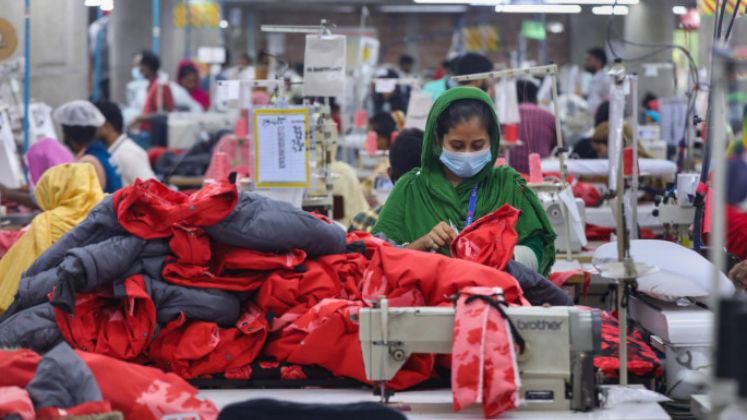
Ferdaus Ara Begum said that according to various reports, 4.5-5 lakh tonnes of waste are generated annually in the country’s garment and textile sector. Only a fraction of it is recycled. Consequently, there is a pressing need to address this issue.
She stated that as a country moves from being classified as a less developed one, environmental issues will emerge as the main industrial challenge. Thus, the only option left to preserve competitiveness is to increase resource recycling. She further said that it is important to maintain the recycling system at the post-consumer stage.
The presentation emphasises that 10.35 per cent of Bangladesh’s GDP comes from the apparel and textile industry. It creates jobs for 4.1 million people, which helps to reduce poverty by 9.1 per cent and empower women by 65 per cent.