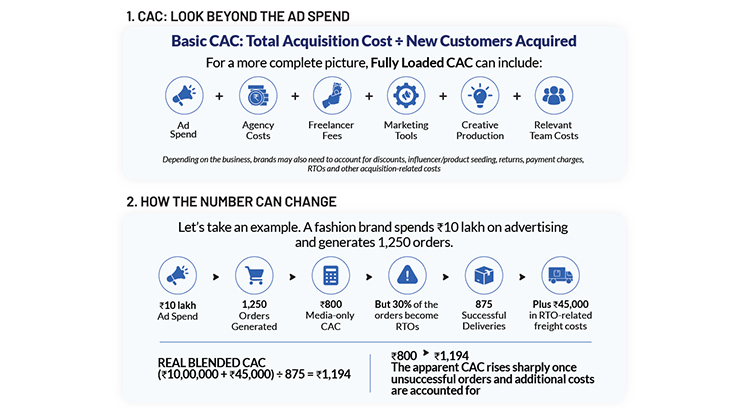
For fashion brands, the real CAC (Customer Acquisition Cost) question isn’t how much it costs to get someone to place an order. It’s how much of that cost the business can afford to carry before the customer proves their worth. That distinction matters more now than it used to, with acquisition costs rising, margins under pressure, and brands moving past founder-led growth into paid channels where the numbers get less forgiving.
There’s no universal CAC benchmark in fashion, but there is a consistent framework underneath the disagreement: contribution margin (the money left from a sale after paying the variable costs of making and selling the product), average transaction size, repeat-purchase behaviour, channel quality, and how long a business can wait to recover what it spent. Where brands genuinely diverge is how much they trust LTV (Lifetime Value, the total profit a business expects from a customer over the full relationship) to justify spending more upfront.

Chippy Mehta, Co-Founder & COO, Bombay Shirt Company, reframes the starting question entirely. It isn’t how much CAC a brand can afford, it’s what kind of customer that spend is actually buying. “A brand with strong repeat behaviour can afford to acquire customers very differently from a brand where most customers purchase only once,” he said. Revenue and ROAS (Return on Ad Spend), in his view, are the wrong measures of efficiency. Contribution margin is what ultimately funds acquisition.

Ashmeer M. Sayyed, consultant and former Chief Retail Officer, DaMENSCH, recommends five lenses to size up a brand’s CAC: the LTV to CAC ratio, payback period, contribution margin, prevailing acquisition costs, and channel-level economics. His working benchmark is a 3:1 LTV to CAC ratio, meaning a customer should be worth roughly three times what it costs to acquire them, though he’ll allow an emerging brand to run at 1.5 to 2:1 temporarily if there’s credible evidence repeat purchases will close that gap within 12 to 18 months.
The LTV Debate: Bet on Future Value, or Not

Karan Singh, Founder & CEO of Bengaluru-based menswear brand Aristobrat, takes the most conservative position in the industry. He argues acquisition cost should ideally be zero, and once a brand has sufficient cash flow, should never exceed 10 to 15% of MRP as a consistent rule across categories. He built his own first 500 customers without any media spend at all, through direct outreach to personal contacts and Instagram followers.
Singh doesn’t favour using LTV projections to justify higher upfront spending. “If a business needs future orders to justify the economics of today’s order, it is deferring the problem rather than solving it,” he said. His preferred route to a lower CAC is retention infrastructure, referrals, CRM-led WhatsApp, SMS and email, so that repeat purchases get cheaper on their own rather than being used to rationalise spending more today.
That tension around LTV exposes a problem often mistaken for a pricing issue rather than an acquisition one. Singh argues apparel priced below roughly Rs 2,000 runs into a genuinely difficult equation once product cost, delivery, packaging, salaries, financing, marketing, marketplace commissions, taxes and acquisition costs are all stacked against it. AOV hides this well: a brand can celebrate a Rs 1,500 order, but if what survives after variable costs is a few hundred rupees, even a modest CAC wipes the transaction out entirely. Sometimes the fix isn’t a better ad campaign at all, it’s better pricing, better margins, or a basket build to carry more weight, because no amount of campaign optimisation repairs economics that don’t work at the product level to begin with.
Mehta takes a more flexible position but insists on evidence over projections. A higher CAC can make commercial sense, he said, when a customer segment has already demonstrated repeat behaviour. “It’s very easy to justify an expensive acquisition strategy by building an optimistic LTV model in Excel,” he noted. Given the choice, he’d rather pay more to acquire a segment with a proven record of returning than pay less for discount-driven customers.

Shivangini Padhiyar, founder of slow-fashion womenswear label The Summer House sits between the two, using contribution margin as her working benchmark. If CAC comes in below CM, the first order is profitable outright. If it equals CM, the order breaks even and everything after becomes upside. If it exceeds CM, the business is leaning on repeat purchases to close the gap. “This is completely normal in fashion but it’s like a bet, not a guarantee,” she said. In her view, a higher CAC is only justified once repeat-purchase signals and category loyalty are already visible, something that “only comes when we look at the LTV, not the invoice,” and can’t be predicted with certainty going in.
A spokesperson from Reliance Trends puts it more bluntly: if new cohorts convert only through discounts and don’t return, the brand is “buying revenue, not building a customer base.”
How Much Data Before the Number Can Be Trusted
On how much history a brand needs before relying on its own CAC, industry and brand views broadly align, even where the exact thresholds differ. The rough industry benchmark is a few thousand customers across at least one full seasonal cycle, with early-stage brands leaning on first-order economics until enough repeat-purchase data comes in. For The Summer House, the practical benchmark runs narrower, around two to three launches or seasons. Mehta cautions against a common mistake: taking acquisition data from the first few months and assuming that pattern holds indefinitely.
Ashmeer puts a firmer number on it from the consultant side, wanting the oldest customer cohort at least six months old with 300 to 500-plus customers before trusting a CAC target, and treating that number as something to keep re-underwriting as more data arrives rather than locking in once. Singh’s bar sits considerably higher still, at least a year of consistent data or roughly 10,000 customers. He said, early on, founders should treat CAC as something to observe and learn from, not something to optimise aggressively against.
Why a Single Blended CAC Doesn’t Work
Most brands have also given up on one blended CAC across the business. A blended number can quietly hide an expensive channel behind a cheap one, or let a high-ticket category paper over a low-margin one, so CAC gets tracked by category, segment and channel instead. A cheaper channel that attracts low-intent, discount-driven buyers can ultimately cost more than a pricier channel that brings in loyal customers. Paid social offers speed but doesn’t necessarily build loyalty. Referral and organic channels tend to deliver stronger economics but at lower scale. Offline gives customers undivided attention, which Padhiyar described as “basically a luxury good” in the current environment.

Speed of Recovery Is Non-Negotiable
Brands are most aligned on the urgency of recovering CAC quickly. Singh rejects treating CAC as a long-term investment altogether, arguing that each order should be profitable from day one, with acquisition costs recovered through the sale itself rather than amortised over some future period. Padhiyar takes a similar view, aiming for recovery “with the first purchase, ideally.” Ashmeer Mehta gives that discipline a number: 6 to 9 months for an emerging brand, with 12 as a hard ceiling, and he points to the far longer 18 to 24-month payback periods common in Indian fashion as a model that can leave a young company dangerously dependent on outside funding.
CALCULATING THE REAL CAC