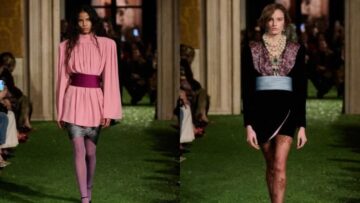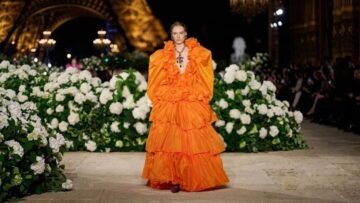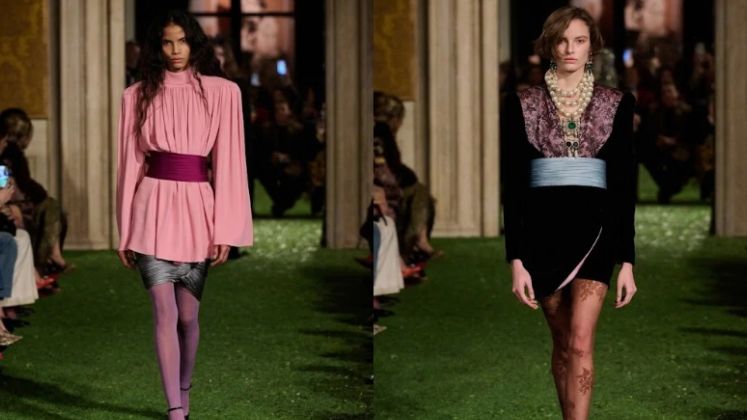
The waist has been fashion’s focal point for several seasons now, and the cummerbund is the latest tool for defining it. After the scarf belt and the chain belt, the cummerbund’s comeback gathered pace in the Spring/Summer 2027 shows, where it surged in popularity. In New York, Daniella Kallmeyer and TWP both worked cummerbund-inspired elements into their collections, while Conner Ives dressed models in the kind of cummerbunds their husbands would have worn to dinner, and Heirlome showed lightweight silk versions at its debut on-schedule show. In Copenhagen, fringed cummerbunds appeared, from silk scarves tied at the waist to proper cummerbund form at By Malene Birger. Menswear fed the trend as well: Celine’s Spring 2027 menswear show wrapped bright silk cummerbunds around sweaters and trousers. For women, the shortcut is to build the waist into the garment itself. Harris Tapper makes a cummerbund skirt, and Thom Browne cummerbund dresses were worn by Lorde at the Met Gala and Olivia Dean at the CFDA Awards
The word itself is Indian. “Cummerbund” is the Anglicised form of the Hindustani kamarband, entered English in 1616, and was adopted by British officers in colonial India after they saw sepoys wearing it. Harper’s Bazaar India makes the same point about the instinct behind the trend: the kamarbandh has long been used to accentuate the waist and add ornamentation to a saree or lehenga, and that impulse now appears in more relaxed forms. Aza’s own account argues that the kamarbandh has graduated from trend to tradition, pointing to South Indian bridal dressing, where the waist belt gives a heavy silk drape its structure.
On the Indian runway and red carpet, the most explicit cummerbund work is in menswear. Esquire India reports that Ibrahim Ali Khan recently wore a cummerbund tuxedo look by Rimzim Dadu, whose sculpted jaal cummerbund inlaid with mother of pearl was among its picks. Sandeep Gonsalves, co-founder of Sarah & Sandeep, told the magazine that the cummerbund no longer needs to belong exclusively to a tuxedo, and with modern tailoring or relaxed separates it reads as a considered styling detail, and he favours tonal dressing in black, ivory, deep brown or midnight. Saggar Mehra of Saggar Mehra Couture said menswear is moving toward more defined silhouettes, and the waist brings structure and proportion to a look; his label shows a same-hue cummerbund breaking the formality of an ethnic ensemble.
In womenswear and accessories, the waist is being worked through belts, kamarbandhs and structured skirt sets rather than cummerbunds proper. Sabyasachi’s belt is positioned as the answer to cinching a saree or lehenga, and Bollywood Hungama’s cinched-waist roundup features a Sabyasachi white tiger-crest belt worn over a striped red sari. Paisley Pop offers a gold-plated kundan waist belt with shell pearls, 66 inches long and 2.5 inches wide, described as a traditional kamarbandh, and Outhouse’s Koko Sigil Pin Belt, at ₹75,000, sits in Harper’s Bazaar India’s waist-adornment edit. Among skirts, Muskann Kapadiaa’s Emma set carries an embellished sequin waistband and is listed as a fusion of traditional and contemporary styles . Tarun Tahiliani’s crinkle-net skirt and corset set has a lace-up back and a pleated, voluminous skirt, and Reeti Arneja’s Banarasi brocade corset and flared lehenga set is listed for festive and sangeet wear.