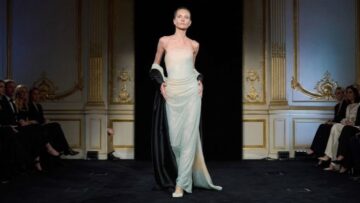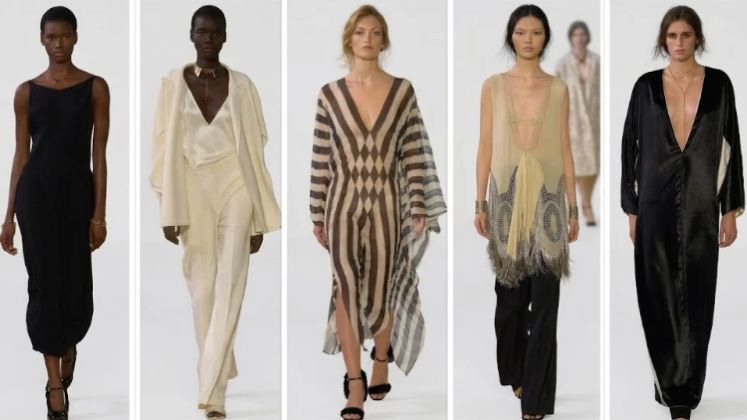
The textural opulence of art deco is shaping this fall’s wardrobes through feathers, fringe, embellishment and geometric patterns. Designers, editors and creators are gravitating towards a mix of beaded tanks, feathered skirts, vintage slips and classic heels, with a few modern details to balance the look. The trend art deco is technically an architectural style that began among French designers in the early 1900s and peaked in the 1920s and 1930s. In fashion it has come to mean a shiny, geometric aesthetic rooted in Roaring Twenties glamour and ending in an Old Hollywood flourish.
On the runway, the revival is led by beading, fringe, metallic fabrics and high-glam silhouettes. Prada’s bejewelled skirts for spring 2027 are the clearest example, while Kim Shui and Carolina Herrera explored vintage pink and green at New York Fashion Week. Chloé has embraced slip dresses, and Celine went viral with a modern take on jazz shoes. Satin and silk are rising, as are hand-beaded tanks and drop-waist dresses at the higher end of the market. The appeal, Baker argues, lies partly in a craving for individualism that is slowing the micro-trend cycle, and in the cachet of handcrafted and thrifted pieces over copy-and-paste viral products. Her styling advice is restraint: choose one standout piece and keep everything else modern and minimal, to avoid looking like a costume party.
India has an unusual claim on this trend. Mumbai’s Marine Drive and the area around Oval Maidan form one of the world’s most celebrated art deco districts, and UNESCO inscribed the Victorian and Art Deco architecture in Fort and on Marine Drive as a World Heritage Site in 2018. UNESCO says the Art Deco cinemas and residential buildings blend Indian design with Art Deco imagery, creating a style described as Indo-Deco. The city’s Regal and Eros cinemas are among the structures recognised. That heritage gives Indian labels a ready narrative, and the market’s appetite for beadwork, metallic thread and evening glamour gives them the craft base to match.
At the couture end, the natural candidates are houses already built on sparkle. Falguni Shane Peacock describes its signature as feathers, sequins and prints, and the label is known for rhinestones, bugle beads, crystals and glass sequins, an almost literal match for the revival’s beaded and feathered pieces. Rimzim Dadu works with textiles made from steel wire and metallic cords, and her Indian Couture Week 2024 collection drew on Baroque, classical music and architecture, so geometric metallic sarees and gowns fit her language. Gaurav Gupta, who has got women to wear glittering gowns in the daytime, brings sculptural structure, and Manish Malhotra’s embellishment-heavy glamour suits a drop-waist beaded dress. Tarun Tahiliani’s fusion of Indian weaving with Western tailoring could produce deco-inflected pre-draped sarees and jackets. JJ Valaya’s collections, which have used antique gold, ivory, champagne and noir with zardosi, aari and metallic embroidery, are close to the deco palette, and Rahul Mishra’s artisanal embroidery could lend the style a more graphic, modern turn.
In the semi-formal tier, the opportunity is in pieces that can be worn beyond a wedding. Papa Don’t Preach by Shubhika and Dhruv Kapoor both offer ready-to-wear pieces that are more accessible than their high-end counterparts, which makes beaded slips, sequin separates and fringe skirts plausible. House of Masaba, which has shown at Indian Couture Week, could translate the look through bold colour and pattern. Ritu Kumar’s heritage block prints and embroidery could be recut into drop-waist silhouettes, and Anita Dongre, a designer serving multiple budgets, could bring beaded evening wear to a wider audience. Raw Mango’s handloom textiles suit a metallic-woven jacket or sari, while Chamee & Palak, known for clean lines, muted palettes and restrained embroidery, are best placed for the minimal side of the style.
At the casual end, art deco becomes a matter of one detail rather than a full look, such as a fringed hem, a beaded trim or a satin slip under a jacket. Nicobar’s relaxed lifestyle design could offer satin camisoles and printed slips, and Fabindia’s mass reach in Indian textiles could introduce beaded or tasselled accessories at accessible prices. AND, a mainstream high-street label, could translate the trend into drop-waist dresses and sequin minis. Suta’s handloom sarees could carry metallic borders and geometric weaves, Péro’s handcrafted, layered pieces suit a beaded wrap skirt or an embellished jacket, and Doodlage’s upcycled approach echoes the thrift culture behind the revival, in which vintage pieces are as prized as new ones.
For India, the trend’s pairing of vintage glamour with budget-friendly styling is worth noting. Baker points out that no single brand leads the revival and that secondhand racks are a major source. That favours labels with the craft and storytelling to compete on originality rather than price. Brands that can point to Marine Drive, to handwork and to a single hero piece have the best chance of turning a global mood into a local sale.