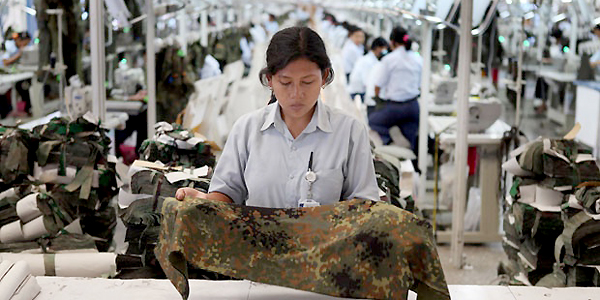
In order to increase the country’s competitiveness in the global market, Vietnam is looking into the challenges faced by its textile and garment industry as well as mulling over measures to overcome shortages of raw materials in order to make the most of the Trans-Pacific Partnership (TPP), of which it is a member.
According to experts, Vietnam has maintained a growth of over 10 per cent, while in terms of technical productivity, its garment industry has come to be included among the world’s top three garment makers. According to these experts, an amount of around US$15 billion would be needed for the country’s textile and dyeing industry.
In this regard, Le Tien Truong, General Director of the Vietnam Textile and Garment Group (Vinatex) said, “This figure is really a challenge for local businesses. So when the market opens, the arrival of foreign investors is unavoidable. So, to ensure healthy competition, the state needs to manage the market properly, with strict legal institutions in both technology and environmental protection.”
However, to get this great benefit, Vietnam also experienced many challenges and barriers relating to materials. In 2015, Vietnam exported $27.5 billion of garment-textile products, but it had to spend $14 billion to import raw materials. Of the remaining $13.5 billion in the country, it spent $6 billion to pay salaries and over $7 billion for domestic raw materials. Thus, Vietnam needs to overcome the problem of input raw materials.
Truong added that it is extremely difficult for small and medium enterprises to invest in the textile and dyeing industry. Businesses need only around $3,000 to invest in a position of garment worker (people and technology) but up to $200,000 for a fibre or dye worker in Vietnam.
Dr Nguyen Duc Thanh, Director of the Vietnam Economic and Policy Research Institute (VEPR), also urged the state institution to develop better policies for the development of the local enterprises.