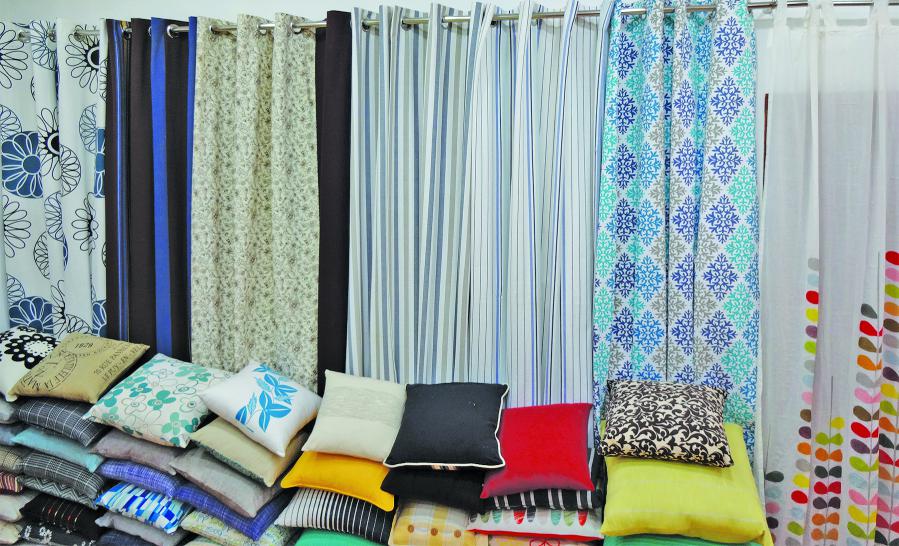
 Famed for its home textiles, Karur accounts for more than Rs. 6,000 crore-business annually, with 80 per cent exports across the globe. The 500 odd companies dotting the landscape of Karur in Tamil Nadu, a two hour drive from Tirupur — which played a significant role in the history and culture of the state and its people — has a niche in bed linens, kitchen linens, toilet linens, table linens and wall hangings.


Predominantly, a buyerdriven business, Karur’s home furnishing industry, is undergoing a transformation from its traditional identity of 100 per cent cotton and basic designs, towards newer blends like polyester, 100 per cent linen and more value additions. Well connected to major metros of the country and blessed with abundance of locally available raw materials, workforce and an enthusiastic Gen Next ready to contribute towards its growth and development, the home textile hub of the South is yet hamstrung by issues such as lack of CETP and scarcity of competent professionals like designers and merchandisers. Nevertheless, it is the strong willpower and enthusiasm of the entrepreneurs that more than make up for the shortcomings. Off late, the industry has received a major booster from the improving US market, which promises better prospects for it.
A stroll along the city’s streets, especially in areas like Sengunthapuram, Ramakrishnapuram, Pugalur Road, Kamarajapuram, Chinna Andan Koil Road, Anna Nagar etc, which houses majority of the factories; one finds that instead of the usual hustlebustle and cacophony, it’s the smooth work in progress, occasionally punctured by machine’s noise, which draws one’s attention. Step in and you are greeted by a happy workforce and a buoyant owner who seems to have found renewed energy, thanks to the US market, which is picking up just at the right time to boost their morale, especially for those who earlier were majorly dependent on Europe for most of their market thrust.



“This year I am expecting good business, to the tune of Rs. 25 crore, as we would start working again with US-based buyers,” says MK Rajendheren, CEO, Veera Home Tex (Veera Group), who maintains that the company has started offering linen and is working on 100 per cent polyester as well. Rajendheren accepts that despite some companies moving forward by using newer blends and value additions, Karur by and large, is still lacking in such experimentations. “It is one of the biggest reasons why Karur is losing out to Panipat and other such hubs,” he adds. Echoing Rajendheren’s opinion, Satheesh Ram, Marketing Director of Homebase Export observes that Panipat is more into designs and fancy items, while Karur is only now moving into such products. “Understanding the importance of designs, most of the companies have roped in in-house designers”, observes Satheesh adding, “Homebase Export also has a full time designer now.”
“Compared with other hubs, Karur needs to improve collective efforts as these are missing.” – MK Rajendheren, CEO, Veera Home Tex
Gen Next is happily joining their family business with proper education and vision. – Gunasekaran, MD, Kuppu Exports with his son G. Pradeep.
However, not everyone is looking to take the PD route for growth. Doing annual business of Rs. 10 crore and expecting to grow it by 10 per cent this year, Gunasekaran, MD of Kuppu Exports comments, “We are following the designs/products according to what the buyers wish,” adding, “With the kind of setup we have, it is difficult to do very good PD in-house.” Gunasekaran’s observations find an apt resonance with K. Ramesh’s thoughts, Director of Tex-Worths, who maintains, “We do PD and get buyer’s appreciation also, but as a whole, there is lack of R&D, like design development in our hub.” Ramesh rues lack of proper support for the Karur textile industry, including proper library and common design studio with the modern facilities where they can update themselves with international fashion forecasts. Besides this, cost involved in PD along with stiff competition, are factors what deter many companies to indulge in it, he feels.
“Despite many challenges, we are closely associated with local administration and pursuing for textile processing park and it is on initial documentation stage. We are in yellow category as we are into home textile industry and don’t use very hazardous chemicals. It will take time and effort but will come out. Similarly we have asked HEPC for a training centre in Karur or nearby area, it is in pipeline but may take some time. Our hub is in process to take benefit of ISD scheme.” – V. Ananthapadmanaban, CEO, Karur Textile Manufacturers Exporters’ Association which is working from 1973 and has 143 members
Nevertheless, what is attracting the buying houses and buyers towards Karur is the increasing trend of compliance certifications and organic products. Almost 9 years ago, Veera Home Tex was the only company to have initiated organic products and got certified for the same after three futile attempts. Now, more than 10 per cent companies in Karur are GOTS certified and the trend is increasing; few companies also have vertical setups, so they are not facing any problem to ensure that the complete chain is compliant. Tex-Worth is GOTS, BSCI, Oeko Tex certified; similarly Kanara Krafts has Sedex and Oeko Tex; Homebase Export is ISO, SA 8000, Sedex and now adopting SQP for its UK- based customers.
However, there are only 6 companies in Karur which have their own ETP; rest all depend on Erode and Salem for washing and dyeing, which is adding 20 per cent to the cost apart from the extra time that it consumes. Similarly, the city is also missing on a good college that can produce skilled designers, merchandisers and shop floor people. Even though nearby Tirupur, Salem, Coimbatore and Chennai have very good colleges, Karur is yet to have any of its own. Eight months to the Assembly elections, there seems to be no takers for its demand for a decent institute. The only support from the government is the sole textile park which is pretty well-organized and houses 36 units.
“Students from NIFT, Chennai come to Karur for internship and promise to join but they don’t; some of them work for one or two months before they jump to the metropolitan cities. Now we have decided not to take any interns from NIFT as we invest time and resources in their projects but they don’t support us. Karur is struggling a lot to get enough designers and even merchandisers. This is despite the fact that Karur is a good pay master. The only reason we understand that nobody wants to work in Karur, is that though the city is developed, but is still being taken as tier 3 or tier 4 city. We approached the govt. for proper training centre in Karur, but nothing happened.” – N. Rajasekaram, Director, Kanara Krafts and Ex. Chairman of CII, Karur district