Surat has always been about fabric. Now it wants to be about garments too. India’s largest fabric hub is turning into a serious apparel manufacturing destination, helped along by a textile policy in Gujarat that makes it attractive for established players to move into garmenting and for new ones to set up shop.
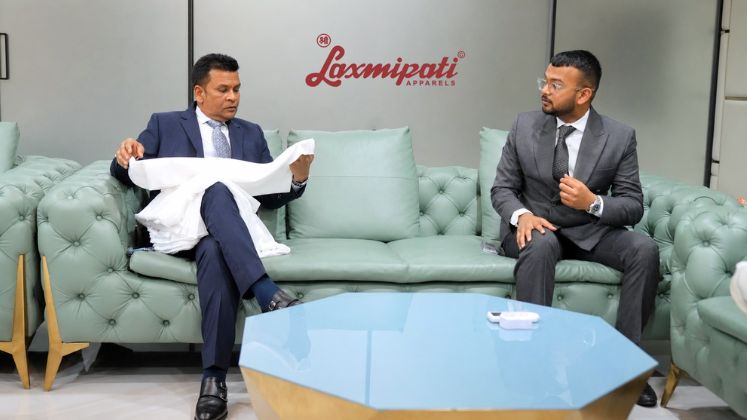
Laxmipati Group has deep roots there. Built over three generations and more than four decades in Surat, the group has grown into one of India’s established textile enterprises, guided for years by MD Sanjay Sarawagi. Now it’s entering a new chapter. Parth Sarawagi, Director, Laxmipati Apparels and a University of Arizona graduate, is leading that chapter through a dedicated apparel manufacturing platform built to serve global brands. The venture is two years old.
For Parth, Laxmipati Apparels is a natural extension of what the Group already does. Drawing on the Group’s expertise across textiles, processing, value addition and technical fabrics, the goal is an integrated manufacturing ecosystem that brings together technology, sustainability and scale to serve the global apparel industry end to end.
The company serves both domestic and export markets. Its client list includes Walmart, Ed Hardy, Express, Reserved, Sinsay, Best & Less, Mossy Oak, Starter and Eddie Bauer. Team Apparel Resources sat down with Parth to talk through the expansion.
“With four decades in textiles, we have already built complete backward integration. In Surat’s market, the prevailing trend was to sell fabric to garment exporters and stop there. We saw a significant gap: customers wanted a complete package, not just fabric. With our integrated base, we were well positioned to deliver the entire solution, fabric to garment, backed by standardised quality. That opportunity is what led us into apparel manufacturing through Laxmipati Apparels,” said Parth.
According to Parth, having fabric, processing, value addition and garmenting under one roof allows the company to develop products faster, shorten sampling and bulk lead times by around 25 to 30%, and give buyers a single point of accountability across the supply chain. He said this also enables tighter quality control, greater transparency and fewer external dependencies.
The company is particularly focused on MMF, activewear, athleisure and performance wear for men and women across both knitted and woven categories. With demand for functional, performance-driven apparel growing in India and global markets, Parth sees these categories as a key opportunity for the business.
To support this focus, the company is building a composite manufacturing campus with a planned investment of Rs 670 crore, bringing together spinning, knitting, processing and garmenting operations alongside new stitching machines.
Automation on the Floor
Automation is being built into key parts of the manufacturing process, from planning and inventory management to cutting, sewing and production monitoring. Digital systems allow the company to track production and shipments in real time, while automated spreading and cutting help improve fabric utilisation and reduce wastage.
On the sewing floor, advanced production systems and hanger automation are being used to manage workflow and line movement. The company also uses bonding technology for categories such as activewear and lingerie, where precision and finishing are particularly important.
The company has also invested in its sampling and product development capabilities, with an in-house team of more than 50 designers, merchandisers and production professionals. The aim, said Parth, is to connect fabric development and product creation more closely and shorten the journey from concept to commercial production.
Quality is managed through multiple checkpoints, including in-house testing, fabric inspection, panel checks, inline and mid-line inspections and needle detection. Parth says these systems have helped keep rejection rates below 1% and client escalations close to zero.
The Green Side of Growth
The plants operate on solar and wind power. The company expects to hit net-zero on coal within the next year and holds certifications including SLCP, BSCI, SEDEX, WRAP, GRS, GOTS and HIGG. For the upcoming greenfield project, it is also pursuing LEED certification, extending its sustainability commitments to the buildings themselves. On the materials side, the company has invested in technologies like Sorona-based fabrics, blending natural and man-made fibres into performance textiles.
A Zero Liquid Discharge treatment plant lets the company recycle and reuse over 6 lakh litres of water daily, enabling 100 percent recycling of discharged water. On the shop floor, 80 percent of the workforce is women.
Structured training programmes, supervisory development, workforce welfare initiatives and dedicated housing facilities support workforce development aligned with international manufacturing standards. The company also runs healthcare initiatives, offering free and subsidised medical services for workers and the wider community.
“I have a strong belief in India’s growing role in global apparel sourcing, and our ambition is to build a globally competitive enterprise from Surat that combines innovation, sustainability, and manufacturing excellence while contributing meaningfully to India’s apparel export story,” said Parth.
The greenfield expansion is central to that ambition, giving the company the scale to take on larger international programmes as it builds out its position in MMF-based garment manufacturing.
Laxmipati Apparels at a glance
|
Expansion path
|