Clothing and protective armour for military, paramilitary and other defence needs is a niche but a well established and important category of clothing that requires a lot more than just wearability. The rigours of the job which such persons entail are among the most demanding with critical requirements for personal protection and survival in diverse conditions. Overtime, technical textiles have become critical to garments with performance needs. Many companies from India are constantly innovating to fulfil the performance needs of this growing market segment, as Government now looks at investing in the best of uniforms for their men.
The global protective clothing market, wherein defence needs are a major chunk, is estimated to be worth around US $ 19.4 billion driven by internal and external security threats, territorial disputes, modernization initiatives, technological innovations, and a general shortage of body armour across the world. Added to this is the industrial protective clothing market, which has been forecast to reach a market value of US $ 8.6 billion by the year 2018, driven primarily by strong industrial production growth in developing countries and stringent Government regulations and guidelines for worker/occupational safety. The growth in Asian countries is expected to be the highest at around 5.8%.
The primary areas of concern for such garments are protection under all environmental conditions which include ballistics, chemical/biological, detection through odour, noise and visual enhancing devices, flame and thermal, insects and micro-organisms. Unlike regular garments, the challenge to meet the stringent needs of uniforms and protective gear starts from the fibre type selection, fibre size dyestuff selection, material technical design to providing the functional finish.
While constant innovations are being done in the product category to make them even more user-friendly and performance-enhanced, most important features today while making this product are durability, breathability and the weight of the uniform. In addition to protection, the gear must have properties for high resistance to sun, resist mildew, withstand static propensity in numerous applications, be water-repellent, have excellent durability to resist abrasion, tears and breaks, meet air permeability requirements that vary according to the end use, and for some military applications, be resistant to petroleum oil and lubricants is significant, in that requirements must be unaffected by the numerous washings.
Lighter weight and more warmth is the key…
Taking all into account the weight factor, for comfort to wearer, amongst the recent innovations, is that of Delhi-based Veritaz, which has a tie-up with Sympatex, a German based company that creates the protective membrane, which resembles a cling-film to be fused between the lining and the outer layer in fabric. The product is primarily for technical textiles used by Indian armed forces working in extreme diverse climatic conditions that range between +10 to -35 degrees C. The company is focusing on creating garments for soldiers posted in areas like Kargil, as currently the technical textiles available in the Indian domestic industry can create products that can cater to temperatures up to -20 degrees C only. Keeping much higher temperatures in mind, Veritaz has come up with a typical three layer suit called the extended coiled weather climate control system.
In this three layered suit, while the base layer consists of merino wool and polyester, having anti-bacterial and anti-fungal properties, on top of it is the mid-layer which is 100 per cent wind proof and water resistant, breathable with a fleece lining inside for added warmth. It is not the normal fleece that is available in the market, which is being used in such specialized clothing, but is a different one which is a lot lighter in weight and is further water-repellant. With a third really rugged outer layer which is 100% water proof, wind proof and completely breathable, the combination of these three gives protection for temperatures of up to -30 degrees C with only a combined weight of 2 kgs. In order to do light weight management, most of the company’s today are using filament yarns like polyester and nylon, which are much lighter than natural cotton yarn and therefore helps in keeping the weight of the uniforms a lot lower. Not only clothes but there are also other products like sleeping bags for army mountaineering that gives protection unto -45 degrees C weighing 2.2 kgs only.
Hollow yarns for warmth

For specialized mountaineering clothing, many other companies like U-long High Tech Textile Company, based in Taiwan, has come up with products that hold specialized technical finishes like the use of hollow yarns that helps in retaining the body heat and therefore keep the temperature inside the suit warm, along with making their jackets durable water-repellant with 80% repellant capacity till after 20 washes. Also at times there is use of chemical yarns in such clothing that react with the sweat specially during the time of mountain climbing or aggressive exercising, creating heat inside to keep the temperature high even in the lowest of weather temperatures outside.
Light weight fabric from high tenacity yarn
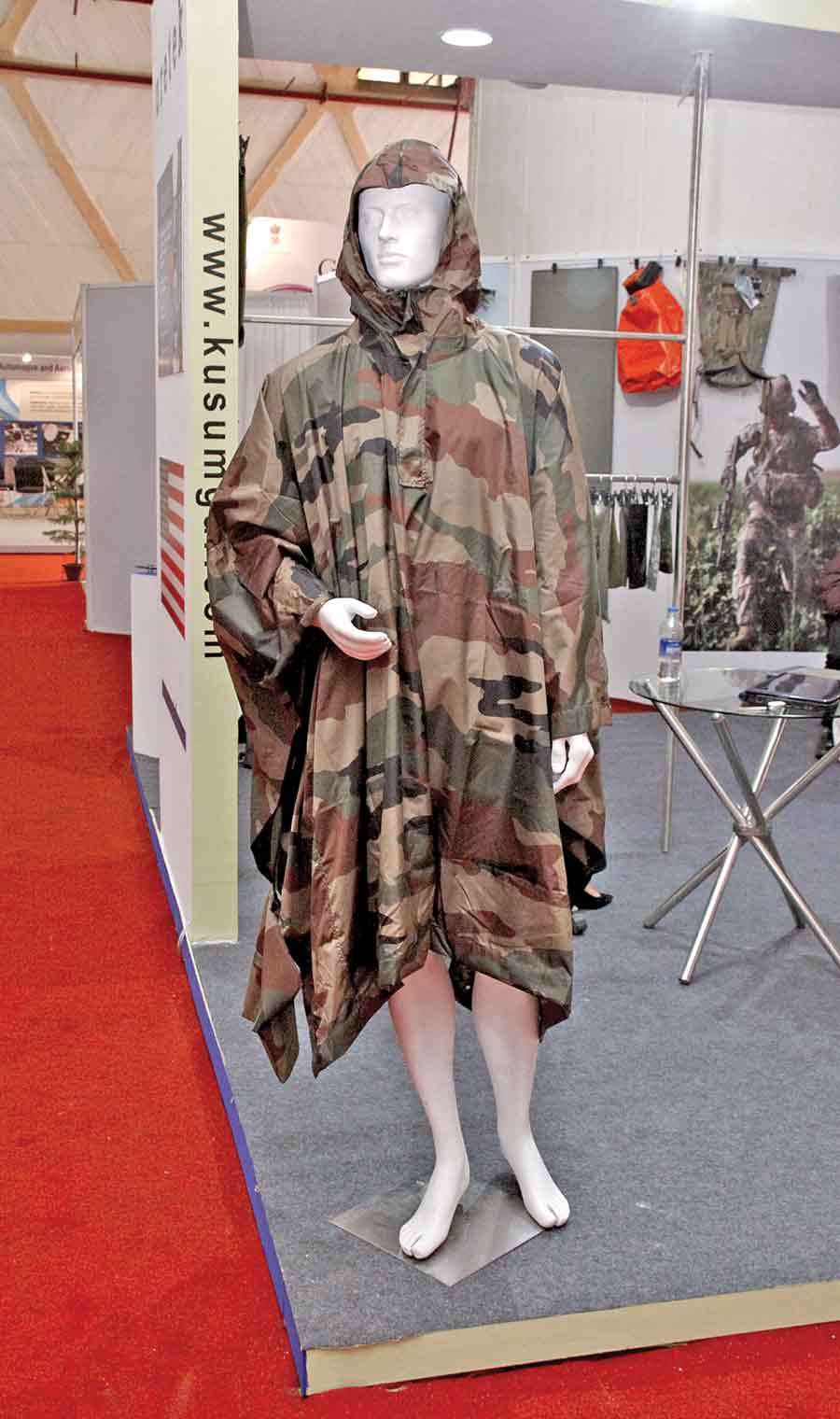
An Indian company, which is investing in R&D to provide light weight but durable fabric for extreme needs, is Mumbai-based Kusumgar Corporates. Manufacturers and suppliers of fabric made of nylon666, which is PU coated, the company also provides lot of finishes like WR water-repellant finishes and silicon coatings. The company is also dealing in protective clothing which are lighter and made out of a high tenacity yarn which are stronger (90 GSM can give you a performance result of 300 GSM), stronger and have breathability, products have properties like quick drying and moisture measurement so as to make the protect lighter and durable in order to make it easier for the military forces to carry the products. For normal military uniforms the company has created a nylon cotton blend that is called nyco, the fabric is breathable, moisture absorbent plus it is much more durable than cotton, so it is a lighter fabric with lesser GSM.