India wants a much bigger seat at the global sportswear table. To claim that space, it needs to strengthen its MMF ecosystem, particularly in polyester, nylon and technical fabrics. That is where companies such as Vietnam-based Tran Hiep Thanh Textile Corporation can bring valuable expertise, having built capabilities in the same areas that India now needs to scale.
Vietnam has spent the past decade building a strong MMF base and deep technical-fabric capabilities, helping it become a major manufacturing hub for global sportswear brands. Tran Hiep Thanh has grown alongside that ecosystem, producing polyester, nylon, polyester-spandex and nylon-spandex fabrics for activewear, sportswear and outerwear, and supplying brands including Decathlon, Uniqlo, Adidas and Columbia Sportswear.
Now, Tran Hiep Thanh is looking at India as a potential new growth base.
Van Nguyen, Commercial Director at the company, sees an opportunity to bring that experience into a market where MMF demand is rising and the sportswear industry is expanding. With the company assessing the market and exploring the possibility of manufacturing in India, Apparel Resources sat down with Nguyen to understand what is drawing Tran Hiep Thanh to India, where it sees the biggest opportunities and challenges, and how far the company could take its India ambitions.

Where does India fit into your growth plans right now, and what is driving your interest in the market?
India is an important market for us for several reasons. First, it has a very large domestic market, and demand for MMFs is growing quickly, particularly in sportswear, activewear and outerwear. A substantial amount of MMF material is still imported from China, so we see an opportunity to offer a competitive alternative in some areas.
For us, the opportunity is also about where our own next phase of growth can come from. We are one of the leading manufacturers of MMF woven fabrics in Vietnam, with an annual capacity of around 80 million metres and plans to expand to 120 million. But as Vietnam becomes increasingly saturated in terms of manufacturing capacity and labour availability, India stands out for its scale and growth potential, offering the kind of market that could support our next phase of expansion.
There is also an opportunity for us to become part of the global supply chain developing in India. We work with multinational and global apparel brands, and many of them are looking at India as an important manufacturing base. Some already work with us in Vietnam while also having manufacturing operations in India. That gives us an opportunity to support these customers with fabric supply closer to their manufacturing locations in India.
India’s recent FTA with the UK and its upcoming FTA with the EU also make the country more attractive as a sourcing and manufacturing base.
Another area where we see an opportunity is technical know-how. India needs more expertise across MMF processes such as weaving, dyeing and finishing, and this is where we can bring our experience to the market. Our capabilities span MMF fabrics, blending, dyeing and finishing, giving us the technical expertise to support India as its MMF ecosystem develops.
As sustainability moves up the agenda, what shifts are you seeing?
Sustainability is now a must for the industry. We no longer see it as a competitive advantage, but as a standard part of how we operate.
Renewable energy is one major trend, with manufacturers looking at solar and wind power. Water treatment and recycling, biomass and moving away from coal are also becoming more common.
Another important shift is towards T2T (textile-to-textile) recycling. In Europe, most brands are already using recycled materials, and we have been working with B2T (Bottle-to-Textile) materials for a long time. Now we are seeing more interest in T2T recycling and other bio-waste materials.
I expect T2T recycling and circularity to become much more important over the next five to 10 years, particularly as EPR requirements develop. We are already working with customers and suppliers on closed-loop projects where textile waste is collected, recycled into fibres and yarns, made into fabric and eventually turned back into new garments for the same customer.
However, scaling textile-to-textile recycling also depends on logistics and regulations. Importing textile waste can be easier in markets such as Taiwan, while countries such as Vietnam and China have stricter licensing requirements. China is different because its large domestic market generates enough textile waste to supply much of its own recycled-material demand.
The industry ultimately needs a complete textile-to-textile system involving brands, manufacturers, suppliers and consumers.
“I expect T2T recycling and circularity to become much more important over the next five to 10 years, particularly as EPR requirements develop. We are already working with customers and suppliers on closed-loop projects where textile waste is collected, recycled into fibres and yarns, made into fabric and eventually turned back into new garments for the same customer.” Van Nguyen, Commercial Director, Tran Hiep Thanh
What do you see as the next big shifts in activewear and sportswear, and what will drive them?
Most of the performance technologies we need already exist. We have solutions for heat protection, cooling, wind protection, water repellency and many other functions. The bigger question now is how we can make these technologies more sustainable.
Many of these solutions have traditionally relied on heavy chemicals and solvent-based processes. The industry is now looking for ways to deliver the same performance with a lower environmental impact. We are seeing more use of biomaterials and recycled materials, as well as a shift towards water-based chemicals.
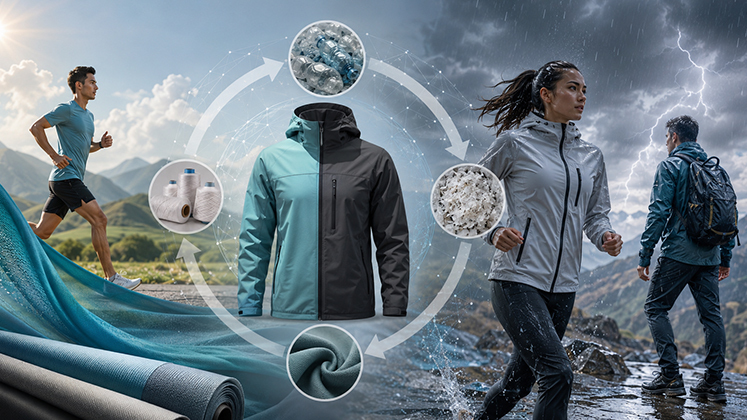
At the same time, climate change and global warming are having a major impact on apparel, particularly outerwear. Weather is becoming more unpredictable, and consumers want clothing that can adapt to changing conditions. In some markets, it can be sunny in the morning and heavily raining in the afternoon. This is creating demand for garments that can provide multiple functions at the same time, such as waterproofing along with cooling, heating or heat protection.