The average weight of textile materials in a mid-size car has increased from 20 kg in year 2000 to 26 kg today, and by 2020 it is expected to reach 35 kg, signifying a considerable increase in application of textiles in its traditional uses which includes seat covers, door and roof coverings and re-enforcement materials, safety belts and airbags. Additionally, this car market is expected to increase by 5% to 3 million cars a year by 2014 and recondition car market is reckoning a similar growth, and will together spur additional use of textiles. Not only this, with safety regulations getting more stringent, it will spur the use of air bags which will increase the scope of sewn products in cars as well.

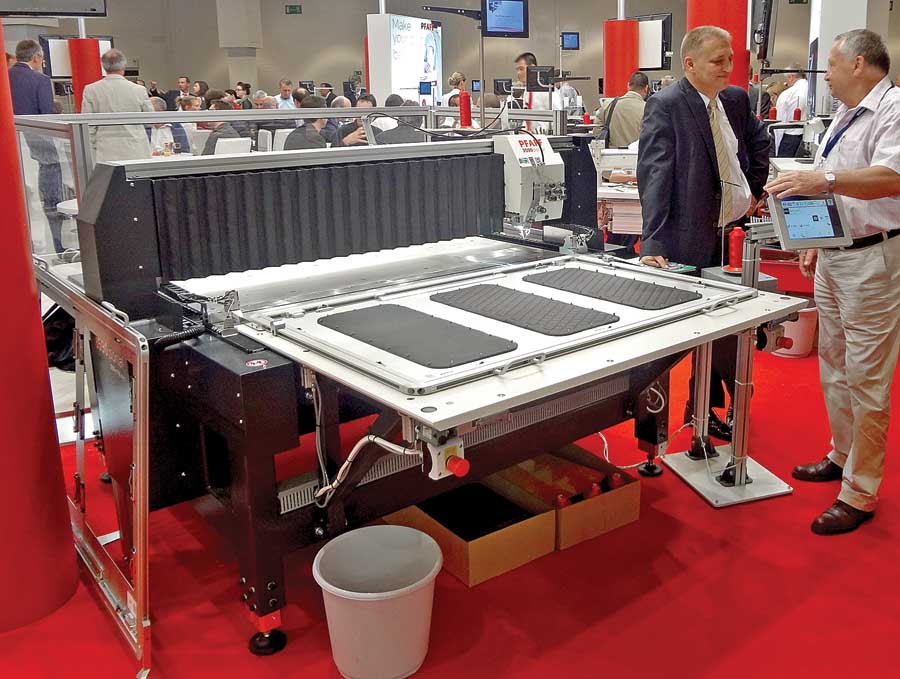
bed machine 868-290341 on display at Texprocess 2013
The sewing machines used for automobile goods can be categorized into highly automatic pattern stitchers and standard heavy duty lock stitch machines. While the need for an automotive pattern stitcher arose because of the requirement of consistent and uniform pattern stitching on large area of seat covers, the basic sewing functions are performed via standard heavy duty lockstitch machines. The heavy duty lockstitch sewing machines are equipped with unison or alternating top feed mechanism to handle thick fabrics, cylinder and post beds are used with roller presser feet to sew small curvature three-dimensional shapes.
[bleft]This year at Texprocess, many leading sewing machine brands displayed their sewing solutions for the automotive textile sewing.[/bleft]
Heavy duty lockstitch machines The standard heavy duty lockstitch machine is specially built to sew car seats and car seat covers. The basic features required in the standard machines are a high rise presser foot with a high needle bar stroke to penetrate multiple layers of material with utmost ease. A large clearance area will also be required since the patterns are generally big in size. But the most crucial feature required for such machines is the unison feed or alternating to feed mechanism to ensure synchronized feeding of material during assembly of parts without slippage and/or puckered seam appearance. The precise manoeuvrability of component is assisted by positive or negatively driven roller presser foot at top and/or flat presser foot at bottom.
Duerkopp Adler introduced its M type twin needle post bed machine 868-290341, which comes with XXL hooks having a large thread capacity. Working with thread sizes up to Nm 8/3, the machine promises high output and excellent performance parameters. The stitch formation is constantly tight due to switchable second thread tension, even at thick spots. The machine is capable of performing decorative stitching with up to 12 mm long stitches while the needle distance can go up to 30 mm.
The seam on air bags requires precise parameters for safety reasons. On the one hand, it shouldn’t be too secure as this will foil the side airbag from expanding and unfolding on an impact in accident; on the other hand the seam must have a minimum strength so that it does not tear open unexpectedly during normal use. Taking care of this requisite, PFAFF Docu-seam-systems are a quality assurance system designed for use on safety relevant seams. The USP of the machine is PFAFF’s developed solution which uses measuring technology online to detect, analyze and document process parameters “stitch by stitch” during the stitching process. A sensor measures the thread force in cN, and the corresponding thread tension is then adjusted within a closed control circuit using a stepper motor. The seam strength is assessed as good/bad and the data is stored automatically in a database where all important process parameters are saved. At the same time a label is printed with clear text and barcode, which details process parameters. The label can be sewn into the seat seam for later inspection of each side airbag seat seam. If a docu-seam is faulty the sewing machine automatically stops and can only be released for the next sewing process by a person with access authorization rights for the docu-seam system.

The range for automobile seam sewing includes 3 main models. The first is PFAFF 3721 Premium, docu-seam-system with needle feed and differentiable feed wheel and roller presser, the machine is ideal for seams which have small radii on finest leather formed parts used for the auto-interior (e.g. dashboards, centre consoles). The second machine is PFAFF 3741 Plus, docu-seam-system with compound feed, ideal for seams on protective covers and basic seats (usually a tape is fed to enforce the seam). PFAFF 3745 Premium is the third model, a docu-seam-system with unison feed – which may be equipped with optional aids such as edge guide with integrated sensor system to detect the seam distance as well as start and finish of the docu-seam, used for sophisticated seams (e.g. side airbags) on seat covers (medium to heavy duty).
[bleft]The heavy duty lockstitch sewing machines are equipped with unison or alternating top feed mechanism to handle thick fabrics, cylinder and post beds are used with roller presser feet to sew small curvature three-dimensional shapes. [/bleft]
Korean machine manufacturer SunStar also has a full range of flat bed, cylinder bed and post bed machines for the segment. KM-1070/1072 is a single needle lock stitch machine with unison feed, optimally designed to manufacture home and car upholstery. There are two dials to separately adjust the lift volume of different presser feet. When there is a temporary height difference of fabric, adjustment can be easily made using the knee switch. Depending on the lift volume, sewing speed can be adjusted in the range of 2000 to 3500 SPM in nine steps. The reliable pneumatic trimming mechanism has enhanced trimming capability for various types of threads.
HIGHLEAD’s GC20618-1 is an ideal machine for stitching car seats, This latest heavy duty compound feed (walking foot) lockstitch sewing machines, is designed with large vertical rotating axis hooks (top load bobbin) for thread loop catching and sliding bars for thread up-taking. It has been sub-classed into single needle, single needle with under-trimmer, double needle and double needle with under-trimmer. The application of needle bearings for arm shaft and hook shaft, cog belt driving, plunger pump lubrication and compound feed by needle bar, presser foot and feed dog provide this series with such splendid features as smooth running, quiet operation and a long service life. This machine is also equipped with a safety clutch to prevent the hooks from damage by over-duty operation.
Pattern stitchers for large area sewing
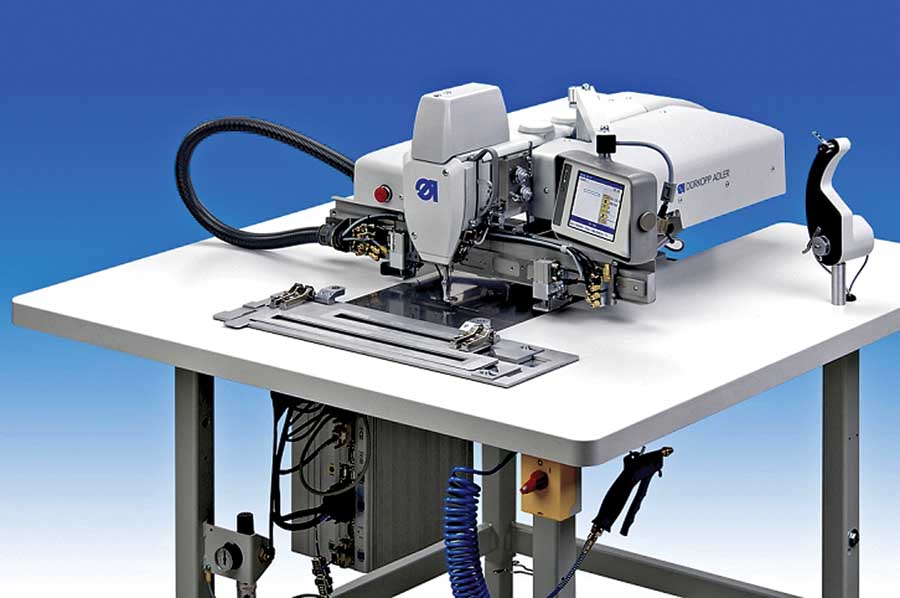
The wide spectrum of application specific to the reproducible safety seams in air bags and functional seams as well as decorative stitching for seats and other interior decorations, puts special demand on the entire stitching technology. One of the intuitive solutions is the large area pattern stitchers. A pattern stitcher would commonly use the intuitive menu navigation at the touch screen control panel to size and position the seam patterns, and “input/output signals” so that every single stitch possible can be programmed and changed to accommodate different patterns.
Such machines come with high lift programmable presser foot and special movable sewing head. Intermittent feed, where the feed stops for the instant when needle enters material, is often used to minimize shifting of the material in the work clamp. Most pattern stitchers come with monitoring devices like needle thread monitoring and bobbin thread monitoring to indicate the amount of thread left.

Duerkopp Adler’s 911-210-6055 CNC-controlled pattern stitcher, with its new and innovative design, offers high bobbin thread capacity, and high sewing speed of 2,000 SPM. The approved M-TYPE sewing technology and the intuitive user software guarantee an excellent sewing result, maximum functionality and high productivity. The electromagnetic thread clamping device ensures neat seam beginning and the thread tension is maintained electronically, programmable per stitch. The swing field size is 600 mm x 550 mm. Programming of “input/output signals” for every single stitch is possible in the machine, and constant, tight stitch formation is ensured by electronic thread tension, programmable per stitch. The machine has an electromagnetic thread clamping device for neat seam beginning. There is thread breakage identification with automatic sewing stop. The bobbin thread capacity is monitored by stitch counting or threads consumption control.
PFAFF 3590 portal is an ideal machine for car seats and airbag production. This programmable large-field computer stitcher can stitch an area up to 1200 mm x 1000 mm, and works on a sophisticated sewing technology based on company’s marathon vertical hook and a unique seam optimizing system, providing the highest seam quality and a perfect stitch quality in multi-directional sewing over the whole sewing area. All complex top-stitch and decorative stitching operations can be mastered with this new PFAFF 3590 portal.

 Bharat Tex Special Report 2026