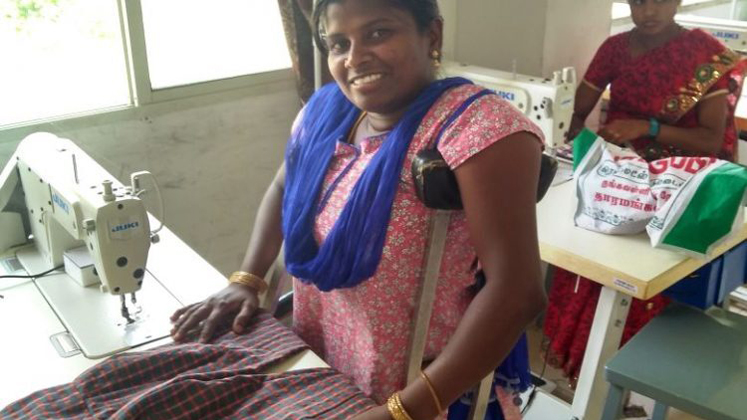
The fashion technology team of Sona College of Technology, Salem, Tamil Nadu (India) has earned a patent for modifying industrial sewing machines used by the garment industry that can be used by operators with special needs.
In garment manufacturing industry, the industrial sewing machines are used that are operated using foot pedal, the design and operating mechanism of which is not suitable for people with special needs, especially those with lower limb disabilities.
The modifications done by fashion technology team on sewing machines include disabling the foot pedal and adding an L-shaped metal plate in the top sewing area.
A gentle press of hand on the plate activates a mechanism that runs the machine. The speed and sewing (folding and feeding) can be done using both the hands. A slightly firmer pressure on the plate increases the speed of the sewing machine.
According to India Education Diary, the modifications work on the principle of a load cell in a weighing machine where application of pressure converts into voltage for controlling motors. An uninitiated person needs three to four days of training on the machine that is suitable for work from home and helps them contribute financially to the family.
This development paves the way for specially-abled persons to achieve their full potential in India’s garment industry which is on a growth curve. In addition, it will enable them to compete with other production staff in terms of quality and productivity.
“Researchers from Fashion Technology department of Sona College were challenged by us to develop or modify a sewing machine that addressed the employability handicap that stares in the face of specially-abled persons. The team came up with a technical modification, trained and certified over a hundred women on the modified sewing machine operation. A few women are already making a living using these machines,” said Chocko Valliappa, Vice Chairman, Sona Group of Education Institutions.
Valliappa further averred, “We are excited that the patent has been granted and sewing machine makers are discussing possible transfer of technology. We hope the adoption of this technology and gifting of these machines under different welfare schemes will help specially-abled persons make a living and boost their confidence.”
According to Professor Dr. D Raja, this is the third patent earned by the researchers in the Department of Fashion Technology at Sona College, whereas 12 more patent applications await final approval.
The earlier two patents were for design and development of “frictionless ring and traveller combination in a ring frame” and “dynamic sweat transfer tester for multi weave fabric.”