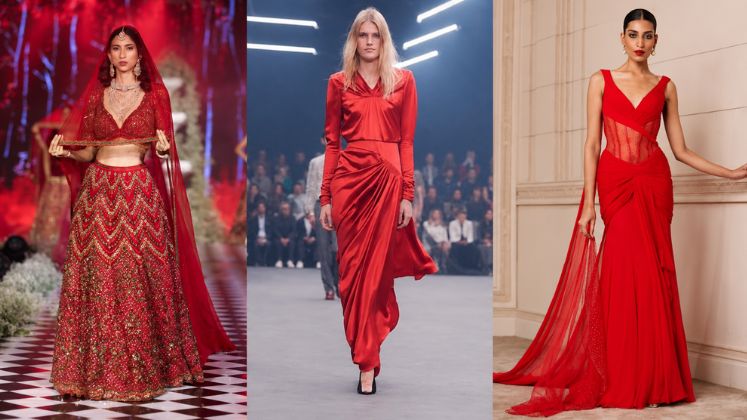
Tomato red is a shade that has appeared across spring/summer and autumn/winter 2026 runways at Valentino, Carolina Herrera, and Balenciaga. It has spread across price points and aesthetics that gives retailers confidence to commit inventory rather than test small. Forecasters describe the tone as warm and luminous, distinct from the cooler, blue-based reds of prior seasons, and notably more wearable than a saturated primary usually allows.
The high street has already absorbed the shift with Marks & Spencer‘s Jersey Ruched Midaxi Drop Waist Dress arriving in chilli red, a spicier, more eye-catching variant edging out the deeper tomato tone that led the trend initially. The colour’s crossover appeal is that it reads as elegant against black and white, but gains dimension against unexpected pairings, like chocolate brown, soft blue, buttery yellow, thus giving merchandisers flexibility across categories.
For India, tomato red requires no market education. The shade is already structurally embedded in the country’s colour vocabulary. Nalli Fashions, the renowned sari brand has positioned it as a fresh, spirited alternative for summer sarees, calibrated to hold up under natural daylight
Contemporary lifestyle labels like womenswear label TheRealB are building it into breathable, tailored silhouettes like the Tomato Red Corset Set, the Cape Midi Dress and other elevated basics, signalling the shade’s move from purely festive contexts into everyday premium wear.
Designers such as Tarun Tahiliani and Neeta Lulla have long embraced tomato red as a bridal and festive staple, exemplified by Tahiliani’s Ever Bloom Draped Concept Saree and Lulla’s Roya lehenga. Beyond these signature pieces, the hue remains a recurring feature across the Indian couture market, appearing in silk sarees, chikankari kurtas and heavily embellished Anarkali suits.
What global runways are introducing as a seasonal discovery, Indian fashion has held as a constant. That overlap gives the trend unusual durability in the domestic market; retailers aren’t asking consumers to adopt a new colour, only to see a familiar one reframed for contemporary silhouettes and fabrics.