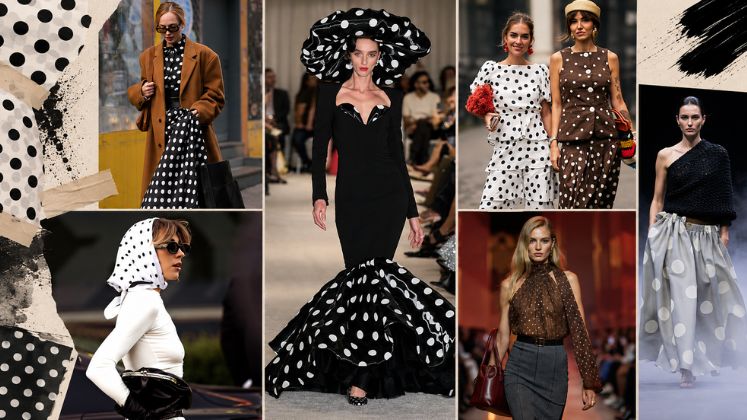
While many prints cycle in and out of fashion, polka dots continue to demonstrate remarkable staying power. Nearly eighteen months into their latest revival, the motif has moved from the runway to the red carpet and everyday wardrobes, with designers reinterpreting it through sheer fabrics, sculptural silhouettes, and oversized proportions rather than relying solely on vintage nostalgia.
Polka dots peaked culturally in the 1950s, when the pattern became shorthand for glamorous, feminine dressing on stars like Marilyn Monroe and Audrey Hepburn, and later Princess Diana. In Spring/Summer 2026, the dot returned to global runways at Carolina Herrera, Valentino, Miu Miu, Khaite, Altuzarra and Dries Van Noten, with palettes stretching beyond classic black-and-white into warm neutrals and chocolate brown.
The dot’s India moment has its own reference points. Zeenat Aman’s retro dressing gave the print its earliest Bollywood association, and it resurfaced this year in celebrity closets. The print’s versatility across sarees, dresses, tailoring and accessories is exactly what keeps it commercially relevant in the Indian market, where occasion dressing and everyday wear both need a print that photographs well and repeats without fatigue.
Homegrown labels have taken the trend furthest into everyday wardrobes this year. Sage by Mala’s Montaigne Dress and The Burnt Soul’s Merlot Dress both use polka dots as their central print story rather than a one-off SKU. Pinklay’s Faith Sleeveless Midi and Nishorama’s Nora Polka Corset Dress lean into the pattern for occasion wear, while FableStreet has moved it into workwear with a satin polka top designed for office-to-evening dressing. Accessories brands are following the same cue; Fizzy Goblet, Vintage Velvet and Salty have all built polka-dot pieces into bags, scarves and footwear, and The Yarn Story has taken the print into menswear with a polka pocket square, proof the trend isn’t confined to womenswear alone.
Polka dots solve a specific problem for Indian brands: a print that reads as elevated but not seasonal, works across sarees, Western silhouettes and accessories, and needs no fresh design language to justify itself each cycle. With homegrown labels already building full collections around it, the dot is shaping up as a dependable, low-risk print bet for D2C brands looking to balance newness with commercial safety through the rest of 2026.