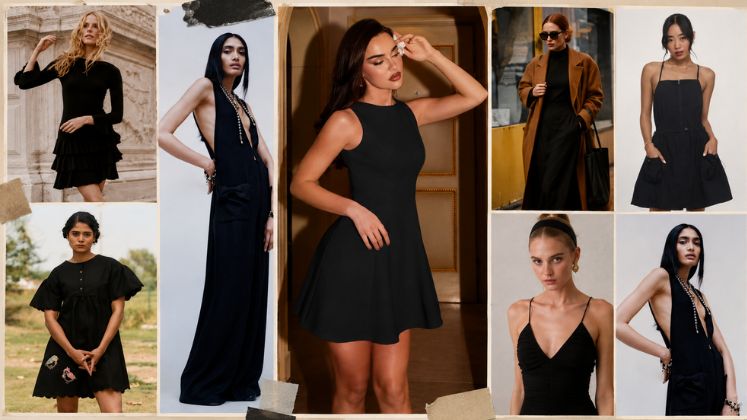
Marks & Spencer’s newly launched Black Column Midi Dress, priced at £42, has quickly emerged as a bestseller on the British retailer’s website. Its appeal lies less in novelty than versatility: the dress can be styled with sandals through late summer and layered under a tailored blazer as temperatures cool. That cross-season functionality is helping drive renewed interest in the little black dress (LBD), positioning it not as a red-carpet staple but as a dependable wardrobe investment and a commercially strong hero product for retailers.
The little black dress (LBD) has remained a fashion constant since Coco Chanel introduced the silhouette in the 1920s, defining it through simplicity, versatility, and timeless appeal. After evolving through decades of changing hemlines and trends, the wardrobe staple is enjoying renewed momentum in 2026. This season’s interpretations update the classic with sheer panels, cut-outs, and sculptural necklines, while preserving the effortless versatility that is its finest quality.
A versatile black dress can be worn with sandals in warm weather and layered with blazers, knitwear, or leather jackets as temperatures fall, making it an ideal cross-season purchase. For retailers, that versatility also translates into stronger merchandising potential, allowing a single SKU to span multiple selling periods.
Internationally, the print and cut are being pushed by names across the price ladder; M&S and Zara at the high-street end, Khaite and Givenchy carrying the idea through to the runway, and Chanel, the silhouette’s originator, still treated as the reference point every time a celebrity wears a version of it.
In India, the little black dress has evolved from a dependable party staple into a strategically merchandised category. For 2026, the trend is defined by Poly Chanderi, stretch satin, and Italian crepe fabrics, alongside ruched bodycon silhouettes, tiered flowing dresses, and power-dressing blazer styles. Retailers are increasingly positioning black dresses across workwear, casualwear, eveningwear, and occasionwear rather than as a single-use product.
Several Indian brands are shaping the category in distinct ways. Biba blends festive elements with contemporary silhouettes through styles such as the Women’s Layered Tiered Dress and Black Cotton Midi Dress with Floral Crop Jacket. House of Fett embraces trend-led western dressing with satin slip dresses, ruched bodycon styles, and structured blazer dresses, including the Velvet Petal Little Black Dress and Elizabeth Embroidered Lapel Dress. Little Box India targets younger consumers with affordable cocktail and bodycon styles like the Cowl Neck Satin Maxi Dress and Knot Detail Fit and Flare Mini Dress, while Label Ritu Kumar offers elevated interpretations through pieces such as the Black Sapphire Short Dress and Black Maury Short Dress. Meanwhile, AND India and Zara India continue to merchandise dedicated black-dress edits spanning mini, midi, and maxi lengths in multiple silhouettes and fabrications, reinforcing the LBD’s position as a versatile, cross-occasion wardrobe essential.
Indian D2C labels are also expanding the category in distinct ways. Nykaa Fashion’s in-house label RSVP offers party-focused styles such as a black polka-dot midi dress, using black as a versatile base for trend-driven details rather than a standalone statement. Meanwhile, Libas has adapted the concept for the local market through black Indo-Western dresses and ethnic silhouettes suited to festive occasions and wedding after-parties, extending the LBD’s versatility into an Indian fashion context.
The LBD’s comeback lands at a useful moment for Indian retail. Festive and wedding season sits directly ahead, and black is increasingly being positioned as occasion-ready rather than purely basics. Brands that can offer one black silhouette flexible enough to move from daytime office wear to evening party wear to a fusion wedding-guest look are solving the same inventory problem M&S is solving in the UK: fewer SKUs, longer shelf life, and a styling story that doesn’t need a new trend cycle to stay relevant.
For Indian D2C labels watching global hero-buy dynamics, the black dress is a rare case where following the trend costs nothing in newness; it only requires better merchandising of something every wardrobe already wants.