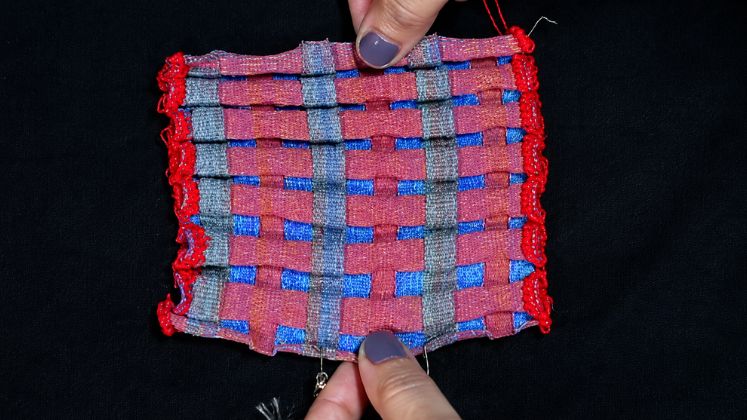
Researchers at Harvard’s John A. Paulson School of Engineering and Applied Sciences have built a new class of knitted textiles that behave like mechanical switches and sensors, with no rigid components involved. Standard industrial weft knitting was used to create dense fabrics that snap between multiple stable 3D shapes, turning ordinary textiles into mechanical metamaterials. The work, led by Kausalya Mahadevan in collaboration with Katia Bertoldi’s lab, was published in the journal Advanced Functional Materials.
The team achieves this multistability through geometry rather than added hardware. Highly elastic yarns are combined with a plating technique, and the fabrics naturally curl into three-dimensional forms before snapping between stable states under deformation. By embedding conductive yarns, the researchers showed that these multistable fabrics can also function as soft, stretchable switches or sensors. As the fabric flips between configurations, electrical circuits open or close, letting the textile act as a soft switch or motion sensor.
This innovation does not require new machinery. The fabrics were produced on industrial double-bed weft-knitting machines already common in garment production, and since the materials use standard double-bed weft-knitting equipment, the process is highly scalable. The researchers have already built prototypes, including a reconfigurable lamp shade with multistable switches corresponding to different colours of light. Broader applications being explored include wearable health monitoring, motion-sensitive clothing, tactile human-machine interfaces, adaptive furniture and responsive architectural installations.
India’s knitwear clusters, Tiruppur especially, run large fleets of double-bed weft-knitting machines already suited to this technique. That gives Indian manufacturers an unusually direct path into smart-textile production, without capital-intensive retooling.
As global sportswear and wellness brands push harder into wearable sensing, knit-integrated electronics could become a genuine differentiator for Indian OEMs supplying performance and healthcare-adjacent apparel categories.