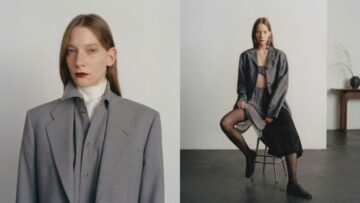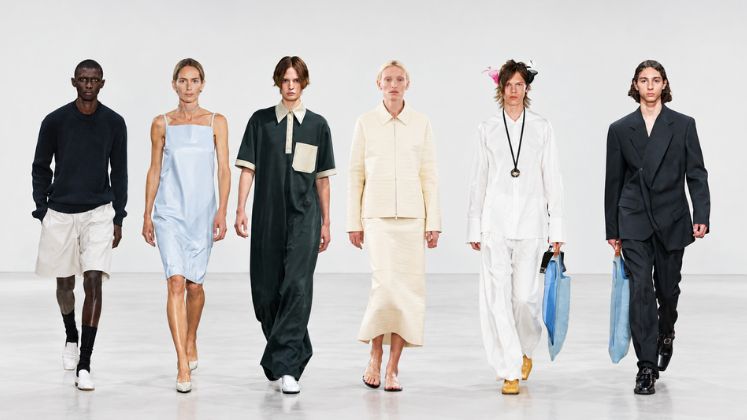
Fall 2026 runways have converged unusually decisively on late-’90s minimalism. Calvin Klein, Miu Miu, Celine, Toteme and Ashlyn all showed black column dresses, pencil skirts and restrained tailoring, a shift trade outlets read as a deliberate break from the early-2000s references of recent seasons. At Calvin Klein, Veronica Leoni’s collection nodded to the late ’70s and early ’80s but carried ’90s undertones too; a sleek racerback gown, a square-necked grey sheath, with casting that referenced the house’s own ’90s muses. Marc Jacobs went furthest, citing his spring 1998 collection alongside Helmut Lang and Prada for his NYFW show. Miu Miu, a label built on recent-season maximalism, worked in a grey blazer and black pencil skirt styled with knee-high boots, while Toteme built texture into all-black dressing via leather jacket, cotton trousers and suede shoes.
At retail, Zara’s current edit shows how quickly the trend has moved off the runway: a satin shoulder-pad coat and boat-neck midi dress reference the era’s soft-structured power dressing, while a fitted ribbed knit top, high-waisted straight-leg trousers, satin vest and poplin wrap shirt cover the everyday-office end; fitted knits and vest layers standing in for the exaggerated shoulder of true ’90s power suiting.
Indian labels are working a parallel, craft-led version of the same restraint. Delhi-based Divyam Mehta anchors his workwear in kantha-print denim suits, colour-blocked jackets with saddle stitching, and ikat silk blazers. Menswear designer Dhruv Kapoor, through his Gen Z-facing line Kapoor 2.0, builds hardworking separates that bridge formal and everyday dressing with contrast colourways and patchwork detailing.
Noida-based The Notebook reworks traditional staples into lace shirt dresses, co-ords finished with sculptural metal buttons, and waist-defining wrap dresses. Assam-rooted label Ura Maku, founded by Manjushree Saikia, tailors its separates from handloom eri and mulberry silk, finished with embroidery accents and old-school waistband adjusters. Designer Aarohi Shah, trained at Oscar de la Renta and Proenza Schouler, offers mandarin-collar jackets, handwoven silk trousers and organza blazers as interchangeable investment pieces.
Delhi’s Gul Sohrab takes a more relaxed route with reversible shackets, wrap skirts, checked shirting and cotton twill jorts. On the mass end, FableStreet cuts structured blazers and formal trousers for Indian body types, Van Heusen Woman anchors accessible daily wear in shirts, trousers and blazers, and Salt Attire keeps to a restrained, mix-and-match neutral palette of crisp shirting and tailored trousers. AND India rounds this out with its Dax shirt paired with high-waisted tailored pants, pleated-front white shirting, and the Golden Detail black trouser.
The cycle is commercially low-risk for Indian manufacturers and retailers; favouring clean tailoring and fabric-led storytelling over trend-heavy embroidery, and playing directly to handloom and craft-tailoring strengths at labels like Ura Maku and Divyam Mehta. For B2B buyers, it signals a season where investment pieces can move across Western-wear and Indo-western racks without retooling sourcing.