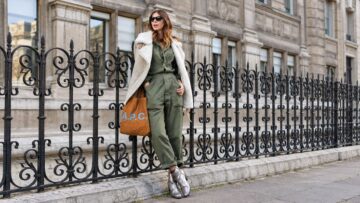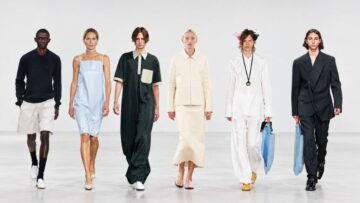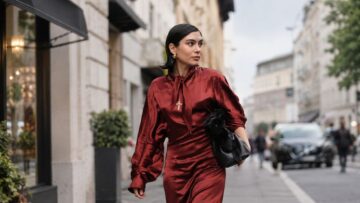
Utilitarian detailing is having its most refined moment yet on fall runways. At Khaite, Catherine Holstein sent military jackets in leather and wool down the runway with corded, ropey trims, while Ann Demeulemeester’s Stefano Gallici followed a Spring/Summer showing of military jackets with an even heavier Fall/Winter dose, intricate frogging, broad shoulders and piped, coloured trim. Frog-closure jackets, a knot-button style originally derived from Chinese garments, also surfaced at Valentino and Kallmeyer, while Dior applied its Napoleonic learnings to denim, working in sparkling embellishments that echoed hussar-jacket closures. Rather than full uniform dressing, the common thread across collections is restraint: a single frogged button placket or a structured shoulder line doing the work, layered into otherwise polished, everyday-wearable pieces.
At retail, Zara’s current edit shows the trend at its most wearable: a fitted blazer with shoulder pads carries the structured officer shape into daywear, a buttoned peplum vest top and button-tab T-shirt borrow the placket detailing in miniature, while barrel cargo pants, mini button shorts and stretch capri pants translate the utility silhouette into off-duty basics rather than head-to-toe uniform dressing.
India’s own military reference predates this cycle by a century; the bandhgala, born of Jodhpur’s colonial-era officer dress. Raghavendra Rathore Jodhpur continues to work its handcrafted frog-button bandhgala jackets, paired with the Jodhpuri collar shirt, as a direct line to this heritage. Tasva offers a more accessible take on the same silhouette, with its signature vertical button placket and high mandarin collar. Rajesh Pratap Singh channels the mood through minimal, textured jackets under his RIP line, including the button-fastened Ahore jacket.
On the contemporary and streetwear end, HUEMN works structured, unisex outerwear in recycled fabrics with a utilitarian edge; Bobo Calcutta applies bold embroidery and print to structured jacket silhouettes; Bloni brings gender-fluid utility dressing into technical, heat-reactive fabrics; Anaam offers relaxed, unisex outerwear that softens the trend’s sharper edges; NorBlackNorWhite blends utility-adjacent silhouettes with revived traditional Indian textiles; Natty Garb reworks utilitarian detailing like patch pockets, structured plackets, into its edgy streetwear collections; and Divyam Mehta rounds this out with colour-blocked jackets finished in saddle stitching, a quieter nod to the trend’s structural DNA.
The bandhgala gives Indian design houses a genuine, centuries-old claim to this trend rather than a borrowed one, meaning coverage can position it as homegrown heritage re-entering global fashion conversation, not just an import. The emphasis on a single structural or hardware detail (a frog closure, a shoulder pad, a placket) over full uniform dressing also keeps production complexity low, making this an easy trend to fold into existing tailoring and outerwear lines without a wholesale design overhaul.