Be it policy disclosure or action on the ground level with regard to transparency, sustainability, over the years, good progress is there but more needs to be done. Even the top brands who are doing well in this direction have to improve on some fronts. And just doing is not enough, they should share it in a totally transparent manner. Highlighting this spirit, the recently launched Fashion Transparency Index 2019 has created a buzz across the globe. The index is more than a review of 200 of the biggest global fashion brands and retailers ranked according to how much they disclose about their social and environmental policies, practices and impact.
The average score amongst the 200 brands and retailers reviewed this year is 21 per cent. This year’s highest score of 64 per cent shows that even leading brands and retailers still have significant room for improvement when it comes to sharing their social and environmental policies, practices and impacts with their customers and stakeholders. The UK Modern Slavery Act, California Transparency in Supply Chains Act and some of the relevant French and EU legislations have forced major brands to disclose at least some information publicly. The index not only evaluated brands’ ethical or sustainability performance but also the amount of information that these brands disclose publicly about their human rights and environmental policies, practices and impacts.
The brands have been chosen on the basis of an annual turnover representing over US $ 500 million and crossing a spread of market segments including high street, luxury, premium, sportswear, accessories, footwear and denim from across Europe, North America, South America and Asia.
Consumer opinions…
Fashion Revolution did a survey of over 5,000 consumers across Europe and found that more than one in three people considers social and environmental impacts when purchasing apparels. 72 per cent of the participants were of the view that fashion brands should do more to improve the lives of the women making their products. And 80 per cent were of the opinion that brands should disclose their manufacturers’ details. As innovation and awareness are the key to sustainability, Fashion Revolution offers free online courses.
Rating methodology’s key areas and average score
| Policy & commitments | 48 |
| Governance | 27 |
| Traceability | 12 |
| Know, Show & Fix | 14 |
| Spotlight Issues | 17 |
5 Highest scoring brands (score in %)
| Adidas | 64 |
| Reebok | 64 |
| Patagonia | 64 |
| Esprit | 62 |
| H&M | 61 |
5 Biggest movers (percentage change since 2018)
| Dior | 22 |
| Sainsbury’s Tu Clothing | 21 |
| Nike Converse, Jordan and Nike | 21 |
| New Balance | 18 |
| Marc Jacobs | 17 |
Worried for women!
Brands say very little about their efforts to empower women and girls and achieve gender equality. Out of 200, just over one-third of brands support women empowerment projects for garment workers. Only three brands publish data on the prevalence of gender-based violations in the supplier facilities.
Transparency
For Fashion Revolution, transparency means credible, comprehensive and comparable public disclosure of data and information about fashion’s supply chains, business practices and the impacts of these practices on workers, communities and the environment.
Altering India
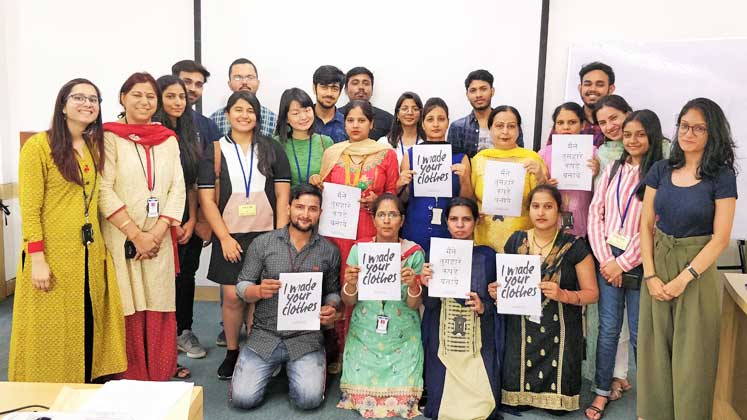
Apparel manufacturers from across the globe actively participated in this campaign… like in India, India’s biggest apparel Shahi Exports hosted the first-of-its-kind guided factory tour to show how clothes from the world’s leading brands get made. 12 individuals, including students and professionals, from varied backgrounds, came and interacted with Shahi management. “As a company started by a female entrepreneur, who herself was a sewing machine operator, there is a strong philosophy we follow of empowering the women who make our clothes and provide power to the global fashion industry,” the company stated.
The Index also talked about the specific steps taken by various brands. As far as India is concerned, ASOS has detailed young worker and child labour policies and remediation procedures in place and works closely with Anti-Slavery International and others to tackle forms of modern slavery. They have not been shy when it comes to mentioning in public about the instances where they have uncovered cases of child labour and poor working conditions in India and few other countries, including a detailed explanation of the steps they have taken to solve these cases and the outcomes of these interventions. One can read about these cases in their Modern Slavery Act statement.
Abhishek Jani, CEO, Fairtrade India Project also shared his company’s viewpoint focusing on why more transparency is needed at the fibre and farm level. Apart from highlighting farmers’ painful conditions, he asserted, “Whilst the disclosures throughout this report show that increasingly brands are committing to source sustainable raw materials, it is imperative that brands go further and seek transparency with regard to the origin of this raw material.”
“More than ever before, brands and retailers are being held to account and beginning to realise that their fashion statements need to be embodied in truth… The fashion of the future is not about the pretty little things, the shoes and handbag, and a new party dress. It is about weaving truth and values into our clothing. We love fashion. We love beautiful clothes. But there is no beauty without truth and there is no truth without transparency.” – Carry Somers, Founder and Global Operations Director, Fashion Revolution
“The fashion industry was built on secrecy and elitism; it was opaque. Transparency is disruptive – in that sense, it’s a breath of fresh air and a useful weapon of change.” – Orsola De Castro, Co-Founder, Fashion Revolution