Consistent growth, backed by quality product and responsive service that can guarantee complete customer satisfaction, defines the winning strategy at Eastman Exports, Tirupur, driven by the vision and acumen of N Chandran, CMD of one of India’s top apparel export companies. Taking forward his dynamic legacy is his son Cibi Karthic, who is not only learning the nuances of the export business, but has also been instrumental in starting a new vertical through an in-house brand ‘Huetrap’, which is their vehicle to enter the e-commerce domain. Speaking exclusively to the father-son duo, Apparel Online unravels the new vertical of the company and the changing business dynamics.
Just 3 years into the business, Karthic has worked hard to adapt to the present business environment, while integrating his own ideas and opinions. One of the very recently launched initiatives of the company is an e-commerce venture, which is timely skewed towards the growing youth consumer looking for newness. “In the past few years I have seen how e-commerce has developed and I felt it was a good area to explore, as it is less risky with less investment and minimal stock requirement. Also it would give me the opportunity to work in the domestic market, while remaining involved with our core business,” reveals Karthic. Currently the company markets their brand Huetrap in the domestic market through their own website and also, through Amazon, Flipkart, Myntra and Snapdeal and one year down the line they plan to ship it overseas.
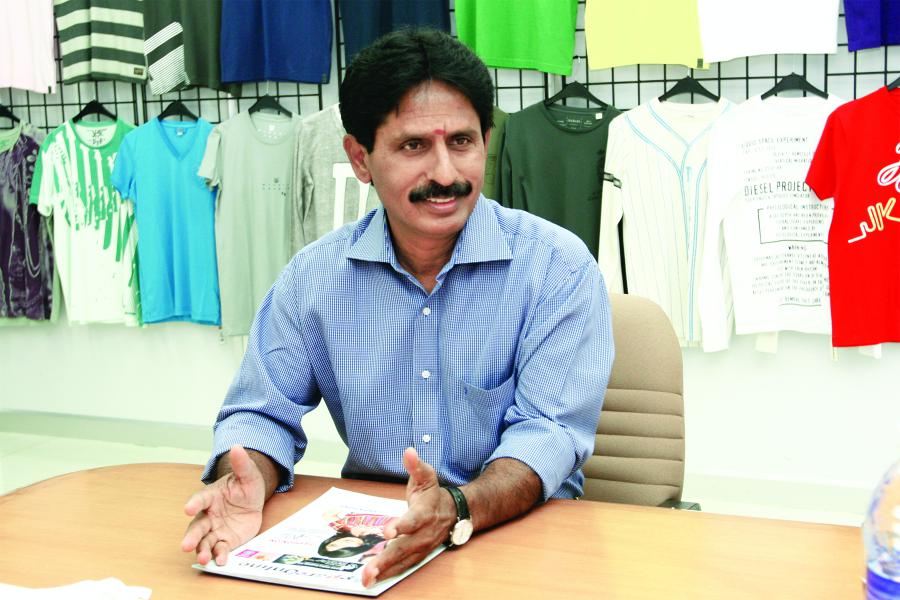
Adapting to e-commerce, a lot of brands are now selling online which makes it rather difficult to differentiate one from the other. What sets Eastman apart is that the company focuses on quality, while offering a wide variety in terms of design. One of the core aspects of this business is that the company keeps on adding 100 to 200 designs after every one or two weeks and manages them at the back-end with minimum inventories. “I have spent a lot of time in making this venture a ‘just-in-time’ operation in the sense that if you look at some of the designs on our website, it’s not even ready. So when an order is placed, we get it done and ship it within 24 hours,” informs Karthic.
Since its inception on e-commerce, the company is receiving very good feedback from customers, especially from the Northern and the Western regions, even when it has not started marketing as yet, which it plans to start very soon. It speaks volumes for the company and its product that just going by word of mouth and a few promotional stints through Google and Facebook, the e-commerce vertical has made a mark. “The response is surprisingly good. When I came back from England I wanted to create designs that I would wear – which to my surprise didn’t sell. The designs which looked good, but were not my personal favourites, were the ones that were selling a lot; so it was very interesting to see the data, what customers liked, and what was happening. Today, in terms of quality, customers can differentiate my brand,” declares Karthic.
“Our ultimate goal is sustainable textile production. Confidence has come back, and if we talk about recycling, we are the best in the world; we can say we are 15-20 years ahead of the rest of the world. Also I can say that the Sumangali issue, of which this region has been accused of, does not pertain to the garment industry and buyers should acknowledge and end this debate.”
Realizing the importance of data analysis, the company heavily banks on its customers for feedback to analyze and base its strategies around it. “I give a lot of importance to data as it tells us what is working, what is not, what customers like about us and what they do not like,” informs Karthic. “The next year is going to be very interesting for us as we are going to focus a lot more on marketing,” adds Karthic.
Focusing on cataloguing and description, the company gets a lot of repeat customers, who are happy with the prompt customer service and the price. “Since ours is a just-in-time model, the only area where we may be slightly behind our competition is the delivery time, as we take up to 24 hours to ship the product,” states Karthic. The company directly ships from its warehouse to its customers but for online portals such as Myntra and Flipkart, they pick up the courier from the company’s warehouse. With the trend of ‘online-only’ portals such as Amazon taking the brick and mortar route, physical stores is one of the many initiatives that the company wants to take up in the future.

With his educational background and technical expertise in textile retailing and finance, Karthic is currently looking at the core areas of business mainly dyeing, spinning, finance and accounting, while learning the manufacturing processes. Generally, garment business has always been a familyrun business in India, which cannot be termed as professional, but things are changing with second generation or the GenNext handling the business and integrating their ideas and philosophy into it. “It is very interesting to see and learn how the next generation across other organizations are coping and integrating into their established setups. I have a certain approach while others may have different ones as their organizations may be structured differently with differing cultures. The nature of competition has also changed. During my father’s time, there was more of a helping-out kind of tendency, it’s not quite the same anymore,” admits Karthic honestly.
With the GenNext coming up with their unique and innovative ideas, it is creating an environment of competition. “My approach is a bit different to how my father manages the company. He has a more handson approach while I rely more on corporate governance mechanisms. We have brought in more professionals and also restructured roles of key people within the organization into executive teams and committees,” asserts Karthic. For the past 2-3 years the father-son have been working on setting up different layers of experts and teams in a corporate manner, who can handle business once the objectives are clearly given.
With unpredictable market conditions, less availability of labour and challenge to keep the existing labour force content, the company understands that technology and good management practices are vital for growth. Bringing in fresh ideas, Karthic is looking at organic growth in the future. What gives the company’s confidence, besides its own strength is the steady growth in business in Tirupur due to the 100% zero discharge status that the region has earned. “Our ultimate goal is sustainable textile production. Confidence has come back, and if we talk about recycling, we are the best in the world and we can say we are 15-20 years ahead of the rest of the world. Also I can say that the Sumangali issue, of which this region has been accused of, does not pertain to the garment industry and buyers should acknowledge and end this debate,” asserts Chandran. With Tirupur market conditions improving and buyer confidence coming back, Eastman is leaving no stone unturned to explore new verticals for future growth.