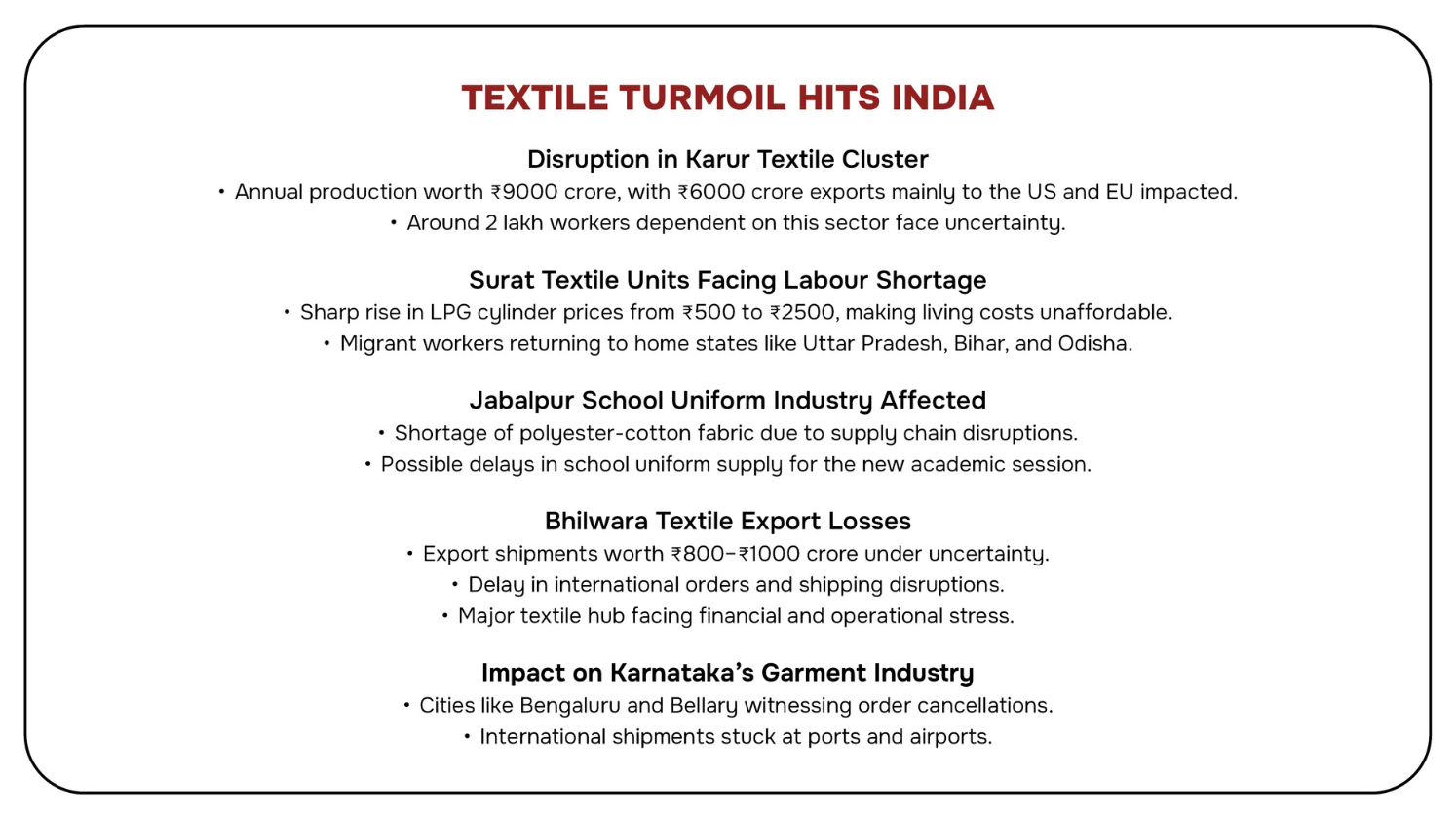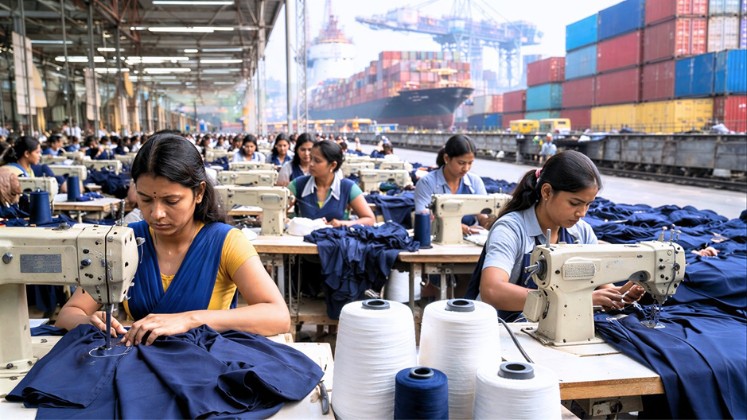
No textile cluster in India has been spared the fallout of the Iran– Israel–US war, and its impact is now being felt across every layer of manufacturing, from energy shortages and labour disruptions to raw material volatility and logistics constraints.
Take Tiruppur, for instance. The hub, which contributes nearly 90% of India’s cotton knitwear exports and 54% of overall knitwear exports, is grappling with LPG shortages. With more than 20,000 units, mostly MSMEs, the cluster depends heavily on LPG, and the shortage is now disrupting production across factories.
A similar situation is unfolding in Sanganer, Jaipur, where the textile printing industry is facing a severe crisis due to an acute shortage of LPG, which is essential for operating flat-belt printing machines.
Manufacturers have limited LPG inventory, and workers are spending hours arranging fuel for daily use. As a result, absenteeism is increasing in garment hubs.
In Surat, textile processors have introduced temporary production cuts amid rising input costs and weakening order flows, while continuing operations at reduced capacity to manage losses. Similar trends are visible across other manufacturing hubs.
In a bid to provide relief to the industry, the government has increased the allocation of commercial LPG cylinders to states from 50% to 70%. However, it remains to be seen how the increase would specifically benefit the textile industry.
Beyond LPG shortages, rising fuel costs are also increasing manufacturing expenses. The recent 25% hike in industrial diesel prices is expected to impact sectors that rely on captive power and heat-intensive processes such as dyeing and finishing. Data from the Annual Survey of Industries for 2022–23 shows that diesel accounts for around 1,700 MW of installed captive power capacity in the textile sector. In terms of the energy mix, it contributes about 5% to 6% of captive power generation, showing its importance as a supplementary energy source.
Raw Material Costs Ripple Through the Supply Chain
These energy pressures are mirrored in raw material costs. In synthetic textiles, 70%–80% of production costs come from crude oil. Polyester and other synthetic fabrics need chemicals like PX, PTA, and MEG, all crude oil derivatives.
This makes the industry very sensitive to oil prices, especially as Brent Crude has jumped to over US $100 per barrel, up from about US $70 before the war.
“Over the past two weeks, polyester fibre prices have increased by around ₹23 per kg, moving from about ₹80 per kg to around ₹103 per kg. Some of the MEG used to make polyester comes from the Middle East, and shipments from that region are now getting disrupted,” said Madhu Sudhan Bhageria, Chairman and Managing Director of Filatex India Ltd, a leading manufacturer of polyester filament yarn. The company has a production capacity of over 1,000 tonnes of Polyester Filament Yarn per day. It produces polyester and polypropylene multifilament yarn and polyester chips at two plants, one in Dadra and Nagar Haveli and the other in Dahej. He added that manufacturers were able to pass earlier price increases to fabric makers. However, the latest rise of around ₹10 per kg is only partly being passed on, with 50%–60% of the increase reaching downstream buyers.
Further downstream, fabric manufacturers are also beginning to feel the impact. Maurya Exports, a textile company based in Ludhiana and specialising in a range of fabrics including Sherpa, fur, flannel coral, and terry fabrics, is facing similar pressures.
“We are facing a big rise in raw material costs. Polyester prices have gone up sharply, cotton is up about ₹40 per kg, and the costs of dyes and other processing chemicals have increased by 15%–20%,” said LB Maurya, MD, Maurya Exports.
He added, “With rising input costs, maintaining both competitive pricing and profitability has become more difficult. We now have to balance cost pressures while still securing and retaining business, which requires careful negotiation and planning.”
Shipping and Air Freight Costs
Soar Talking about higher shipping costs, N. Thirukkumaran, General Secretary of the Tiruppur Exporters Association, said, “Earlier, exports were shipped through the Red Sea and the Suez Canal, but this is no longer possible. Shipments are now going around the Cape of Good Hope, which adds about 10 to 15 days to delivery times.”
Echoing this view, Pallab Banerjee, MD, Pearl Global Industries Limited, said, “Shipping routes are still working, but many shipping lines are avoiding the Red Sea and taking the longer route around the Cape of Good Hope. This has pushed up shipping costs a lot. For example, container freight rates for the India–US route have increased by nearly 150%.” The company caters to international clients such as Inditex (Zara), PVH Corp. (Tommy Hilfiger and Calvin Klein), Walmart, and Target, among others.
However, Pallab added that customers who use FOB shipments from Indian ports are not directly affected because they have long-term contracts with shipping companies. In these cases, the extra cost is borne by buyers and their logistics partners, so the direct impact on garment exporters has been limited.
At the same time, air freight has been badly affected due to fewer Middle East carriers, driving up costs sharply. Exporters who miss delivery deadlines may have to rely on costly air shipments to avoid contractual penalties, putting additional strain on their finances.
“Air freight costs have increased by about 200% since the start of the Iran war,” said Pallab.
Thirukkumaran added, “For the EU, if air shipment earlier cost around ₹100 per kg, it now costs about ₹200 to ₹250 per kg. For the US, costs have increased from around ₹250 to ₹300 per kg to about ₹500 to ₹650 per kg.”
Experts said that if disruptions continue, the combined impact of higher input costs, longer transit times, and tighter supply chains could force changes in sourcing, pricing, and production planning, especially for MSMEs, which have limited capacity to absorb prolonged volatility.