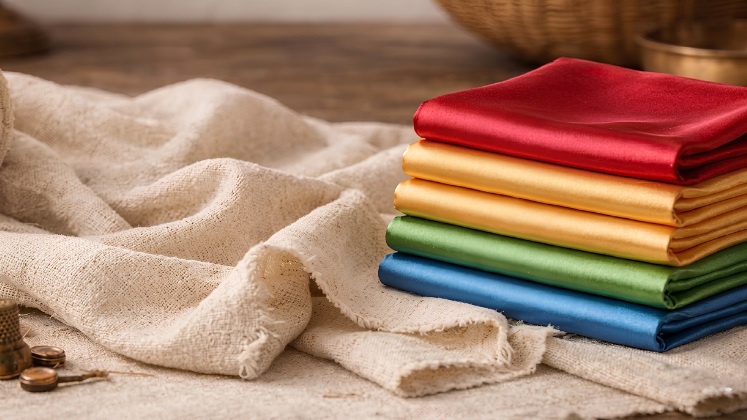
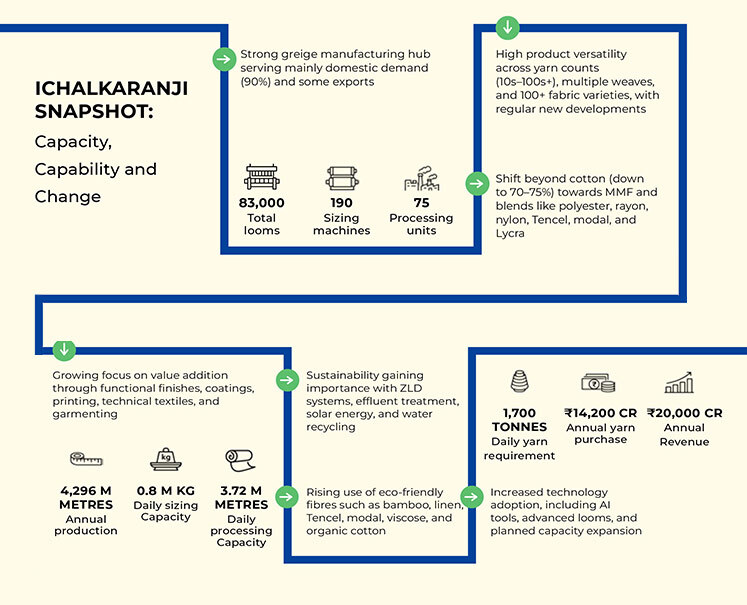
What began as a hub for cotton sarees and dhotis, Ichalkaranji has grown into a major textile centre serving both domestic and global markets. The cluster, known as the country’s largest hub for cotton greige fabric, produces about 4,296 million metres of fabric annually.
The region is maximising its potential in greige fabrics, offering a wide range of varieties to meet different needs. Local manufacturers have built deep expertise in sizing and handling complex yarns, working with yarn counts ranging from 6–10 up to 120. Warp beams can hold 18,000 to 20,000 ends, and production units range from small facilities with 12 looms to large ones with 200 airjet machines.
This flexible setup allows the cluster to handle everything from small customised orders of 100 metres to very large volumes of 5–7 million metres, as nearly 90% of Ichalkaranji’s production continues to cater to the domestic market.
Greige Core Strength of Manufacturers
Several local manufacturers exemplify this expertise in greige fabrics. For instance, Mahalaxmi Tex Clothing, with a production capacity of 1 million metres of fabric per month, offers a wide variety of cotton greige fabrics.
The company handles a broad range of yarns and counts, from 10s to 100s in single yarns and 2/10s to 2/80s in double yarns, across the cotton and blended constructions. Its capabilities extend across multiple weaves such as plain, oxford, dobby, satin, twill, and corduroy, with fabric widths ranging from 38 inches to 110 inches. All fabrics undergo inspection using the 4-point American system to ensure quality.
Mahalaxmi Tex Clothing serves a diversified customer base, including Indian brands, D2C and online labels, legacy fashion brands, wholesalers, and exporters.
Likewise, Hari Om Textiles, which sells about 4–4.5 lakh metres of fabric per month, focuses on greige and finish fabrics across industries.
For menswear, the company produces dobby greige fabrics with textured designs used in shirts and premium garments, along with plain greige fabrics suitable for large-scale production and dyeing.
For womenswear, it offers cambric fabrics that are soft and suitable for tops and dresses, mulmul fabrics for lightweight summer wear, and butti fabrics with woven designs used in ethnic clothing.
Its shirting and topwear fabrics are supplied to major brands and online platforms such as Pantaloons, Myntra, and Amazon, and the company also serves garment manufacturers in Mumbai and Bengaluru.

Building on this focus on variety, Varun Jain, Director, Tiara Fashions, emphasised “We launch 60–70 new articles regularly, each in 40–70 colours, to keep up with changing trends. At any time, we offer around 150 products, including core and seasonal fabrics.”
The company has a production capacity of around 1 million metres per month and manufactures cotton and blended fabrics, including dyed products.
Its range includes dyed shirting fabrics, cotton and blended shirting fabrics, poly-cotton fabrics, as well as drill, twill, and defence fabrics. These are available in different counts such as 60s, 50s, 40s, and 30s.
Tiara Fashions also offers a wide variety of shirting fabrics in stripes and checks, across weaves like plain, oxford, twill, satin, herringbone, broken drill, fil-à-fil, and dobby.
Another key player, Ramkrishna (Jhanwar) Group, focuses on cotton fabrics with a range of structures and constructions, while also using digital tools to support product development. “We have built a digital product library supported by customised AI-based software. This system allows buyers to upload reference products and search our database to find matching or similar fabrics,” said Vasudev Jhanwar, Director, Ramkrishna (Jhanwar) Group.
The Group has a monthly capacity of approximately 3.3 million metres of fabric. It supplies both grey and finished fabrics, with an even split between the two. Processing activities are outsourced to specialised units located in Mumbai, Bengaluru and Delhi.
Approximately 85% of the group’s clients belong to the garment export segment. Key customers include companies such as Shahi Exports, Pearl Global, Modelama, Richa Global, Basant India, Anubav Apparel and Texport Syndicate.
The company also exports fabrics directly to international markets. Around 5% of exports go to Sri Lanka, while additional shipments are made to markets such as Dubai and Spain.
The company’s cotton fabric range includes both plain and textured constructions, developed using weaves such as plain, leno, misdent weft butta, honeycomb, and dobby. These fabrics are made in 100% cotton, with widths around 142–147 cm and GSM ranging from about 40 to 250.
Also working in the cotton greige fabric segment is Badrivishal Fashiontex Pvt. Ltd., which has a monthly capacity of around 1 million metres.
The company produces cotton-based greige fabrics, super fine cotton fabrics, piece-dyed finished fabrics for garments, and 100% cotton printed fabrics for men, women, and children.
It offers 100–150 varieties, developed using different yarn counts and constructions, such as 60s×60s satin, 60s×50s satin, 20s×20s cotton, and 20s×20s slub cotton.
Around 80% of its production is focused on shirting fabrics, with smaller volumes in suiting and bottomwear. Badrivishal Fashiontex mainly caters to garment manufacturers and also supplies to OTC (over-the-counter) fabric players.
Meanwhile Parag Khandelwal, Director, Arunoday Textile Mills, pointed out, “Our main market is GEM (Government e-Marketplace). Around 70% of our supply goes there, and the rest is across India. We are primarily a grey fabric supplier, producing about 25–30 lakh metres per month. In addition, we produce around 50,000–60,000 metres of finished fabric monthly.”
Operating around 200–300 airjet looms, the company manufactures a wide range of products, including cotton fabric, dyed fabric, garment fabric, hospital uniforms, industrial fabric, rayon fabric, school uniforms, duck fabric, kora fabric, and lycra fabric.
He added, “There is good competition on GEM since everything is online and transparent, and quality matters a lot. Businesses that focus on quality tend to grow.”
Similarly, Priyalaxmi Textile Mills, which has a weaving capacity of around 2 million metres per month, manufactures diverse fabrics, including cotton-lycra stretch and 100% cotton dyed shirting.
Shift Towards MMF and Value-Added Finishes
At the same time, the region is evolving beyond cotton greige and basic finished fabrics. Manufacturers are increasingly moving toward manmade and blended fabrics, along with a wider range of value-added finishes, as market demand shifts towards more differentiated products.
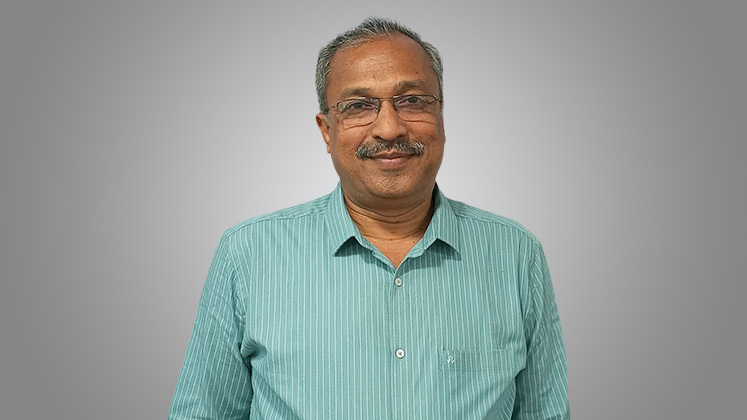
“Around 5–7 years ago, nearly 85% of the fabrics produced in the region were cotton. Today, cotton accounts for around 70–75% of production, as manufacturers increasingly explore MMF and blended fabrics to overcome the limitations of cotton in terms of versatility and production scale,” said Anil Goyal, Partner, KK Group, and President ISFMA (Ichalkaranji Shuttleless Fabrics Manufacturers Association).
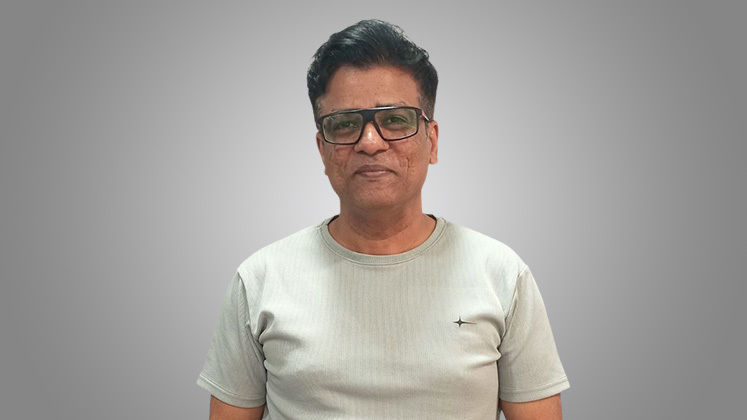
Similarly, Nirmal Kumar Jain, CMD, Mahalaxmi Tex Clothing, highlighted, “Our focus is on fabrics aligned with fast-fashion trends. Apart from cotton, we offer a wide range of fibres including silk, linen, rayon, polyester, nylon, Tencel, modal, and Lycra. We also develop fabrics in various dobby structures and stretch formats, along with finishes such as wrinklefree, water-repellent, fire-retardant, antibacterial, stain-resistant, and lisa peaching, as well as coatings like pigment, Teflon, and PU.”
This shift is also visible at Hari Om Textiles, which offers a wide range of finished products for men, including pyjama fabrics, poplin, Lycra, slubs, and kurta materials. For women, it offers finished fabrics for dupattas, chunnis, topwear for ethnic wear, bottomwear like pyjamas and trousers, and kidswear.
In addition, Hari Om Textiles caters to industrial and institutional segments. Its industrial fabrics include dyed fabrics with long-lasting colour, coated fabrics with water- and abrasionresistance, and printed fabrics for branding and utility applications. For institutional use, it supplies fabrics for schools, security uniforms, railways, and defence applications, along with made-up textile products.
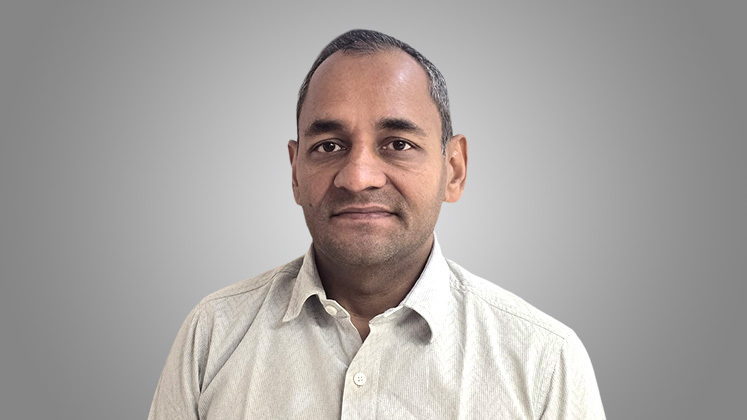
“At first, we mainly supplied grey fabrics to big companies like Raymond, Century, and Ashima. But after ups and downs in the yarn and fabric market a few years ago, we decided to start making finished fabrics too. We realised that finished products are more profitable than raw materials,” said Ramesh Bang, Director, Hari Om Textiles.
He added that their dobby fabrics are pre-washed and compressively treated, keeping shrinkage under 3% for accurate garment manufacturing.
Another key player, Ramkrishna (Jhanwar) Group, produces polyester and poly-blend fabrics using weaves such as dobby, plain, leno, and mesh constructions, often combined with spandex for stretch. These fabrics are used in applications such as sportswear, workwear, uniforms, and industrial textiles.
The Group uses machinery such as Benninger sizing systems, Tsudakoma airjet looms, Vamatex rapier looms, and Cimaco looms.
Building on the industry’s push toward value-added and finished fabrics, Badrivishal Fashiontex is expanding into digital and rotary printing. This move reflects the growing demand for customised and design-flexible finished fabrics.
The company currently has a monthly capacity of around 1–1.5 lakh metres for rotary printing and about 50,000 metres for digital printing, and plans to set up an in-house digital printing unit once digital printing demand reaches around 1 lakh metres per month.

“The expansion in weaving is driven by rising demand for finished fabrics. With over a decade of experience in in-house looms, we are now increasing capacity to meet requirements,” said Siddhant, Director, Badrivishal Fashiontex Pvt. Ltd.
The company works with fabrics such as dobby constructions made from cotton and polyester blends, which allow for textured and patterned surfaces, as well as Lycra-based fabrics for applications such as activewear, sportswear, and fitted garments.
Meanwhile, companies like Woventex continue to focus on cotton while gradually introducing blended fabrics to meet export demand, especially in the US. The company’s market is evenly split between domestic and export sales, with around 90% of its production cotton-based.
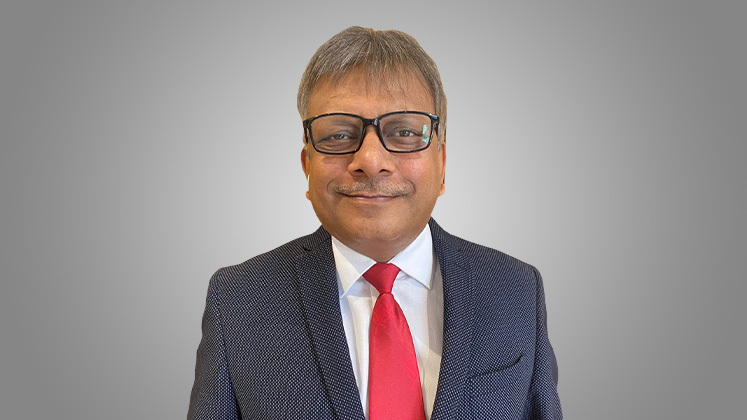
“At present, we produce around 1.5 million metres of fabric per month. Our manufacturing setup can handle widths from 36 inches to 144 inches, enabling production for a wide range of applications, including industrial and specialised fabrics,” said Ravi Adukia, Director, Woventex.
Its products include coated fabrics (rubber, PU, PVC), double-faced fabrics, polyester geotextiles, nylon and PP agrotextiles and nets, filter fabrics, bamboo fabrics with anti-microbial finish, gauze, and flannel. It also makes greige, dyed, and printed fabrics such as suitings, shirtings, swiss voiles, and bed linens, with counts from 20s to 100s and widths from 39” to 108” in weaves like plain, twill, satin, butta, and dobby.
In industrial fabrics, it produces canvas from 4 oz to 18 oz for uses like art canvas and shoe canvas, along with coated cotton and blended fabrics. It also makes polyester, nylon, and polypropylene fabrics for industrial use. The company also produces made-up items such as towels, coin bags, postal bags, drop cloths, flannel dusters, bath blankets, and coated gloves.
Even large players like Ken India (Ken Enterprises Limited), traditionally known for their strength in greige fabrics, are now moving up the value chain. The company produces around 6 million metres of fabric per month and is among the largest exporters of woven greige fabrics, supplying to over 20 countries. Its product range spans fabrics from 50 to 320 GSM and widths between 38 and 132 inches, catering to global brands such as H&M and Amazon.
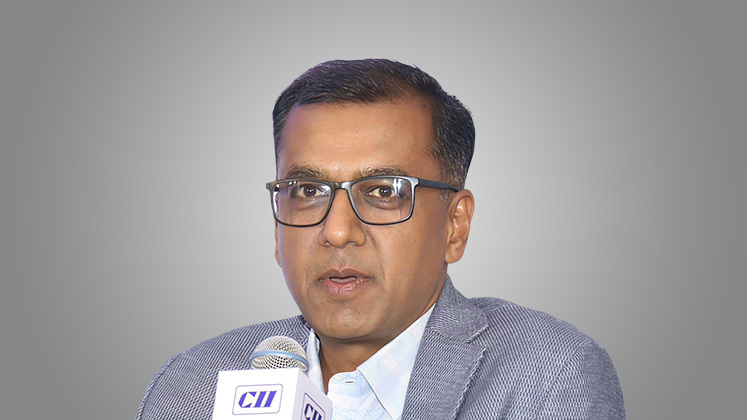
“While we have a strong base in grey fabric manufacturing, our future focus is on expanding garment exports and increasing processed fabric capabilities. We have already started exporting apparel to markets like Malaysia, Singapore, and Dubai, and are preparing to expand into Europe and the US,” stated Nikunj H. Bagdiya MD, Ken Enterprises Limited.
Similarly, Arvind Cotsyn (India) Ltd is also moving beyond cotton into a wider range of fibres, supported by a production capacity of around 2.5 lakh metres per day.
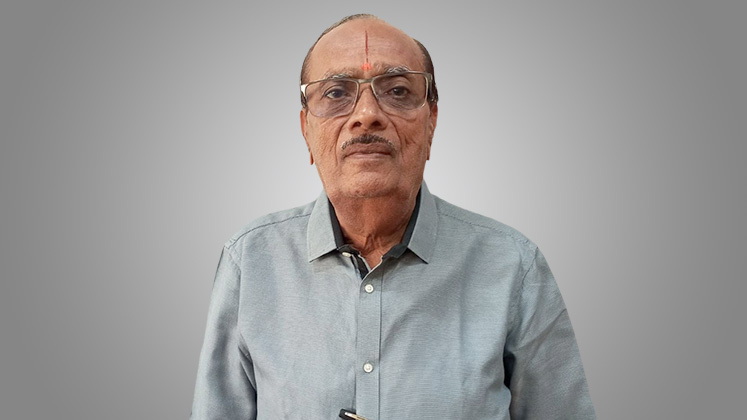
“We work with a wide range of fibres, not just cotton. These include polyester-viscose, polyester-cotton, 100% polyester, linen, Tencel, modal, and lyocell, sourced from both India and international markets like China,” said Bhikulal Marda, Chairman, Arvind Cotsyn (India) Ltd.
Around 40% of its production is supplied to brands, corporates, and institutions. The company works with players such as Shahi Exports, Gokaldas Exports, Mafatlal Industries, and Arvind Limited, with 72 of its looms dedicated to Shahi alone.
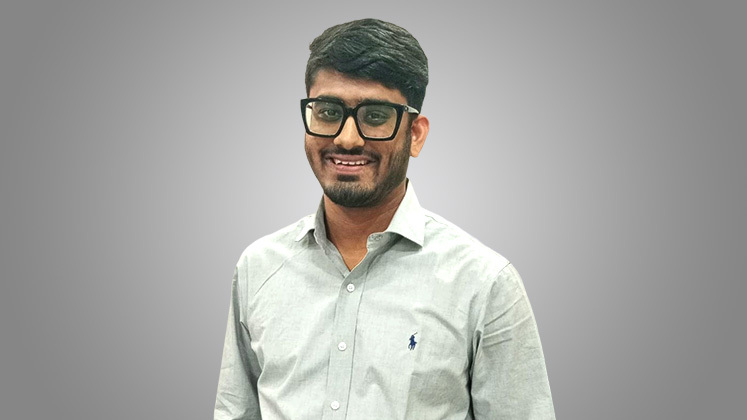
Some companies, while traditionally focused on grey fabrics, are innovating in how they engage with customers. “We provide both a grey fabric sample and a finished version when showing new fabrics to customers. This helps them approve designs faster and make quicker buying decisions,” said Nilay, Director, Saryu Syntex (Birla Udyog).
The company’s USP is its ability to customise fabrics. It offers jacquard monogramming, which adds branding to the buyers’ greige fabric, ensuring precision and providing a high level of customisation. The company works with corporate clients and exporters and maintains a strong focus on quality through four-point fabric inspection.
Currently, Birla Udyog has about 108 looms and a production capacity of 1 million metres per month.
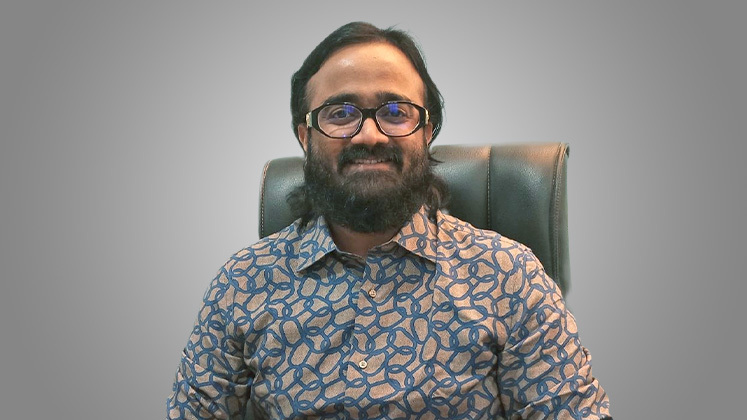
Some companies are now also moving into garment manufacturing. For example, Vadinge Group has already established itself in garment manufacturing, starting in 2022 with 220 machines. “Every month, we produce 50,000–60,000 garments, including 15,000 shirts and 40,000– 45,000 bottoms, split roughly equally between trousers and chinos,” said Ravikant B Vadinge, Director, Vadinge Group. Some of their clients include Amazon, Reliance, Lee Cooper, Yousta, and DMart, and the company handles around 4.5 lakh meters of fabric each month.
Similarly, Arunoday Textile Mills is also expanding beyond fabrics into garmenting and direct-to-consumer channels. The company is planning to launch its own shirting brand and sell through platforms such as Meesho and Myntra to tap into higher volumes. As part of this expansion, it has acquired around 10,000 sq. ft. of space and plans to install 90–100 machines, with the project expected to be completed by 2026.
Meanwhile, the Ramkrishna (Jhanwar) Group is exploring partnerships in processing and plans to enter garment manufacturing by 2030.
Industry Bets on Sustainability to Boost Global Share
Manufacturers are now realising that just adding value is not enough to increase the cluster’s global market share beyond the current 10%. Environmental management has become very important to attract foreign buyers and fully leverage the benefits of FTAs such as the recently concluded FTAs with the UK and the EU, especially as Western markets tighten environmental regulations.
Companies like Indo Count and Raymond are using Zero Liquid Discharge (ZLD) systems. The government has also approved a new Common Effluent Treatment Plant, which will add to the existing capacity of 12 MLD. Some units have started installing solar power, but fully shifting to solar energy may take five to ten years.
For instance, Woventex is investing in renewable energy and certifications to meet global demand for sustainable textiles. It holds certifications like GOTS and GRS and has installed a 500 kW solar system that supplies about 40% of its energy, with plans to add another 300 kW.
At the same time, Badrivishal Fashiontex plans to get OEKO-TEX certification by 2027. It is also setting up an in-house lab in the next six to eight months to test fabrics and ensure quality and compliance. This lab will cost around ₹50 lakh to ₹1 crore. On the materials front, Hari Om Textiles is exploring new fibres such as jute for bags and bamboo for making sustainable and comfortable fabrics.
Ramkrishna (Jhanwar) Group also offers sustainable fabric options. These include linen fabrics made in weaves such as plain, double cloth, and other textured constructions using slub yarns, as well as bamboo fabrics made from bamboo fibres or bamboo blends like bamboo-cotton and bambooviscose.
Taking a broader approach, the company is also working on multiple global certifications including GOTS, OCS, GRS, RCS, OEKOTEX, Sedex, and the Higg Index. It currently runs a 200 kW solar system and plans to increase it to 1,200 kW within a year.
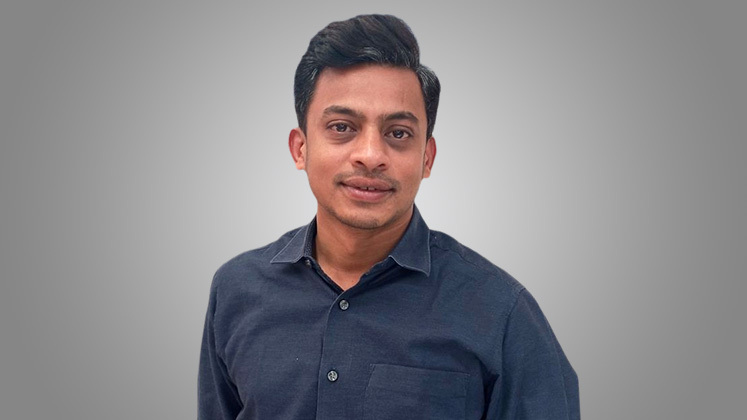
Another company, Priyalaxmi Textile Mills, produces a wide range of fabrics using eco-conscious yarns such as Tencel, viscose, modal, bamboo, and organic cotton. “Our dyeing process uses a ZLD system. We are also installing solar power systems to further reduce our environmental impact,” said Ashish Baheti, Director, Priyalaxmi Textile Mills.
Sustainability is also a key focus for Ken India. The company supports this focus through multiple certifications such as Primark Cares, ISO 9001:2015, GOTS, Textile Genesis, BCI, OEKO-TEX, Higg Index, Sedex, and Cotton made in Africa.
Its apparel division, Ken Global Designs Pvt Ltd, was established in 2020 and has an annual capacity of 5 million pieces. It has two operating garment manufacturing units with around 500 sewing machines, both of which are Sedex compliant. The company manufactures products such as shirts, boxers, pyjamas, womenswear, and loungewear for brands like Pepe Jeans, Amazon, DaMENSCH, Myntra, and Arvind Group, among others. The group’s total annual turnover is approximately ₹500–600 crore.
Despite the progress, infrastructure gaps continue to pose challenges for exporters. One key issue is access to testing facilities, as many manufacturers currently have to send samples to Ahmedabad or Mumbai to meet international testing and compliance standards, leading to delays.
“To address this issue, the government has approved the establishment of a textile testing laboratory in the Ichalkaranji cluster, with an investment of around ₹3–4 crore. The project is being developed as a joint venture, and the facility is expected to become operational within the next six months,” mentioned Anil Goyal, adding that the hub is aiming to double its growth over the next three to four years.
(With inputs from Dheeraj Tagra)





 Bharat Tex Special Report 2026