With automation revolution in the flat knitting industry outside China, sweater manufacturers are rapidly installing automatic flat knitting machines and replacing hand flat knitting machines. With so many automatic machine options present in the market, and with only a handful of them successful, it is hard for sweater manufacturers to decide which machine to invest in. With the same thought-process in mind, StitchWorld discusses in detail the developments in flat knitting technologies, focusing on the features that contribute to low machine downtime, higher output, loop control and consistency in quality of the output. The technologies discussed in this article are not found in a single machine from every brand, but are rather present in specific machines depending on its application and price.
Productivity
In the last two decades, developments in flat knitting machines, used majorly for knitting sweaters and other knitwear products, have been channelized towards making the machines more efficient, by reducing the yarn wastage, manual intervention and optimizing the knitting speed without compromising on the quality of the end-product. Features such as digital stitch device, stitch presser system, spring-type sinkers, needle breakage sensor, automatic oiling system and rapid carriage return system, ensure precise stitch control, loop formation, knitting speed and lower machine downtime.
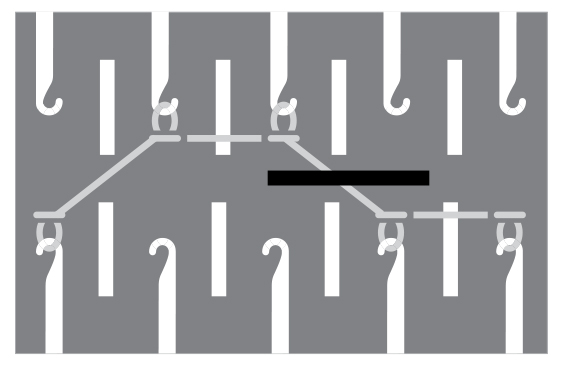
The Digital Stitch Device (DSCS) treats each stitch as digital data and hence is able to control the length and shape of every stitch. Once a specific loop length is programmed, it continuously adjusts yarn feed and tension to yield consistency in every loop of each course, within ±1%, which is virtually impossible with conventional analog systems. This results in production of knitwear with uniform dimensions and shaping, reducing the quality rejections due to size variations and deformed shape. Also contributing to loop control are the spring type sinkers and stitch presser system. Unlike conventional forced operation sinkers, the spring-type mechanism gently holds down the yarns which prevent the knitwear from being damaged due to the high hold-down force of the conventional sinkers. This results in significant improvements in quality and texture of complicated structural patterns and dimensional fabrics. Even Pelerine springtransfer needle with spring-loaded latch and conical hook are used to ensure knitting with precise tension and low needle consumption.
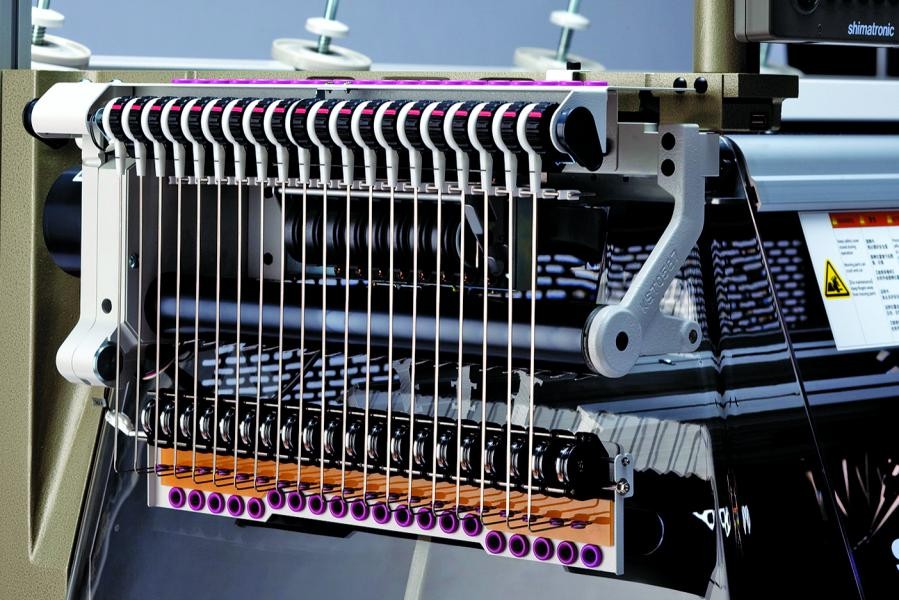
To reduce the overall downtime, the knitting machines are equipped with numerous sensors for not only monitoring the thread line, needles and carriage movement but also for immediately stopping the machine, preventing further damage to the equipment and production of poor quality knitwear products. One such intervention has been the needle breakage sensor that automatically stops the machines once a broken needle is detected. Hence only 2 to 3 needles are damaged, instead of 50 to 60 needles, if the same was missing. A similar preventive measure is the automatic oiling system, wherein needle bed is oiled automatically as a precautionary measure even when the operators have been asked to oil the same at regular intervals. Hence in case an operator forgets to oil or does not do the same properly, the machine will continue to function properly. To prevent large amount of lint being accumulated on the needle bed, machines are equipped with a cleaning device, consisting of a turbine-driven suction system with brushes at the suction point, which significantly reduces the manual cleaning time. To safeguard the end-product and machines from power cuts and outages, the manufacturers have included inverter in their machines, which enables the machines to start knitting right from the point where it stopped, giving a uniform output.
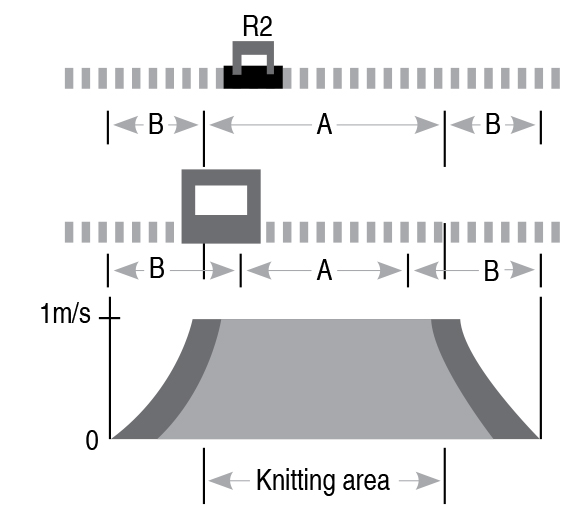
For optimizing the knitting speed, the machines have been equipped with Rapid Carriage Return System that achieves quicker carriage returns after each course. For a given knitting width, a larger and heavier carriage requires more space at each end of the machine to decelerate, return and accelerate again to its original knitting speed, so the actual portion where the carriage runs at full speed becomes very limited. With a compact, lightweight carriage, less space is required for the carriage to make returns, allowing more area for the carriage to run at full speed. This allows faster knitting per course, resulting in higher productivity. In some machines the carriages can be coupled together to knit a wide panel swiftly. Depending on the design, the system moves the carriage 15% to 20% faster than the conventional flat knitting machines.
To reduce the overall downtime, the knitting machines are equipped with numerous sensors for not only monitoring the thread line, needles and carriage movement but also for immediately stopping the machine, preventing further damage to the equipment and production of poor quality knitwear products with interventions like the needle breakage sensor and automatic oiling system as a preventive maintenance measure.
Quality
Quality of a knitwear product is defined by its adherence to the given designs, which is ensured by embodiment of features such as Digital Stitch Device (DSCS), mentioned previously, by converting every stitch into data and communicating the same to the machine. Along with the same, a special motor-driven system and patented stitch presser system allows the stitch pressers to individually turn-on and turn-off loops for knit and transfer designs, in either course direction. This significantly contributes in improving the quality of a design. Loops are also controlled by the unique yarn gripper and cutting system, which consist of two yarn grippers and one yarn cutter that work in tandem with each other. Since the gripper and cutter are separate units, they can be independently activated to delay cutting while holding, or perform holding alone, increasing the design possibilities. Upgrades have also been made in the takedown system, which are now, equipped with a row of special forward-facing needles, unlike the sideways facing needles in case of conventional takedown system, ensuring snag-free loop release and consistent quality.
A machine’s ability to replicate a design seamlessly is also dependent on the number of yarn feeders in the machine and even different types of feeders exist for producing intarsia designs. But companies have developed a single type of yarn feeder capable of producing all kinds of patterns. Since the yarn feeders move independently of the carriage, and are set programcontrolled in their horizontal and vertical position, even more knitting techniques such as inverse plating, intarsia plating and selective plating are possible.
TECHNOLOGY PROVIDERS
SHIMA SEIKI
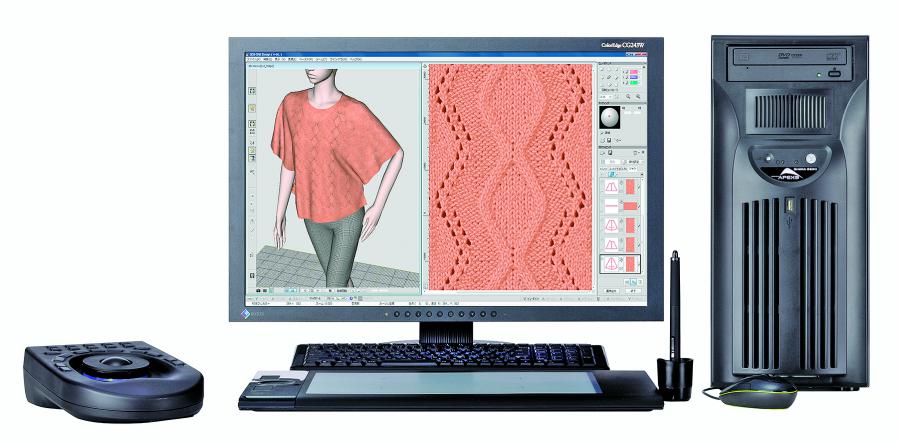
The Japanese pioneer in flat knitting technology, Shima Seiki has acquired 62% of the global market share with its presence in almost every sweater manufacturing country. It offers a wide array of flat knitting equipment for sweaters, gloves and seamless garments along with SDSONE APEX3 design system, P-CAM series automatic fabric cutting machines and SIP-160F2 textile printing machine. The company is also credited as the inventor of WHOLEGARMENT technology, through which a three-dimensional knitwear can be produced, which is required for further linking or knitting. Beyond knitting machines, Shima Seiki has also developed the SDS-ONE APEX3 design system, which is capable of everything from patternmaking to grading and marking for designing knitwear products.
CIXING
Producing right from computerized knitting machines, seamless underwear knitting machines to pantyhose jacquard knitting machines, Cixing has become very popular among the flat knitting industry. The Chinese company has been giving tough competition to the already established European machine manufacturers and has not only captured the Chinese market, but Bangladesh, India, South Korea, Russia, Hong Kong and other 22 regions also. The acquisition of the Swiss flat knitting machine manufacturer Steiger, enabled Cixing to access the advanced technologies of the company, further improving the knitting machines produced by the company.