Three decades of experience in manufacturing lingerie products, may ensure robust production systems and loyalty of buyers, but the real edge comes from the in-depth knowledge of the product and strong quality management systems. A case in point is the unfathomable expertise of the Chittagong based pioneer in manufacturing bra and panties, which was established by the father of Asheek Bhuiyan, Managing Director, Uni Group of Companies.The groups consists of 4 factories with a total of 1,300 sewing machines – 600 for panties and 700 for bras – manufacturing 3,00,000 dozens of panties and 30,000 dozens of bras per month.
The foundation of bra manufacturing at Uni Group was laid in 1995 with the establishment of its first bra manufacturing facility, for which the company hired Chinese technicians unlike the presently common trend of hiring Sri Lankan or Filipino consultants in bra manufacturing facilities across the world. “When we ventured into bra manufacturing both Sri Lanka and Philippines were not even near achieving excellence in lingerie manufacturing, and it was only China which had attained expertise in the product,” explains Asheek.
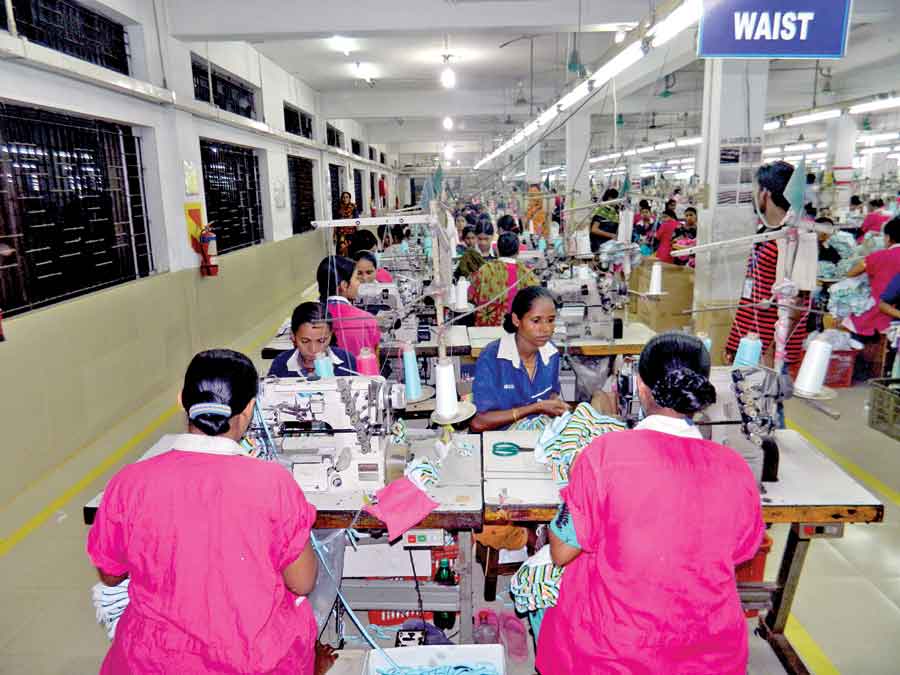
This Chinese intervention in bra manufacturing gave Uni Group one of the most innovative production systems for manufacturing lingerie based on the principles of grouping similar operations in process based groups, instead of setting up assembly lines like the rest of the apparel manufacturers. “If a group sewing the bra wings has 10 girls, all will do wings. But if I have an assembly line, maybe I will have 3 girls doing the wings so that if one of the girls is absent, the production will drop drastically. So I need to bring multi-skilled operator who can do all the operations of a bra or panty in the assembly line or bring a girl from another assembly line, which is not possible,” elaborates Asheek. The company claims high absenteeism as the strongest reason for following this production system and on an average 10 to 50 people are absent regularly on a daily basis.
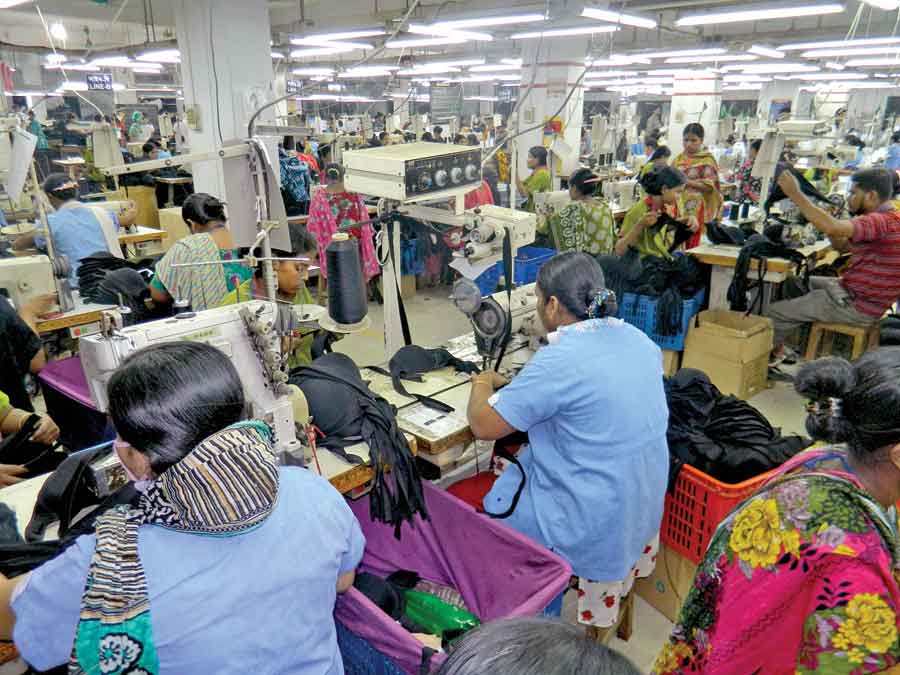
This system not only guarantees unhindered production in case of high labour turnover and absenteeism, but also ensures greater production in comparison to assembly lines in scenarios of low style changeover and long production runs of millions of pieces. “New colours of a style are invariably loaded on sewing lines after every 90 days but the real style changeover in terms of new style with a different construction happens only after every two months,” informs Asheek. Such long style changeover schedules are complimented with even smaller learning curves of sewing operators of just 1.5 days on an average.This has been made possible with the further segregation of the sewing groups on the basis of their ability to do the three predominantly run styles of sports, moulded and without padding bras. Moreover each group’s supervisor keeps track of which style is being done by the sewing groups assigned to them and hourly counting of output is done to ensure adherence to the hourly targets. Since the operators are not that educated, helpers are placed on most of the sewing stations to assure that they follow the written measurements and instructions.
Asheek claims that the system, which is a more customized form of team working or modular manufacturing that is followed in the lean manufacturing environment of companies in Sri Lanka, gives near about the same output to its advanced counterparts. “In comparison to Sri Lankan factories which do not use any helpers and have final packing in the same lines, the output of my line is 95% equivalent to what those companies are producing per sewing line. For example we are operating 230 sewing machines and getting an output of 800 dozens per day and the same would be 900 dozens in Sri Lanka,” shares Asheek. The output not only depends on the product standardisation but also on the capability of the line supervisor, and the way workers are handled which is defined by a company’s capacity to take the best out of them. “If an operator is capable of giving me 10 dozens per hour, but I’m able to take only 7 dozens from them, then the fault is mine, not the operator’s. Therefore, when we hire a new sewing operator, in the first week itself we judge his maximum potential and then give him the targets accordingly,” asserts Asheek.
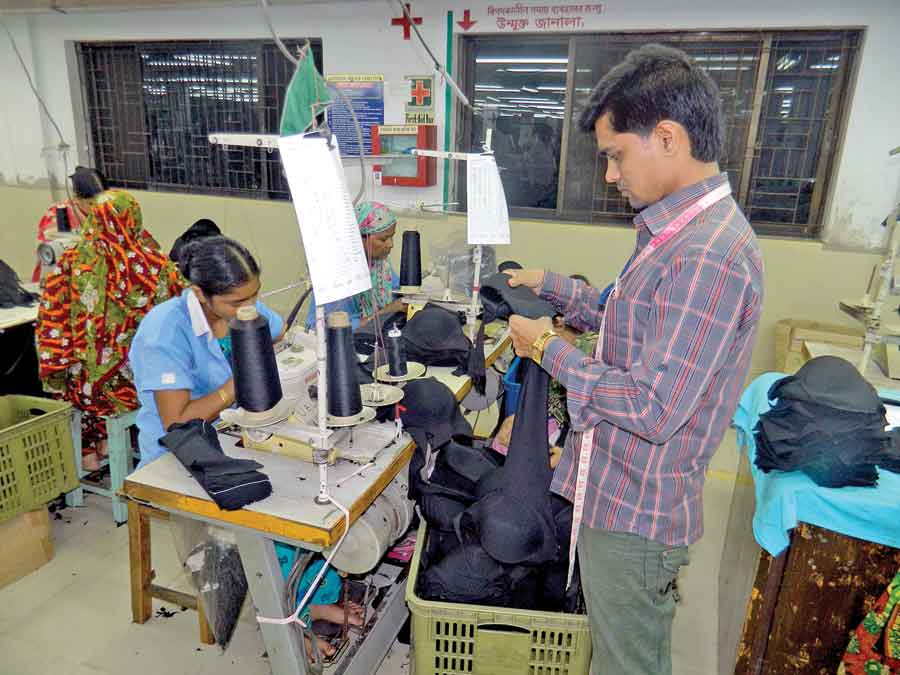
For quality control, critical operations in the bra have been defined by the company and a roving quality checker is responsible for checking the quality of these operations. The operations are elastic attachment to the bottom, armhole and neckline, and topstitching on the same. For these operations the company has installed elastic feeding attachment on the respective machine which not only saves elastic by regulating its consumption but also avoids the requirement of a helper for measuring and trimming the extra elastic.
The final checking paradigm defined by Uni Group as per the specifications outlined by buyers like Walmart, divide the bra into the front and back part and within it the right and left parts, to ensure that no component of the garment is missed in the final inspection. Firstly the label of the garment is checked for similarity to the size mentioned on the bundle ticket and then the production order details are referred to for other details like the colour, fabric content and wash care instructions. If the label has been heat transferred, its placement is matched and the quality of the print is checked with the provided sample. After the label, the measurements of the bottom band are checked, subsequent to which the bra is visually checked for symmetry in the centre front, neckline and both the cups, both in terms of the shade variation and matching of stripes and prints. In this step, the shade variation of all the components is also checked and the overall garment is inspected for cut marks, stains and marks. Lastly, the hook & eye is fastened and the overall symmetry of the bra is checked and the garment is released for final packing.
[bleft] The standard package of a panty prepared in Uni Group contains 5 such items in different colours as defined by the buyers and the time taken by an operator in preparing one pack is just 1.7 minutes. [/bleft]
During the checking of back strap, top and bottom area of wings, wings and cup joint, underarm seam, armhole seam, neckline operation and centre front for SPI, seam cracking, adherence to seam allowances, raw edges, shirring, waviness and untrimmed thread edges, the hook & eye, front & back strap, ring & slider and wire channel operations are paid special attention. The ring & slider is checked manually by moving the slider up and down the bra strap, ensuring that the width of the strap is apt for easy movement of the slider.The wire channelling is checked for dropped stitches, shade variation against the PP sample and also checked is the placement of bartack. In case of the front strap, only the placement of the bartack is checked, while in case of the back strap not only is the strap checked for any kind of twist but also that the strap end through thering & slider is secured.
The Uni Group now has plans to add another 1,00,000 dozen to its current capacity. “We can always increase our capacity but for that we have to make sure that we have orders. Our present turnover is US $ 15 million and by next year we plan to achieve the target of US $ 20 million, and in the next three year we plan to achieve US $ 35 million,” concludes a very upbeat Asheek.



 Bharat Tex Special Report 2026