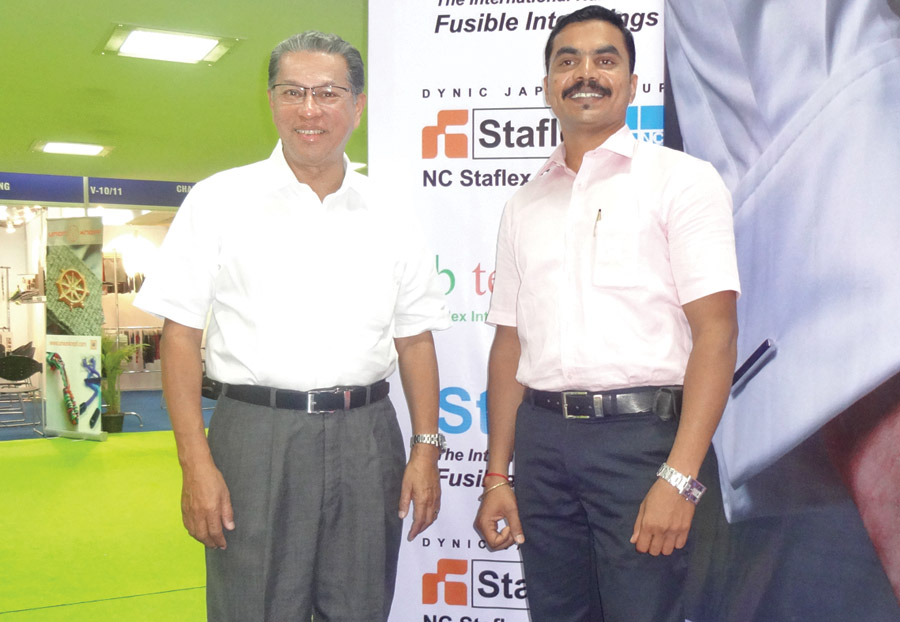
Entering a new market is always difficult and when the critical selling point is ‘quality’ it can become a real challenge, especially in a market like India which is very price-sensitive. But moving ahead undeterred is Staflex Interlinings from Japan. Represented in India by Textilines, the company has since its entry into India made noticeable dent in the interlining market with many companies showing interest in their quality offerings. “The response in the last 7-8 months since we entered the Indian market has been encouraging and since our product is only targeted to customers manufacturing high-end shirts, they understand quality, but the challenge is to convince those who are at the lower spectrum of high-end,” says Ernest V Raj, Managing Director, NC Staflex Co. Pte Ltd., a Japanese company with its manufacturing setup at Singapore, who are pioneers in cotton fusible and non-fusible interlinings in the global market since 1973.
The response has indeed been upbeat and the company claims to have met a manufacturer who was using competitor’s product for seven years but wasn’t satisfied so they started using Staflex, recently. “The company initially found our products very expensive but they could save a lot through Staflex because they had no rejections unlike when using the interlining from a competitor where if 10 shirts were produced, out of them at least two were rejected every time, incurring huge losses,” shares Raj. There are many such garment manufacturers upgrading their interlining requirements with Staflex for quality. The company is looking to grow slow and steady in India, and the main focus would be to bring about a change in the customer’s mindsets. “Collar is the face of the garment, if someone picks up a shirt, that is what comes into the hand and its quality and feel determine the quality of the whole garment, manufacturers need to understand that,” says Dayananda CK, Proprietor, Textilines – Staflex Interlinings India Distributor.
The company is encouraged by the influx of the younger generation which is taking over these days in the garment industry and is more updated and open to change. “We have noticed that at many manufacturing units, run by the second generation of the family, all the products are being replaced by more expensive products having good quality and they are able to explain the reasons for the same to their elders,” opines Dayananda. Currently, Staflex gets its major business from the shirt manufacturers of North catering to the domestic market.
It is not a new understanding that there is a huge difference in the mind-set of the people dealing in domestic and exports business, but contrary to the belief of many, Staflex has observed that while domestic player does not mind shelling out some extra money if he finds something useful because it’s his own business and he doesn’t have a set limit, the exports have got a budget and a limit in which they have to get the job done, so they are less interested in spending more on quality.
Very upfront on technology, Staflex has recently invested US $ 1.4 million on a new dyeing and finishing machine, because the old machine wasn’t able to meet the new standards set for formal wear. With this investment, which should be up and running by July, the company would be able to supply better interlining like lower formaldehyde content which is highly demanded by most of the European labels (below 30 ppm as against the present 75 ppm level) and better shrinkage, without affecting their prices. “We intend to maintain the same price for about 1-2 years, as the Japanese machines we are installing give better productivity and allow us to balance our investment,” concludes Raj.