A year after the global community came together to support the bruised Bangladesh industry, reeling under the tragic aftermath of the Rana Plaza collapse, both the major initiatives – Alliance and Accord, representing the US and European retailers respectively have published reports on their findings and achievements in this one year. Though not really a revelation to the industry, it does come as a surprise for outsiders who have been fed on news that Bangladesh industry is very unsafe, and that in fact less than 2% of the factories were found to be hazardous in the true sense out of the 1,487 factories audited by Alliance and Accord so far, while many others just require adjustments to be worker-friendly.

On reading the report, one wonders as to whether the international brands were unaware of this situation earlier and if it actually needed a catastrophe like Rana Plaza as a wakeup call… and then to brand the entire industry as non-compliant and insensitive was a bit over the top. To its credit, the Bangladesh industry has shown great character in facing the backlash and believing in themselves. One thing is for sure, the incident has proved to be a game changer for the industry.
Even Rob Ways, ED, Accord Bangladesh agrees that the industry is cooperating and is open to change. “At the owner level, we are getting full cooperation and they are trying their best to learn and comprehend the reports and install the necessities. In the 900 factories that we have audited, there is not a single exception, and surprisingly the resistance is coming at a macro level, from the voices who represent the industry like the Transparency International Bangladesh (TIB), the workers and their unions, who do not fully apprehend what is happening and are apprehensive that it will impact then as an industry,” shares Rob, who should know the pulse of the industry having been in the country for the past six-and-a-half years.
Factories forced to close down…
Despite the cooperation extended, it cannot be denied that the industry is upset with the way the audits are being done. There are many allegations of malpractices, even to the point that the whole process is slowing down the industry. Accord, in particular, has been under fire with many claiming that factories have been shut down on grounds that are not even verified. A case in point is when the Accord team recommended the temporarily shutting down of two factories – Fame Knitwear and Softex Cotton – both located in the same building in the capital’s Mirpur. They said the columns and the foundation of the building were not strong enough to bear the load. However, the owners claimed that no soil test, which is mandatory to determine the strength of the building’s foundation, was done; the claim was substantiated by the Dhaka city Development Authority, also called RAJUK.
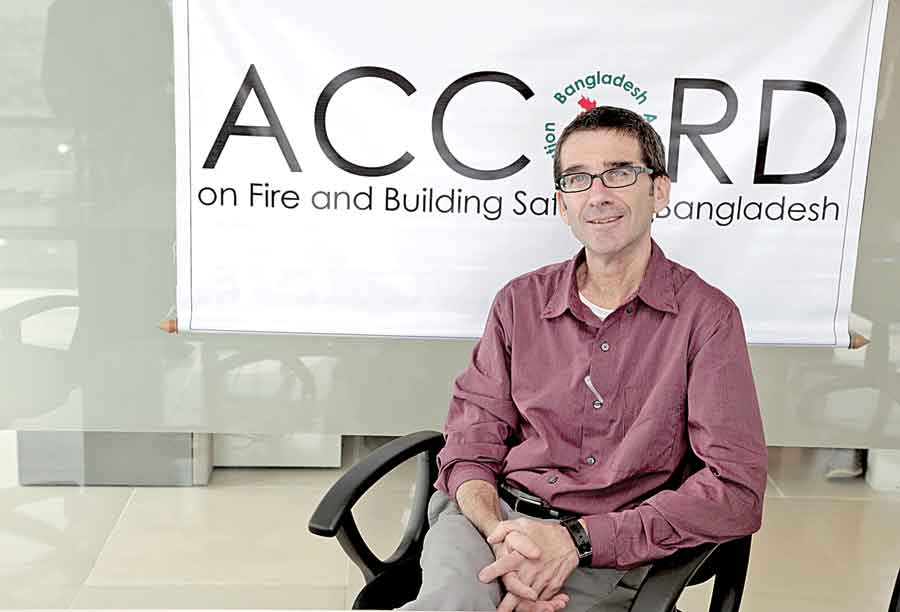
Rob has another story to tell. “Most of the buildings we are auditing were either built before the BNBC (Bangladesh National Building Code) was finalized or built in a way that is not compliant to the building code. So, to go back and try to rebuild or modify them in order to make them compliant is next to impossible. Unless I put pressure to change or modify by exposing the factories, how would we be able to fix accountability,” he argues. Rob also stresses that they never ask the factories to vacate their premises and shift, but the factory owners themselves find it more prudent to accelerate the construction of a new building rather investing in the current one.
Emphasizing that rejecting factories on a ‘pass’ and ‘fail’ methodology is not the aim, but to keep the factory a preferred supplier is the goal, Rabin Mesbah, Managing Director, Alliance for Bangladesh Worker Safety says, “We want to motivate better safeguards in factories and have given a timeline for the conformity of every remedial measure. Like for example a factory needs 12 weeks to setup a fire emergency exit door, so we’ll go and audit them again after 12 weeks, if it is still not there, then the non-conformity will pertain. Any major non-conformity (if not met within the timeline provided) will affect the relations between the brand and the suppliers decreasing the factories’ business.”

Both the initiatives blame the cost involved for change as a major reason for discontent. “Finance is required to install fire alarms, sprinklers and other safety devices and financial resources is an empowering aspect,” says Rabin. Acknowledging that factories may even be temporarily shut down to make the necessary changes, Alliance has committed to partner with the factories to ensure that workers do not lose salaries during the redemption period. “Initially, the Alliance was formed so that should there be any adverse effect on workers due to temporary closures of the factories, we would compensate them with their wages in a 50% partnership with the factories until 2 months. But now, after reconsidering, we have decided to extend this policy for 4 months, that is, we have doubled our compensations as more time is required for change,” shares Rabin. Alliance claims to have made US $ 100 million affordable capital available to factory owners and US $ 5 million support available to displaced factory workers during the one year in operation. It also claims to have compensated 1,000 displaced workers, who worked for the 10-odd factories which have been shut partially or fully.
Accord on the other hand, though also talks about worker protection during the redemption period has made no such commitment to contribute. “We don’t have a welfare fund, but we do enforce the factories that they are required to vacate immediately because the building cannot sustain the weight of the manufacturing operations… Under the Accord’s Article 13, it is mandatory to maintain proper employment relationships with the workers during the closure period. We have about 18 cases in which the factories have been ordered to do so. The factory pays the wages 100%, we don’t account for any compensations being made,” says Rob. However, he does goes on to state that they support those factories that ask for help. “We financially help factories for remediation purposes and also in some cases of wages if the factory is suffering serious losses,” he adds.
Duplication of audits…
“Rejecting factories on a ‘pass’ and ‘fail’ methodology is not the aim, but to keep the factory a preferred supplier is the goal. We want to motivate better safety guards in factories and have given a timeline for the conformity of every remedial measure.
The fact that both Accord and Alliance are working on the same principles and are following the same methodology to achieve the same goal but for different set of buyers, has created confusion for those who work for both the US and European buyers with many claiming duplication of audits and that too with different results. While Alliance has 26 members from America, Canada and Australia, the Accord has 183 affiliated retailers from Europe. Rob denies that there have been audit duplications the way it is being reported in the press and the few that have happened is to the discredit of Alliance. “Accord had committed to Alliance and the fellow members that they would not inspect any factory which produces goods for brands which are members of both Alliance and Accord. And we were trying to work out this issue with Alliance to avoid any duplicity, but Alliance did not honour our effort. Alliance has already inspected all the factory making apparels not only for brands registered under it, but also the ones who are making for brands registered under both, Alliance and Accord. We are now left with the decision on what to do next. Should we inspect these factories which are making goods for brands registered, both under Accord and Alliance, or do we just find a way to avoid the double inspections,” says Rob.
Why audit factories already approved by buyers…
Another area of concern for the industry is that many brands, both American and European, had already started auditing their factories soon after the Rana Plaza tragedy, much before the initiatives were formulated and even these factories are being audited again. The problem actually lies in the fact that inspections conducted by the brands were done on standards that are different from what was eventually developed as the core for safe factories, so monitoring agencies have reason to believe that some differences in findings will emerge. “Our Chief Safety Inspector (CSI) has the authority to accept fully or partially the audits being done by our signatory brands. There are a few cases where even after fully accepting the audit findings of the brand the CSI has also gone ahead to conducted inspections again in the same factory, taking into account and combining the information professed from the other brands’ inspection to ensure that it has been inspected at par with standards as set by the Accord,” informs Rob.
What after the initial audits are over…
According to the latest Alliance report, on completion of one year in Bangladesh, inspections of all 587 factories that come under its preview is over while the Accord, which has to audit over 1,500 garment factories is committed to finish the task by the end of September 2014. Now the industry is looking to see how the next phase will be rolled out.
“At the owner level, we are getting full cooperation and they are trying their best to learn and comprehend the reports and install the necessities. In the 900-odd factories that we have audited, there is not a single exception, and surprisingly the resistance is coming at a macro level, from the voices who represent the industry like the Transparency International Bangladesh (TIB), the workers and their unions.” – Rob Ways, ED, Accord Bangladesh
Rob defines the role of Accord after inspections as that of a fixer – identify problems in the key areas and ensuring that they are fixed. “The goal is also to make sure that the brands and the factories honour their commitments over the next 5 years, which implies monitoring that the factories are being made safe and that the people who are part of the safety and health monitoring systems receive support in training to work effectively,” says Rob. In fact, to make sure that there isn’t any backsliding in dealing with any safety issues that come up subsequent to the inspections and the repairs being done, Accord has recruited case managers, complaint handlers and engineers to support and be available to the factories always.
Right now the outreach for Accord is in explaining to the industry the inspections, reporting findings and on working with the Brands, Trade Unions and factories’ representatives in the implementation and monitoring of the corrective action.” Our next step will be to setup safety and health committees, we’ll help the workers elect their representatives in those committees and explain them the role and function of these committees. The people who are nominated are diligent enough candidates to commit to the safety and health issues. After these committees are formed, we will work with the management to train them and impart them the skills required for these safety and health issues & joint labour management,” adds Rob.
“The goal is also to make sure that the brands and the factories honour their commitments over the next 5 years, which implies monitoring that the factories are being made safe and that the people who are part of the safety and health monitoring systems receive support in training to work effectively.” – Rob Ways
Sharing similar views, Rabin says that as of today, Alliance has the commitment to legally bind the factories for 5 years, for which it has decided to continue monitoring on similar lines until 5 years after the improvements, conducting re-audits to maintain and sustain the improvements, after which they will handover the responsibility to the brands and the Government. “The factories have ensured that no matter what the conformity issues, the brands won’t shift their business from them; also there is a commitment of funding for remediation for 5 years. But there are some giants who actually don’t require any financial help but technical assistance to improve from the buyer’s prospect, so we are helping them out in that direction,” says Rabin.
Government lends full support…
Both the initiatives were very happy with the support that they have been receiving from the Government. “The Government and garment associations have been fully behind us,” says Rabin. In February 2014 when Alliance conducted a seminar at TradeExpo to educate the industry, the Minister of Commerce inaugurated the event and declared the lifting of tariffs on fire suppression equipments (61% to 0%) and LED lights (141% to 0%). Now 4 major equipments – sprinkler, firedoor, emergency exit equipped light & prefab materials are tariff-free, which is a major contribution to the cause. In fact Accord, highly impressed with the Government support, is keen to continue including Government personnel in the inspections and regulations process. “We are supporting the development of the database where the Government will disclose what’s happening in the areas of safety. We help the Government with the information we have about the critical findings so that they can update it in their database,” concludes Rob.