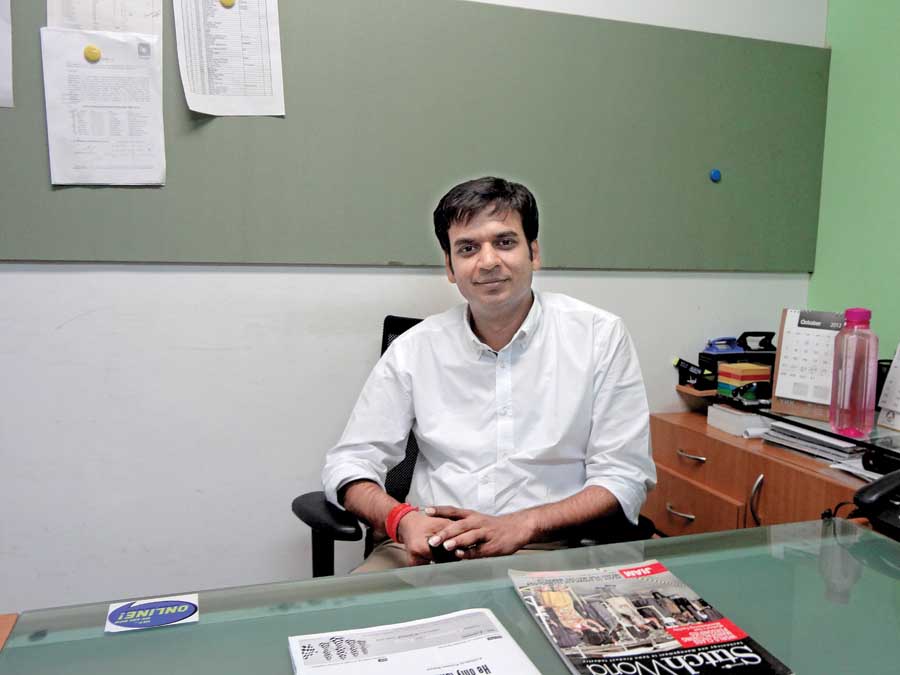
There are very few garment manufacturing companies in India which have taken the joint venture route for growth; Prateek Apparels Pvt. Ltd is one of them. The company has recently completed the first phase of its 3-phase factory by the name of Bilteek Fashions, a joint venture with Turkish shirt manufacturer Bilsar. The new factory at Doddaballapur, on the outskirts of Bangalore presently operational with 200 sewing machines, manufactures high-end formal shirts. Although Prateek Apparels has four self-owned factories around Bangalore with a capacity to produce six lakh pieces of denim, formal and casual shirts, Sanjay Dalmia, President, Prateek Apparels, believes that a joint venture was the ideal choice for expansion. “Joint ventures bring out the right mix of value to the investment,” he says.
Established in 1947, the Turkish JV partner Bilsar is among the largest apparel and textile conglomerates in Turkey, producing two million shirts annually with turnaround times as low as two weeks, both for its in-house brands and foreign buyers. “They brought a lot of experience and solutions to the table, specific to high-end formal shirts. Although the same could have been achieved through consultants, we believe that with direct involvement of two owners in a venture, it immediately becomes much more effective. The facility was a result of the company’s impeccable capacity planning,” adds Dalmia.
Prateek Apparels which started its journey with exports but later found growth restrictive under the quota system, moved on to become a dominant domestic market player by tying up with Madura Clothing in the initial stages to produce for its brand Peter England. However, in recent developments the company has re-launched their export operations.
Realizing very early that in order to survive competition in the garment trade they have to find a niche, and Prateek Apparels developed the concept of design-to-delivery. Today, the company’s design studio – Munch Design Workshop – develops up to 600 designs every month. So confident is Dalmia on the capabilities of his product development team that the company works with a firm policy that it will export only its indigenous designs and not reproduce spec-sheets. The designers at Munch study the brands, do an extensive research and only then make a collection to present before the buyers. “Brands are ready to pay 5-10% extra for such services,” states Dalmia. Unlike bigger brands that have a design team, there are numerous standalone wholesalers and retailers in Europe without access to a design studio. “We are eyeing them as the target,” adds Dalmia.

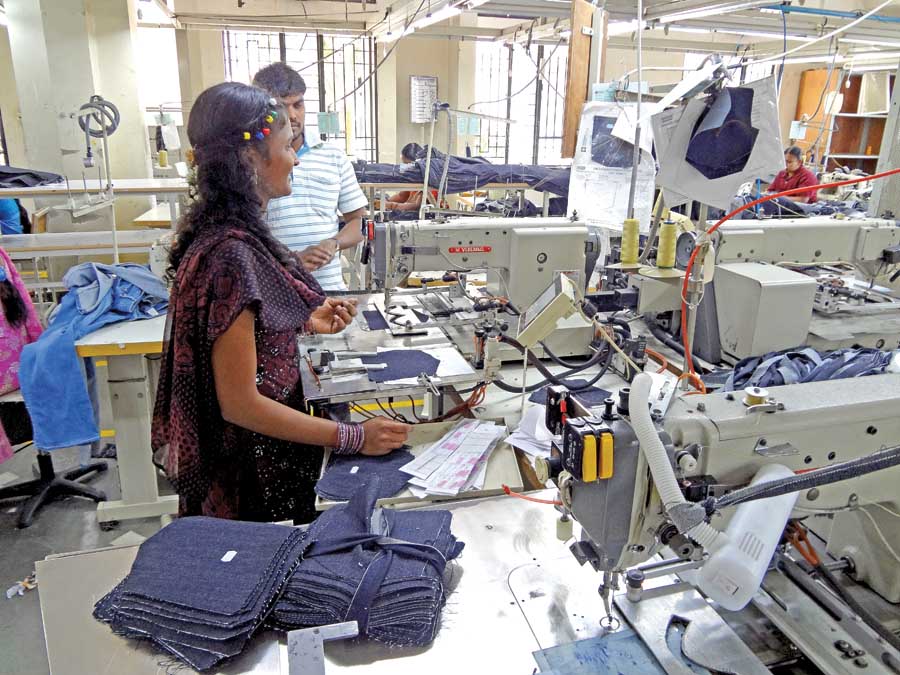
To support such a huge Product Development team producing styles after styles on a continuous basis, Prateek Apparels requires a steady support of talented people in terms of designers, patterns masters and merchandisers. In order to handle the vast number of styles efficiently the alignment of production lines with the Industrial Engineering department and PD team is of utmost criticality. “We have product based factories, thus while changes in style may be frequent, the base product will remain the same,” informs Dalmia. Prateek has factories exclusively for formal shirts, casual/fashion shirts and denim jeans. Within the factories, Prateek has deployed special ‘style changeover teams’ which handle style transitions smoothly.
Even though Prateek is a patron of latest technologies for optimizing the manufacturing process and advocates the implementation of right systems, the manufacturing is structured to supplement product development. The products are divided into core, semi-fashion, fashion and high fashion product categories and the entire system is designed to cater to the high number of styles – 50-60 per month and in small volumes. Unlike most factories the lines in Prateek maintain a very high WIP. “The purpose is that if a back-panel of a particular shirt style is over, the next shirt style’s back panel shall be loaded immediately.
[bleft]India, as an apparel manufacturing hub, has neither cheap labour like Bangladesh nor fast turnaround times like Turkey… So where do we stand. It is, therefore, necessary for us to level the field by reinventing the business strategy around a particular niche, which we have done by perfecting our Product Development.” – Sanjay Dalmia President, Prateek Apparels[/bleft]
In one line, at the same time, there are 5 styles running,” informs Dalmia. The company works with extra supervisors, one for each section – front, back, assembly, and overall, thus saving them from the style changeover time and batch setting. Also the higher WIP system, from cutting to sewing, is meant to give breather to the operators and it also ensures that if for some reason one style is late, it shouldn’t impact the sewing line. The part preparation lines work with bundles and the final assembly lines have an indigenously developed manual hanger system for ease of material movement.
There is certainly a high cost to such a business model, “almost 20% more manpower is required across all departments. This leads to increase in manufacturing cost by 30-40%, and the product development cost goes up by 50%. If an exporter handles 10 to 12 lakh pieces per month and employs a certain set of pattern masters and other such people as backend, we are handling 6 lakh pieces per month employeeing a far greater number of people. This is necessary for supporting our multi style and small quantity production,” justifies Dalmia.
Despite high cost of production due to high WIP, more people, more styles and more style changeovers, for the company the challenge really is of high absenteeism and labour attrition. “The primary focus has been on recruiting fresh operators and training them in our in-house training centres and then retaining them through continuous engagements and ensuring that the tailors are involved in extra-curricular activities such as sports and cultural activities in addition to other life and personality development skills,” concludes Dalmia.
 Bharat Tex Special Report 2026