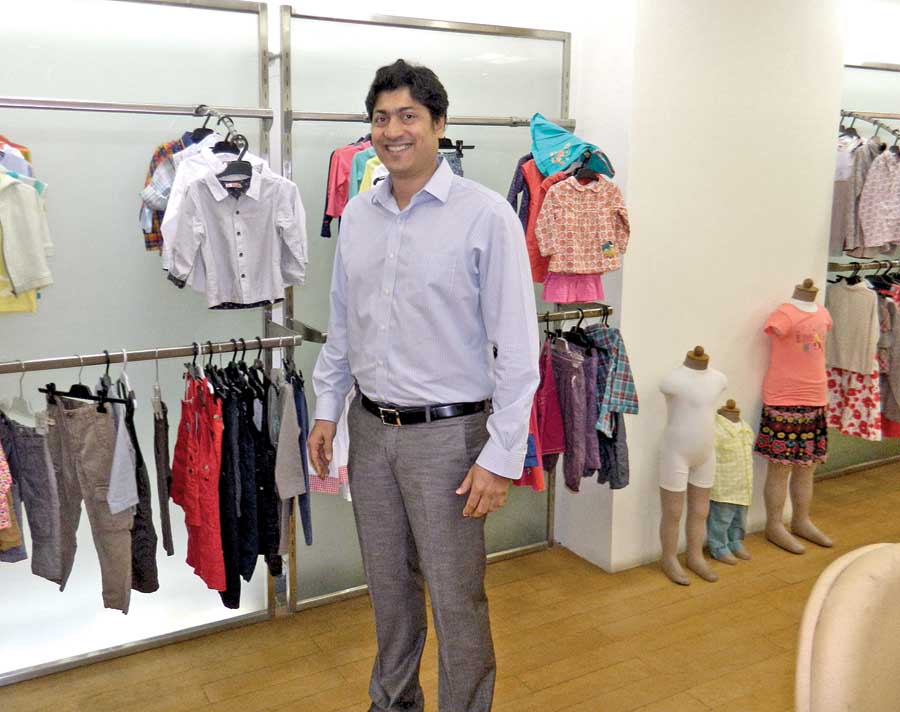
One of the most fundamental theorems for the success of an apparel manufacturer in the global economy is that greater the number of styles handled by the company, the better is the profitability owing to the increased preference of the buyers to place small quantity orders. Based in Bangalore, Pradhan Mercantile (PMPL) has personified this concept in its business strategy and operations as a kidswear manufacturer with a setup of 1000 sewing machines distributed in four manufacturing facilities. Highlighting the company’s focus on product development and management of its manufacturing operations via cutting edge IT interventions, Team StitchWorld in an exclusive interview with the two-decade old enterprise, spoke to the first-generation entrepreneur Amir Pradhan, Managing Director, PMPL.
[bleft]“Quality is taken as a package. If a customer says I pay you more for better quality or pay you less for poor quality, we don’t work. The standard remains the same, irrespective of the product and buyers.” – Amir Pradhan[/bleft]
With humble beginning as a job worker in Mumbai, PMPL has an installed capacity of 4 million pieces per annum, of which approximately 2.5 million pieces per annum are dedicated to woven and 1.5 million to knits. “We started with a European buyer’s boys division and our competitive prices and quality standards could fetch us business of all their kidswear products,” started off Amir Pradhan, Managing Director, Pradhan Mercantile, whose passion together with the same of his elder brother Jamal Pradhan has made the success possible.
The competitive edge of the company is giving its buyers a complete kidswear product range of woven blouses, tops, dresses, skirts, shirts, nightwear, overalls, knitted tops, leggings and T-shirts, both in knit and woven fabrics, in age bracket of 2 to 14 years and in the infant category between 0 to 23 months.
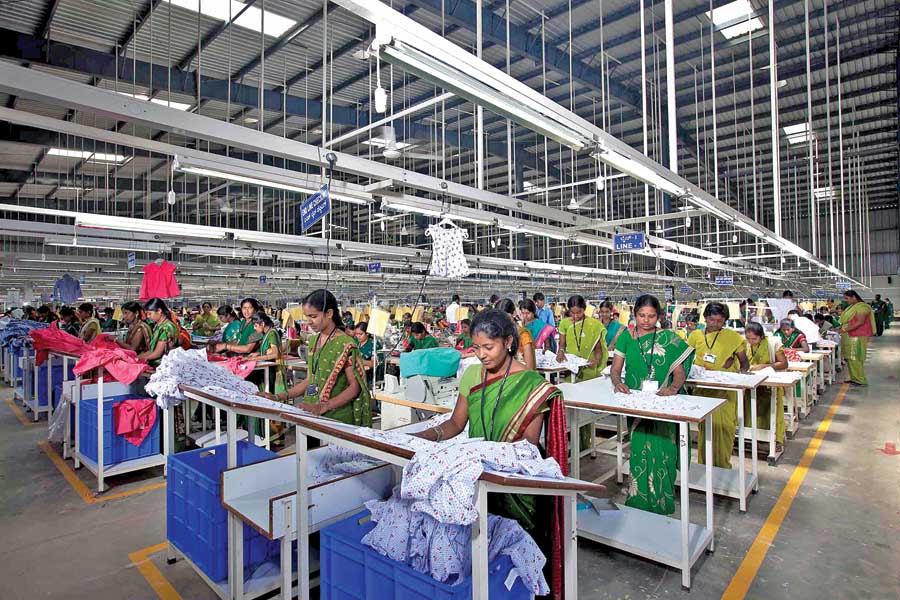
The competitive edge of PMPL doesn’t stop at giving its buyers a complete product range in one kidswear segment but at preparing an ‘assortment’ of products and in 7 respective sizes. “Most of the companies follow the sizes – extra small, small, medium, large and extra-large – which are usually manufactured in the ratio of 1:2:2:1:1 respectively, but in our case there are 7 sizes represented by 7 different ages whose ratio not only keeps changing from order to order but also from assortment to assortment, i.e. a complete package for the size sets and styles as per the requirement of the retailer and even packing some pieces separately for replenishment purposes, which cannot be handled by most manufacturers,” explains Amir Pradhan. The company has adopted cutting edge IT solutions for handling the increased complexity in style and sizes of a single order both on the shopfloor and at the pre-production stages. With this improved ability, PMPL has increased the speed to the market for its products, as the buyers do not have to reopen the shipments in their central warehouses and repack into smaller packages for individual retail stores. Even the barcode stickers for the retailors are placed by PMPL for retailors to just open the cartons and place the apparels in the shelves and racks.
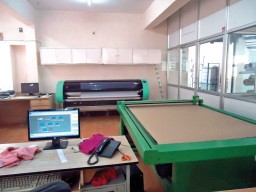
The size and style assortment capabilities are complemented by the company’s in-house setup for value additions like laser cutting for applique work and embroidery. “Product development is a two-way process, which means not only do we follow the guidelines given by the buyers but we also develop our collections and present the same to our buyers, for which we have two designers, one from India and the other from France,” adds Amir Pradhan. Apart from the value added products, the company also has factories for replenishment business (repeat orders of previously done styles). For catering to the increasing demand from its buyers, PMPL has plans for setting up a new factory in Tumkur area of Bangalore with more than 600 sewing machines. PMPL has IT interventions to improve delivery performance of multiple styles and fabric savings through Lectra Modaris for pattern making and Diamino for marker preparation and ERP from Jeevan Infotech.

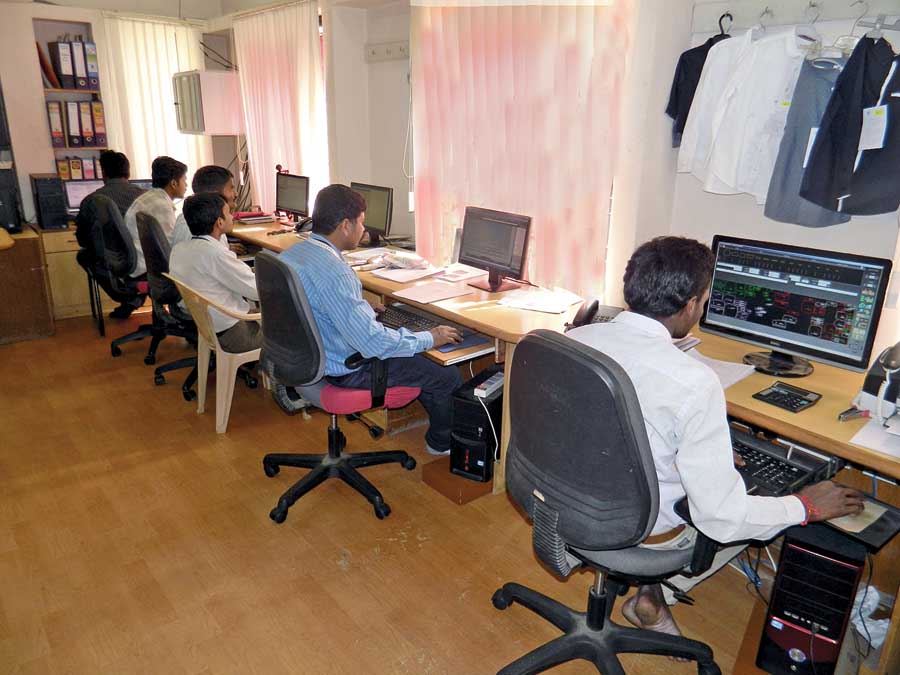
At a very early stage, around 5 years back, the company had realized to strengthen its product development capabilities to grow further and faster to achieve the targets by choosing Lectra’s Modaris for pattern making and Diamino for marker preparation. “We handle in all 100 styles every month and the challenge was to reduce manual errors, improve efficiency in operations, develop complicated styles and easily modify patterns at any stage of the process, without compromising on our on-time delivery performance, the number of styles handled by us and consistency in delivering quality,” avers Amir Pradhan, content with performance of pattern and marker making systems from Lectra.
The company claims to have moved beyond the process of digitizing patterns by use of features like ‘marrying of patterns’, which has further reduced the time taken for making patterns. This function is used for matching of the patterns, in order to carry out the checking of sizes and then take-up the necessary correction. The patterns are matched using the reference objects located on each of the patterns and are coloured differently for easy recognition and matching. This feature not only avoids the need of plotting the patterns and then checking them with original patterns but also reduces the time taken in pattern creation.

Another highlight has been the training of CAD operators in specific areas of shade wise fabric grouping and increasing the marker efficiency, which has further contributed to the fabric savings of 2 to 3%. The company also uses Alys plotter from Lectra and Wilcom embroidery software.
The time when PMPL decided to go for Lectra’s solutions for pattern and marker making, the company also decided to go completely paperless for much more efficient management of its business and make available real-time information to everyone working in the organization.
“I personally never wanted to bother my merchandisers by repeatedly asking them the order status, who would then come to me with a bunch of files and paper, after having wasted even more time in collecting the same,” opines Amir Pradhan. He believes that with real-time availability of information – from accounts to merchandising to production to material in-house – the company is no more ‘shooting arrows in the dark’. Moreover the company is doing all this without the use of any RFID or barcode system, and only with the use of a customized ERP system, from the Coimbatore-based company Jeevan Infotech.
The crux of the ERP system’s functionality can be summed up as real time view of the complete business of PMPL with total transparency on the internal and external transactions. “Let’s say I have allotted an order of 7,000 piece to one of my facility and after the order is complete they end up making 9000 pieces, but now when everyone is logged in the system, we know the status after cutting, pre-sewing and post-sewing on a daily basis through the Factory Management System module in the ERP, completely negating the possibility of such occurrences,” elaborates Amir Pradhan. Further boasting the ERP’s functionality, PMPL is also able to keep track of the buyers sourcing patterns, so that production forecasting can be done more accurately.
[bleft]The dominance of IT in the company is resembled by the use of video conferencing by employees for internal communications due to the multi-location factories of the company.[/bleft]
At the intra-personal level in the organization, reminders are sent for the start of production, material in-house and transfer of goods from department to department. Also integrated with the ERP system, is the calculation of rejection rate, on-time delivery percentage, right first time quality percentage and other such reporting systems which are critical to improve performance, including daily reports of attendance in each of the manufacturing facility. “All these interventions have helped us ship right quantities and good quality products which otherwise would result in a huge loss to us and much more then that would be losing our buyers too,” shares Amir Pradhan, who claims that any buyer who has once worked with PMPL, has not left the company.
With so much transparency within the organization, PMPL has been able to avoid any kinds of shocks and surprises at the end of production. “We usually work with nominated vendors only and along with the present requirement we also give them the projected requirements for the complete year. Moreover our orders are always treated as top priority by them because we both are in a mutually beneficial relationship and we help each other in our lean periods,” avers Amir Pradhan, attributing to the seamless integration of its business operations to its ERP system.