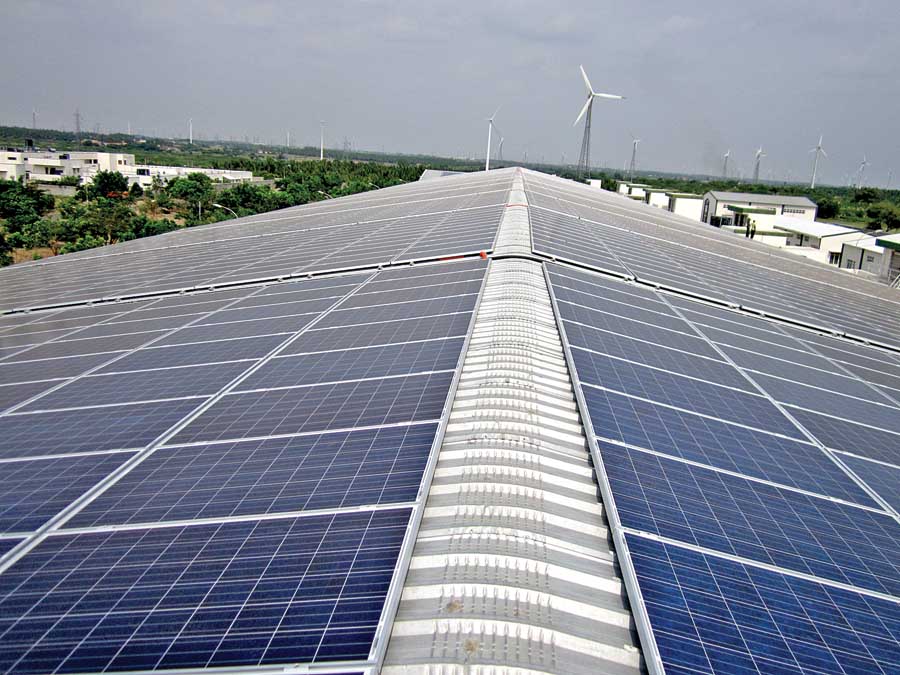
The operating overheads of an apparel manufacturing facility reflect heavily on the costing of the products manufactured in that facility. Of these overheads, electricity consumption towards lighting and maintaining optimal temperature on the shop floor including the running of sewing, finishing, embroidery and other heavy machines, contribute greatly to the cost per machine per minute. The industry has been on the lookout for alternate sources of energy for a long time, be it the windmill, biogas plants or solar panels. Among these three models, solar panels are easier to maintain and install, and also require much less space, but with constraints of high initial capital investment. After investing in wind energy, apparel and textile hubs such as Tirupur, Erode, Salem, Coimbatore, Chennai, Karur, etc. they are now leading the movement towards installation of solar power projects. StitchWorld spoke to key solar energy solution providers like Kondas, L&T, TORP, MIT Corporation, Solarcare and MROTEK, highlighting the recent investments and a SWOT analysis of solar energy systems for the garment industry.
Apparel and textile companies, namely, MG Cotton, Majestic Exports, Alpine Knits, Benso Garments, NSP Tex and KG Denim, are the frontrunners in installation of solar power plants for captive consumption. “Across India we have total installations of 100 MW across various sectors, but the drive towards solar energy is so great in Tamil Nadu that we already have projects under implementation stages in the state with a combined capacity of 100 MW,” avers R. Thirumoorthy, Head – Business Development (Tamil Nadu), L&T Construction (Solar Projects). The solar project division of the US $ 14 billion L&T Construction has installed 20 MW capacity solar power plants in Madurai-based Ramalinga Group’s spinning mill with 2,50,000 spindles.

Another ongoing project for the company is with KG Denim for their fabric, home textile and apparel manufacturing units, wherein the company would be installing a 15 MW capacity solar power plant to feed these divisions. The capacity of L&T’s solar power projects range from 5 MW to 20 MW. “One of our most successful implementation has been in Tirupur-based Apex Clothing Company, which has already installed a solar power project with a capacity of 20 MW and would be adding another 10 MW to it. The same company has been leading a consortium of 7 other apparel and textile companies like Warsaw International and Alpine Knits, which would be installing similar solar power projects soon,” shares Thirumoorthy and predicts that the state will have a combined capacity of 5,000 MW of solar power in the next 5 years.
Another company working with solar energy, Chennai-based TORP Systems has done successful implementations in KOB Textiles manufacturing bandages with a peak capacity of 100 KW, 80 KW rooftop solar power plants in Kanam Latex, Nagercoil in Tamil Nadu and 168 KW solar power plants in BMW’s manufacturing plant in Chennai. “In the apparel and textile industry we foresee a 10 MW opportunity exclusively in roof top solar power installation market. Moreover, in Tamil Nadu alone there is an opportunity of 1,000 manufacturing units which can adopt solar power plants,” shares V Ramakrishnan, Director, TORP Systems, who bases his predictions on his regular interaction with companies in Erode, Tirupur and Coimbatore.

The company foresees a bright future in the apparel and textile industry as it specializes in roof top solar power systems, which is most suitable for the industry needs. “The biggest advantage of roof top installations is that you do not need to utilize land, which is very scarce and expensive, increasing the overall cost of the project. Roof top solar power plants also keep the building cool by absorbing all the heat. But not every structure can take roof top solar power systems due to structural and safety issues,” adds Ramakrishnan. The most defining issues on how successful a roof-top installation would be are the type of roofs and the wind force in the region.
Roofs made of reinforced concrete can easily withstand the weight of solar panels spread across the area. In a sloping roof, the direction of the slope and angle of inclination affect the output of the solar power plants. “The impact is not major but better results can be achieved if the roof is south facing, with one face of the slope towards the north and the angle of inclination is nearly 10 degrees,” elaborates Ramakrishnan. The wind force in the region defines the strength with which the panels need to be bound with the roof, as there is a risk of the solar panels being blown away in cyclonic regions like Chennai. In concrete there is no problem as the roof can certainly hold the panels to itself, but in case of roofs made of metal, the minimum thickness should be of 0.5 mm.
Why Tamil Nadu is so receptive to alternate energy sources…
With so much capacity building happening in the state of Tamil Nadu, solution providers give reasons ranging from greater solar irradiance to the progressive mindset of the people; also the industry faced major power crisis in Tamil Nadu, making solar energy the top choice. With 15 implementations in the apparel and textile units based in Tirupur, Solarcare foresees installation of solar power plants with a combined capacity of 6 MWs. “Power shortage was the biggest reason behind our 100 KW installation in Majestic Exports and it was the first solar power plant backed by a battery of 2000 Ah, which allows them to utilize the power generated during the day, in the night. Majestic Exports requirement was 600 kWh of electricity per day, 30% of which was fulfilled by the 100 KW solar power project,” shared S. Sivakumar, Chief Manager – Solar, Solarcare.
“I would urge the apparel and textile industry to use solar energy as a competitive edge by making their operations more sustainable and reduce the carbon footprints. These aspects really do appeal to the international brands and retailors.” – V Ramakrishnan, Director, TORP Systems
The company did its first implementation in 2010, which was followed by few implementations of 10 KW to 20 KW, but big success came with the 100 KW solar power plant implementation at Majestic Exports in 2012. “That year, including Majestic Exports, we installed 1.2 MW of combined capacity in apparel and textile industry of Tirupur alone,” said an upbeat Sivakumar. Solarcare has similar installation of 100 KWs in companies such as the Tirupur-based Alagendira Exports and Mangayarkarashi Mills in Madurai. The way the industry is taking to the technology, Sivakumar foresees nearly 100 new apparel and textile companies in the region installing solar power plants, in the coming 2-3 years. Solarcare does not manufacture the equipment and has tied up with MROTEK for inverters and solar panel manufacturer MV Photovoltaic Pvt. Ltd.
“Power shortage was the biggest reason behind our 100 KW installation in Majestic Exports and it was the first solar power plant backed by a battery of 2000 Ah, which allows them to utilize the power generated during the day, in the night.” – S. Sivakumar, Chief Manager – Solar, Solarcare
It is no secret that the industry in the south has always been very proactive in implementing new ideas and the increasing demand for solar energy is among the latest examples. “Tamil Nadu was always very big in wind energy, generating about 6 Giga Watts (GW) of wind energy alone. So people are much more open to the concept alternate energy, but in other states the power situation is not that bad for people to go in this direction,” believes Ramakrishnan. Adding on further Thirumoorthy says, “The measure of solar irradiance (power per unit area on the Earth’s surface) is relatively high in the region. Moreover the region has 330 days of clear sun.” Disagreeing with the reasoning, Sivakumar explains, “The factor of Solar Irradiance is higher in western and central regions of India and even the consistency of sunlight throughout the day is also fairly good. The only deterrent from my point of view is the initial investment and mindset of the people.”
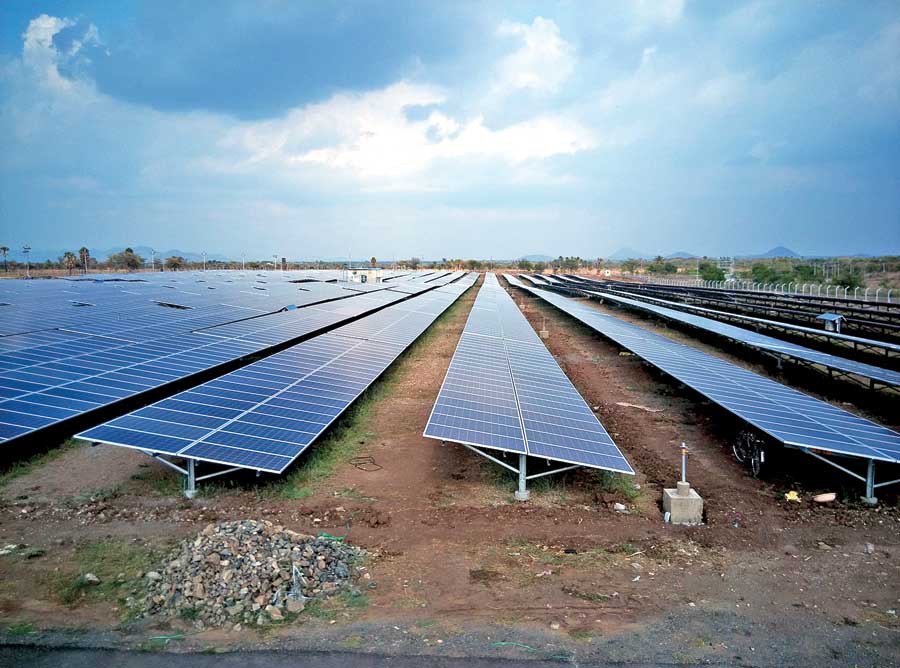
No doubt, the cost of implementation, especially if it has to be installed on the ground is very high, as a solar power plant with a capacity of 1 MW requires 1 acre of land. For players in the south the cost of land is relatively low compared to regions like Delhi-NCR, Bangalore and other metros making the project more viable. As of today, while the land cost in North India’s major industrial regions is around Rs. 20 to 30 lakh per acre, in Tamil Nadu the same would cost Rs. 20,000 to 30,000 per acre.
Constraints of Solar Energy…
A strong basis for scepticism regarding the potential of solar energy has been the performance of solar panels on days with low or no sunlight, but the same is only a common misconception about the technology as the solar panels do not require light for generating electricity, they need heat. “When there will be diffused sunlight, power would still be produced, though not at the same efficiency levels but at 60% to 70%. It is only on very rainy days that the efficiency may come down to 30% to 35%,” asserts Thirumoorthy.
According to specialists, the only real drawback of solar energy is that it drops down to zero after 6 PM. The solar panels start producing energy from 6:30 AM in the morning and reach peak capacities between 11 AM to 2 PM. For greater efficiencies solar panels should be oriented in the north-south direction, while facing south. Other aspects such as variance from stated wattage, temperature coefficient, conversion efficiency, durability and the type of solar cells used, influence the output of solar panel. The temperature coefficient rating is important to determine what impact the heat has on a solar panel’s operation after installation; the lower the percentage per degree Celsius, the better. The efficiency of how a solar panel converts light into electrical energy will determine how much power the system generates.
According to MIT Corporation, who is the dealer of the multi-national solar panel manufacturer Yingli Solar, photon rating test accurately defines the heat to electricity conversion efficiency of a solar panel and the solar panels from Yingli have achieved 93% efficiency in the same, placing the company’s solar panels among the top 5 most efficient solar panels. “The photon rating test was conducted last year and we made an improvement from the previous year’s mark of 85%. The test does not measure the peak efficiency rather the average conversion efficiency over a period of time,” explains D. Sathishkumar, CEO, MIT Corporation Solar Solutions. Yingli Solar is the world’s largest solar panel manufacturer, based out of China, with combined installations of 10 GW globally. MIT Corporation has already installed solar power plants with a combined capacity of 5 MW in Tirupur, and a total of 15 MW in the apparel and textile industry of Tamil Nadu.
Presently two types of solar power plants are used for utilizing the energy generated through solar panels. Off Grid System wherein power generated through solar panels is stored in batteries for using at night time. Another is the On Grid System wherein sunlight is not stored in any form for future use and electricity is generated and used in real time. “As of now the storage of solar energy increases the overall cost of the project due to the regular maintenance costs and disposal problems. In India, the companies are using solar energy directly, without any storage,” adds Thirumoorthy.
Continuing the comparison, Sivakumar shares, “A solar power plant with a capacity of 1 KW will produce 4 kWh of electricity per day in an Off Grid System and the same power plant will generate 5 kWh per day in an On Grid System, as there is less transmission loss in the Off Grid System due to the presence of batteries.” Another reason behind the lower acceptance of battery supported solar power plants is that companies who are going for solar power for reducing carbon footprints and increasing their sustainability quotient, are discouraged by the emissions from the lead batteries which in turn increase the carbon emissions.
Heavy initial investment… lower running cost
The capital investment (excluding the land required) in a solar power project ranges from Rs. 60 lakh to Rs. 1.5 crore for a 100 KW capacity solar power project. Moreover, about 10 square metres of land is required per KW for a solar power plant. “If you have 200 sewing machines, your consumption is 50 KW, which would be the installed capacity of the solar power plant and this much capacity will generate 200 to 250 kWh of electricity per day,” points out Sivakumar of Solarcare. However, there is no cookie cutter approach to the same, as factors such as the load per hour of a factory also define the capacity of the solar power plant required. “An apparel factory does not only have sewing machines which require low energy but it might also have automatic cutters and spreaders, and other similar heavy machines which can increase the load on the electricity circuit,” explains K. Neelamehan, Sales Executive, Kondaas Automation.
The cost per kWh of a solar power plant is between Rs. 10 to 12, which although lower than the Rs. 18 to 20 per kWh cost of a diesel generator, is higher than the Rs. 7.5 cost per kWh charged by the state electricity board. But the frequent power cuts increase the overall cost per unit. “As the scale of operations increase the cost per unit from a solar power project drops further. Moreover, the state electricity tariff has been rising at an annual rate of 16% and we expect it to cross the mark of Rs. 12 per kWh in the next five years,” adds Sivakumar. Another advantage which further enhances the cost competitiveness of solar power plants is an ROI period of 5 to 6 years, while the solar panels have a life of 25 years, which means free energy for the rest of the 20 years. “The only maintenance required for a solar panel is periodic dusting and cleaning, as there are no moving parts or any kind of consumables. With nearly zero operating costs, solar power plants enable an apparel manufacture to be cost-competitive,” reasons Ramakrishnan of TORP Systems. As far as the capital investment is concerned, a lot of institutional investors are willing to help people financially for such installations, at a nominal interest rate of 6% to 7% due to the sustainable aspects of the project. “We have also tied up with domestic and international investors who setup a solar power project and charge a company on per unit basis,” shares Sivakumar.
The Government of India has also laid out incentives for companies installing solar power projects in form of 80% accelerated depreciation on the capital investment. “Let’s say you have invested Rs. 1 crore in a solar power project, you can show Rs. 80 lakh as depreciation in your balance sheet and avail a rebate of Rs. 30 lakh. Similarly, the remaining 20% can be depreciated within 5 years’ time,” deciphers Sivakumar. However, the companies informed that the process is very long drawn and requires tireless coordination with the Ministry of Natural Resources, and it can take up to a year for availing the benefits.
SOLUTION PROVIDERS
L&T Construction (Solar Projects)
L&T is India’s largest solar photovoltaic EPC (Engineering, Procurement & Construction) player with in-house capabilities for designing solar photovoltaic power systems, balance of system, which include wiring, switches, support racks, an inverter and battery in case of Off Grid System but excluding photovoltaic panels and pre-requisite power evacuation systems that allow generated power to be immediately evacuated from the solar power plant to the grid for distribution. In partnership with leading solar technology providers, L&T offers solutions in key areas of the solar value chain covering concentrated solar power and solar photovoltaic technologies. The company leverages its expertise in sourcing and project management to its customers. L&T can provide solar power systems connected to the grid, rooftop & micro grid PV systems and concentrating solar power systems. The company is known for completing the 20 MW solar power project in Phalodi, Rajasthan in just 60 days from design to commissioning. L&T is a leading solar power project provider for the apparel and textile industry with projects like Apex Clothing Company, KG Denim and Ramalinga Group.
https://www.lntecc.com/homepage/RenewableEnergy/home.html
TORP Systems
Based in Chennai, TORP Systems is one of the leading solar photovoltaic systems integrator. TORP’s capability spectrum covers development of economically viable and technically superior solutions in Engineering, Procurement and Construction (EPC) of Solar Energy Projects by partnering with core solar technology providers. TORP’s competencies encompass all the key elements in the solar value chain including providing key raw materials to leading solar manufacturers through its group company UnegaPte, Singapore. The company specializes in rooftop solar power plants and has installations in technical textiles oriented companies like KOB Textiles and Kanam Latex.
https://torpsystems.com/
Kondaas Automation
One of the largest UPS manufacturing and distribution company based in Tamil Nadu, Kondaas was founded in the year 1995 and since then has created a niche in solar products. Kondaas’s solar inverter equipped with Variable Frequency Drive, which will give maximum torque with minimum sunlight. The system requires no battery; the panel can be directly connected to the inverter which in-turn can be connected to a 3-phase motor. The Okuma Sampling Path control (OSP)-based CNC control will track & extract maximum power from the solar panel so that the motor runs at a constant torque for the wide range of intensity of sunlight from morning till evening. This will give 35% extra energy which results in pumping 35% more water compared to the conventional 3-phase inverter plus 3-phase pump or DC motor based water pump. The company has done significant implementations in companies such as MG Cotton in Tirupur.
https://www.kondaas.com/
MIT Corporation Solar Solutions
Based in Coimbatore & Tirupur, MIT Corporation is the regional distributor of Aeon Renewable Energy Solution Pvt. Ltd solar energy systems Integration Company. Aeon is the strategic partner of Yingli solar, for the Indian market. Yingli now has a production capacity of 3.6 GW and occupies 12% of the world market share in module selling. Aeon-Yingli partnership aims at bringing world class solar energy products to India. Aeon and Yingli together, targets to form professional business areas specializing in renewable energy, solar accessories, solar based retail products and green agriculture. Along with a wide portfolio of photovoltaic cells, Aeon also specializes in services such as consulting, troubleshooting, energy audits, energy efficiency improvement and ROI and cash flow analysis on energy improvements. The company has already installed 20 MW of combined capacity of solar power plants in the apparel & textile industry of Tamil Nadu.
www.aeonenergy.biz
Solarcare
A 100% subsidiary of Windcare India, Solarcare India Pvt. Ltd. is a complete solar solutions provider with an installation experience of over four years. Located in Tirupur district in Tamil Nadu, the company emerged as a specialized branch focused on solar energy from Windcare India Pvt. Ltd, which is a leading solution provider for wind energy and leading vendor for wind turbine manufacturers, including Suzlon, Vestas, RegenPowertech, Gamesa, GE Wind Energy, Pioneer Wincon and GWL and solar panel manufacturers including LANCO, Vikram Solar, Emmvee Solar, Sukam, SMA, Delta and ALPEX Sola. For Off Grid Systems, which require battery back-up, Solarcare has tied up with MROTEK for integrating its UPS inverter with the solar power plants from Solarcare. Majestic Exports, Alagendira Exports and Mangayarkarashi Mills are some of the applauded installations of the company.
https://www.solarcareindia.com/