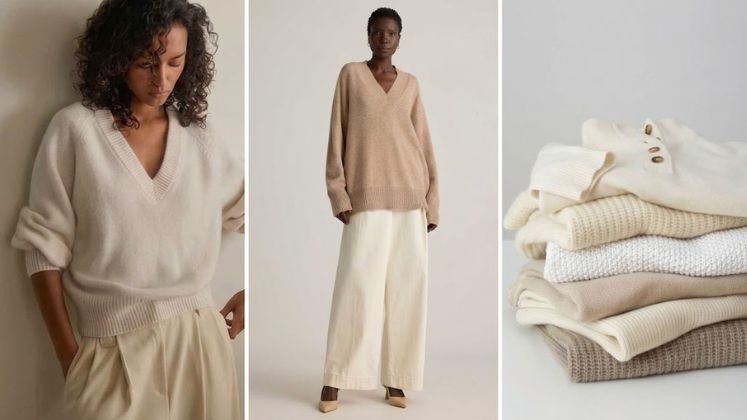
Cashmere is being pitched as autumn’s most elevated knitwear trend. It shows up in turtlenecks, button-down cardigans, V-neck pullovers and even brushed short-sleeve polo shirts. The details are what make the season feel new. Raised seams, dropped shoulders, funnel necklines and tapered cap sleeves add structure to otherwise minimalist shapes. Pastels and saturated colours keep the fabric from reading as a safe neutral.
The luxury houses set the tone. Loro Piana’s Fall/Winter 2026-27 collection is built around a nomadic fluidity, with cashmere and baby cashmere among its signature fibres. Its palette moves from ochre and brown through green, grey and tundra, ending in black and white. WWD singled out a pumpkin-coloured cardigan with bell sleeves, embroidered in the same yarn, and tuxedos with cashmere shawl collars instead of satin. Vogue Hong Kong noted a shawl-collared chenille cashmere and wool knit inspired by the insulation worn by Norman fisherfolk. The house also leaned on paisley, in earthy and pumpkin hues, across its shawls and cashmere scarves. Brunello Cucinelli remains the other reference point. It was founded in 1978 on artisanal women’s knitwear in coloured cashmere and is now closely tied to the quiet-luxury movement.
Below the luxury tier, a wave of contemporary labels is making cashmere feel wearable and modern. Loulou Studio, formerly Loulou de Saison, has been praised for its tailoring, curved hems and shoulder-seam detailing. Jenni Kayne’s fisherman sweater is 100% GCS-certified cashmere, and that certification tracks animal care and supply-chain integrity. Forbes Vetted points to White + Warren, whose sweaters have been a benchmark since 1997, and the New York label La Ligne, founded in 2016 and known for its striped knits. Anthropologie’s latest cashmere drop, with a 100% cashmere oversized sweater at $188, shows how far the fibre has moved beyond the luxury tier.
In India, cashmere is a local story as much as an imported one. On the mass-premium side, Uniqlo is best known for its cashmere sweaters and Heattech range. The deeper heritage lies in the Himalayas. Pashmina is the finest cashmere, from Changthangi goats on Ladakh’s Changthang plateau, GI-tagged and now authenticated with QR codes on more than 51,000 shawls since 2024. Labels such as Pashmee, whose pieces are hand woven by artisans in Kashmir, including Kani work, and Kuttons, which sells products handcrafted from pashmina from the Ladakh Himalayas, work in that space.
Delhi-based designer Zubair Kirmani runs the label Bounipun and opened a store in Srinagar. Among the larger knitwear players, Monte Carlo has a premium line, Luxuria, positioned as a luxury collection built around clean layers with rich textures. Shingora, known for scarves, shawls and winter fashion, makes knit sweaters and pullovers at its in-house facility in Punjab.
For buyers and manufacturers, the story is as much about proof as about product. A supplier trend report argues that in the quiet-luxury segment, sourcing certified, traceable Grade A cashmere and communicating that story clearly is a competitive edge. It also points to demand for luxury knits with practical finishes such as machine-washability, anti-pilling treatments and travel-friendly construction. Indian exporters and domestic brands with strong knitwear capability are well placed to answer both demands, provided the traceability paperwork is as good as the yarn.