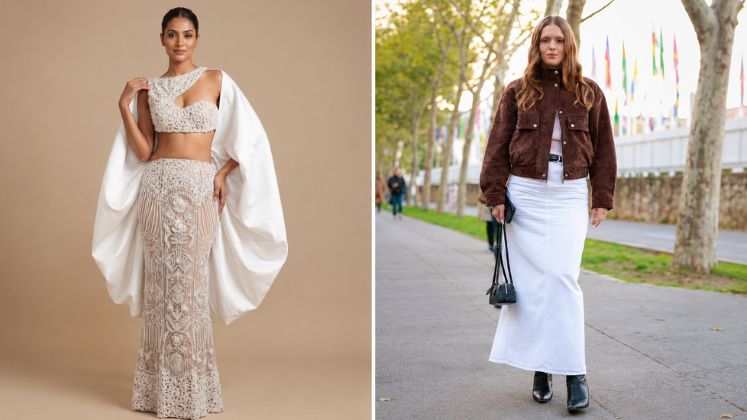
Not every skirt story this season is about ornament. At The Row, the column skirt distilled the season’s mood into an elegant, narrow shape. It shows that a well-judged silhouette can carry a look without embellishment. The long, lean line elongates the figure, which is why it reads as sophisticated rather than overworked.
The shape was not confined to one label. At Marc Jacobs and Tod’s, button-down shirts and column skirts recalled the body-skimming silhouettes of the early 2000s, which suggests the column is part of a wider fitted, early-2000s reference rather than a standalone idea. The skirt is also appearing within tailoring. Tom Ford paired a collarless utility jacket with a sleek pencil skirt cinched with a leather belt, one example of the season’s return to coordinated skirt sets.
The column is not new, and it may be handed over to a fuller shape. Full midi skirts at Khaite appeared to pick up where 2025’s column-skirt trend left off, though a few column skirts still appeared on that runway. That matters for buyers. The column carries momentum from last year, but the next phase may be volume, so assortments should weigh both.
Street style has helped build the look. In Paris, a suede column skirt from The Row was worn with a turtleneck, and the styling advice around it is practical: for petite frames, the long length can be balanced with a heel or adjusted by a tailor. Length and proportion are where this skirt succeeds or fails with consumers, which makes fit and finishing a point of difference for brands.
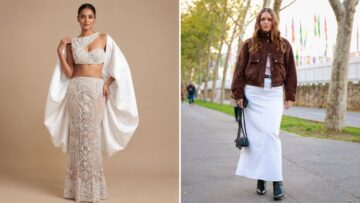
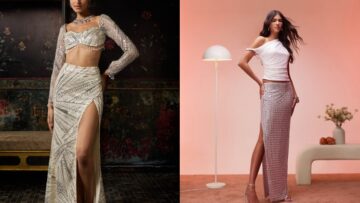
Where the global conversation around the column skirt is about restraint, the Indian version is more ornamental. Internationally, The Row’s long, narrow line is valued for what it leaves out. Indian labels tend to treat the same straight silhouette as a surface for craft, with block printing, appliqué and hand embroidery. A column skirt runs straight from waist to hem rather than tapering like a pencil skirt, and it is this uninterrupted line that gives designers room to work.
The clearest example in ready-to-wear is AFEW, the contemporary line from Rahul Mishra, the first Indian designer to present at Paris Haute Couture Week. Its skirt collection lists a Slim-Fit Column Skirt with Floral Print and Appliqué among 69 styles, all with India as the country of origin. Black is the largest colour group in the range, cotton and polyester lead the fabrics, and the brand positions the collection as moving from brunch to elegant eveningwear. The column here is a daytime-to-evening piece with decoration, not a purely minimal one.
Āroka comes closest to the global ideal while keeping a distinctly Indian textile story. Its Monolith Column Skirt is a body-skimming midi in hand block-printed Ajrakh Mashru, with a clean waistband, a back zipper and a centre-back vent for ease of movement. It is sold ready to ship in sizes from XXS to XXXL, with a custom-size option, which shows that a crafted textile and a precise silhouette can sit in the same everyday product. At the western-wear end, Sage by Mala offers structured midi skirts in sizes XS to 5XL and is explicit that its clothes are neither ethnic nor fusion. Its Vichy Pencil Skirt, in brown and crème gingham, and its ivory cotton poplin Sorbonne Skirt show the tailored, office-ready side of the market, though both are closer to pencil or midi cuts than to a strict column.
Couture treats the shape differently. Rianta’s, a Gurugram house better known for bridal lehengas, has created a dedicated Column Skirts section, which currently lists eight pieces. Its Bijou Skirt Set is typical of the approach: a fitted skirt in mint green satin jacquard, hand embroidered with pearls, cutdana, sequins and stones, sold with a structured blouse and a feathered cape. Delivery averages eight to ten weeks, and customisation is handled through WhatsApp. The section also includes lehenga-style pieces, which suggests the house is stretching the term to suit its occasion-wear customer rather than adopting the minimalist definition. Duchess Kumari, a luxury label founded by Alka Suman, Divita Rai and Adhyayan Suman, has similarly pitched its festive collections around quiet luxury and modern ease. JODI builds its pieces on hand block-printed Mashru silk, printed in Jaipur and made at its workshop in Pune.
What emerges is a market in which the column is being claimed twice. In ready-to-wear, it is a clean, versatile line that Indian textiles can decorate without overwhelming it. In couture, it is a fitted base for embroidered sets suited to weddings and festive evenings. For brands and suppliers, the common thread is craft. The silhouette is global, but the surface treatment, from Ajrakh and block printing to zardozi-style handwork, is where Indian makers differentiate themselves.