India stands at an extraordinary inflection point. With a population of 1.4 billion people and a middle class projected to reach 600 million by 2030, the country represents both a manufacturing powerhouse and one of the world’s most dynamic consumer markets. But here’s what makes India truly distinctive: these two forces aren’t developing in parallel – they’re amplifying each other.
From Epic Group’s front-row perspective, we’re not just building manufacturing infrastructure to serve global brands. We’re simultaneously serving India’s rapidly evolving consumer base – from price-conscious mass markets in tier-3 cities to premium shoppers in metro flagships. This dual mandate is making Indian manufacturers sharper, more versatile, and more capable than ever before.
India’s Growing Domestic Market
The middle class is expanding significantly year after year, creating unprecedented purchasing power that’s reshaping retail. More Indians are traveling overseas, social media is making the country increasingly fashion-forward, and television exposure to global trends is creating aspirations that didn’t exist a generation ago. What’s particularly striking is how the geography of growth is shifting. Historically, retail growth concentrated in major hubs: Mumbai, Delhi, Bangalore, Chennai, and Kolkata. But the next wave is coming from tier-2 and tier-3 cities like Lucknow, Chandigarh, and Ludhiana.
At Epic, we’re participating directly in this geographic expansion. Our decision to locate the Trimetro manufacturing campus in Khurda, Odisha – in tier-2/3 geography rather than traditional manufacturing hubs – reflects this broader shift. We chose Odisha deliberately for government incentives, proximity to Paradip port, and a workforce with the resilient mindset and attention to detail that garment manufacturing demands.
Why does this matter for manufacturing? Because serving diverse Indian consumers across this vast geographic and economic spectrum forces manufacturers to develop capabilities across the entire value chain.
The Global Manufacturing Edge India Has Built
The Indian apparel market operates as three distinct segments simultaneously, each teaching manufacturers different world-class capabilities. At the lower end, extreme price sensitivity requires mass manufacturing at scale. This is where India builds efficiency, speed, and cost competitiveness – skills that make India competitive for global value brands. The middle market demands better quality while maintaining accessible pricing, with consumers responsive to trends and social media. Manufacturing for this segment requires consistent quality and faster turnarounds – exactly what mainstream global brands need.
The premium space is particularly exciting. Indian consumers will pay for quality if they don’t have to fly to Singapore or New York to get it. But capturing this market requires luxury-level quality, impeccable finishing, and demonstrable sustainability – proving Indian manufacturers can compete with premium production anywhere.
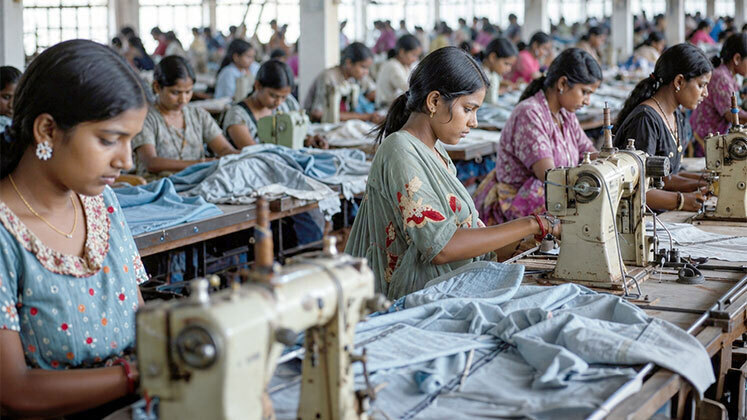
Domestic market diversity forces manufacturers to build a complete capability spectrum. A manufacturer might produce value basics for a mass retailer, mid-tier fashion for an emerging brand, and premium products for a flagship store, all within the same operational ecosystem. When international brands source from India, they’re tapping into capabilities honed on one of the world’s most demanding and diverse markets.
India’s manufacturing advantage goes beyond labour costs. It’s built on structural advantages maturing at exactly the right moment.
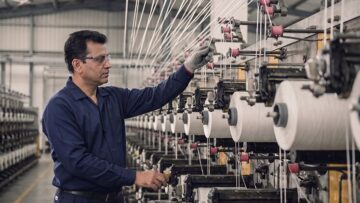
Start with integration. India offers yarn-to-garment integration either under one roof or within a tightly connected ecosystem – a genuine competitive advantage delivering speed-to-market through reduced lead times, better quality control, and cost efficiencies. At Epic, partnerships like our Spectra denim facility in Gujarat producing 700,000 pieces monthly are expanding to cover full vertical integration.
Technology investments are accelerating, but the approach is about augmenting capability, not replacing workforce. Trimetro’s 40-acre facility employs 7,000 to 10,000 workers producing 20 million garments annually, with 80% women in manufacturing and support roles. But it’s built with automated sewing lines, AI-enabled planning systems, and IoT sensors monitoring resources in real-time. The Brain Box development platform handles over 1,000 tech packs monthly. Digital traceability tools like Oritain verify raw material origins and ensure end-to-end transparency.
Workforce development is happening at unprecedented scale. At Trimetro, we implemented a 90-day intensive training program in sewing, safety, 5S practices, and quality management.
Sustainability as Operational Reality
The gap between sustainability ambition and execution is where most manufacturers stumble. At Epic Group, Trimetro demonstrates what climate-resilient, sustainable manufacturing looks like at scale – not aspirational targets for 2030, but operational reality today.
The facility runs on 6 MW of rooftop solar panels supplemented by offsite renewable power through Power Purchase Agreements, with battery storage ensuring continuous clean energy operations. Water management goes beyond conservation to net positive impact. Harvested rainwater is stored and used throughout operations. Zero wastewater discharge – every drop is treated and recycled. A central lake system recharges groundwater, meaning the facility gives back more water than it consumes.
Climate resilience extends to the building itself. Structures withstand cyclones and flooding. High-efficiency chillers and HVLS fans maintain worker comfort while reducing energy costs. Heat pumps operating at 135°C produce dual outputs – hot water for industrial usage and chilled water for air conditioning – far more efficiently than conventional boilers.
Phase II expansion begins in December 2026, and Trimetro’s learnings inform Epic’s broader infrastructure strategy. When international buyers visit and see these systems operational at scale, the conversation shifts from “Can India do this?” to “How quickly can we scale?”
As global brands face increasingly stringent ESG requirements, India has the opportunity to establish firstmover advantage in South Asia for sustainable manufacturing at scale. The infrastructure is being built. The systems are operational. The commitment is demonstrated through investment, not just intention.
Ready to Lead
The China+1 diversification strategy is happening now, with real orders. But the critical question isn’t whether brands want to diversify – it’s where they can go at scale.
Bangladesh faces capacity constraints and infrastructure challenges. Vietnam lacks textile integration and is reaching labor cost parity. Other Southeast Asian markets are either too small or face political and infrastructure limitations. India, by contrast, offers scale that can handle global volume, integration from yarn to garment, quality capability across all segments, and stability from a growing domestic market not solely dependent on exports. For leading international retailers, the value proposition is clear: manufacturing capability that can scale, sustainability that’s verifiable, and quality systems delivering zero defect standards. Facilities like Trimetro can produce 20 million garments annually with renewable energy, zero wastewater discharge, and full digital traceability.
Challenges remain. Logistics need continued improvement. Bureaucracy needs streamlining. The skilled workforce pipeline needs continuous investment. But the timing is right. Geopolitical shifts are accelerating sourcing diversification. Infrastructure investments are reaching critical mass. The domestic market provides both scale and a capability testing ground.
The Era of Leadership
India isn’t positioning itself as just another sourcing alternative. The ambition is bigger and the foundation is stronger. India is ready to lead. The dual engine of domestic demand and export capability creates momentum that’s rare in global manufacturing. Together, they create a manufacturing ecosystem that’s resilient, versatile, and continuously improving.
For brands and sourcing leaders looking at the next decade, India offers a compelling combination: scale, quality spanning value to luxury, versatility proven in the world’s most diverse market, sustainability infrastructure that’s operational, and a growth trajectory providing long-term stability.