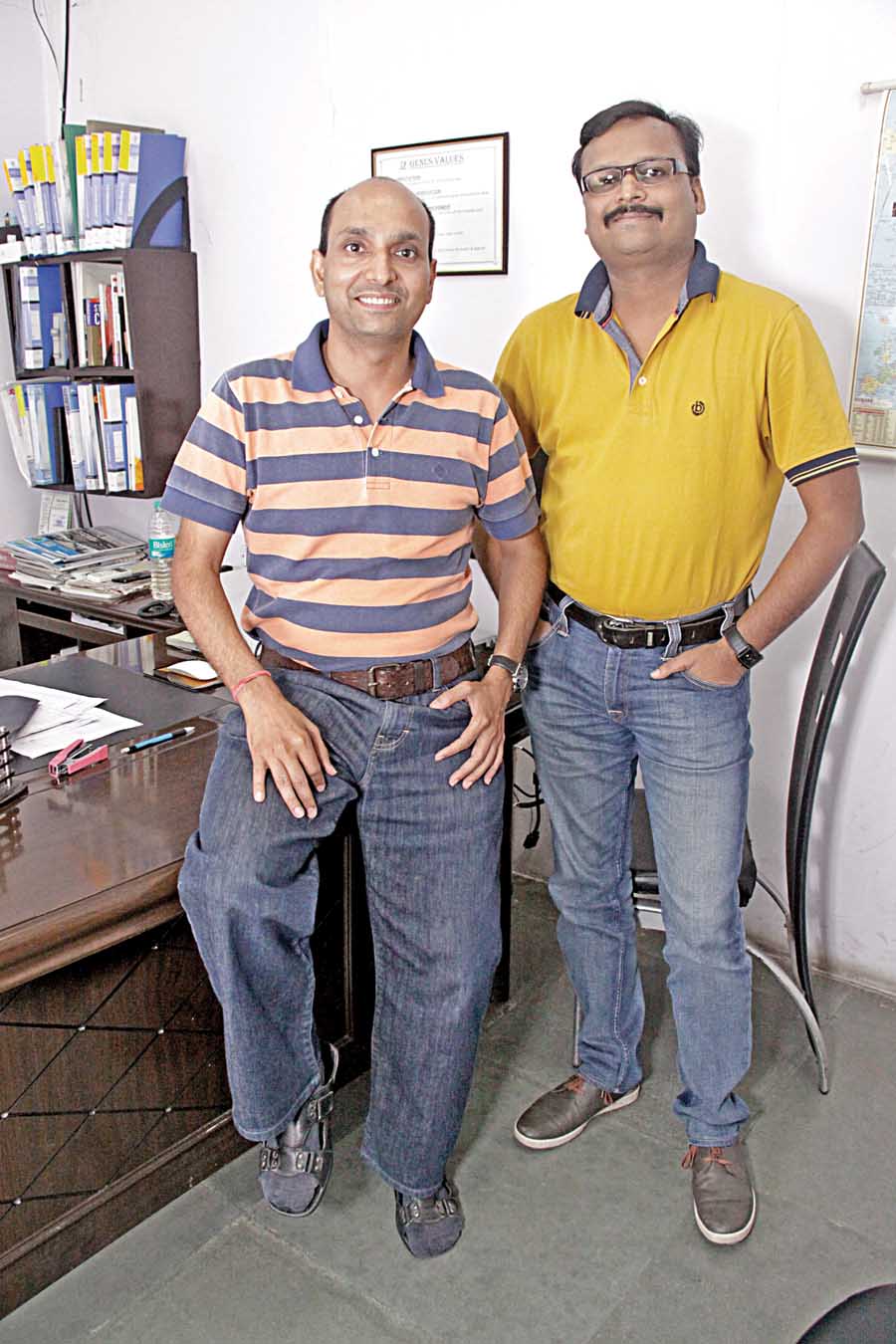
Since 2008, apparel manufacturing operations have all been about survival, possible only by maintaining cost-effective and efficient manufacturing operations. But when Genus Apparels was setup in 2007, overcoming all odds, it doubled its turnover in just two years which is a remarkable feat, offering lot of clues for other apparel manufacturers to emulate the processes and systems to go ahead in the game. The company, with a modest setup of 250 sewing machines and a humble top management, achieved the same without even increasing the sewing capacities. Team StitchWorld, in an insightful interview with Amit Agarwal, Managing Director and Sanjeev Garg, CEO, Genus Apparels, highlights the niche created by them in a product which is done by almost everyone in northern India, making it clear that it’s not the product rather the approach which makes you successful.
Value added ladies knitwear is the product manufactured by Faridabad-based Genus Apparels, a group company of Kailash Group and a result of the acquisition of L M Sagar Exports. The product if looked from a broader perspective is very regular for Delhi-NCR. “The fabric is the greatest strength of my product and we started focusing on the same 3 years back,” stated Amit and goes on to share that 50% of the products manufactured use fabrics developed by the in-house teams of technicians and designers. Sanjeev, who is a textile engineer by profession explains further, “A normal single jersey fabric costs US $ 6.00 per kg and if I’m making a fabric with a different yarn or weave the price can go up to US $ 11 per kg which gets reflected in the FOBs of our products which is around US $ 10, nearly double of what one gets for a basic garment.”
Operational Excellence Along with the fabric development, garment and fabric washes are also the company’s forte, and are among the core responsibilities of the top management of the company. The fact which has empowered the company to create such a niche in fabric development is that the company buys yarns and then makes them available to their fabric vendors, for making the fabric. “This not only helps us keep a tight control over the fabric quality, but also helps us save 5-7% of fabric development costs,” shared Sanjeev.
The company intends to stay flexible in fabric development by outsourcing the knitting by giving its in-house fabric development team maximum options, rather limiting them by adding certain kinds of knitting machines in-house.
Recognizing style changeover time as a major hindrance in on-time delivery, the company takes the same in consideration and makes it a part of its time and action calendar (TNA). “Basically we play with two dates the file handover and planned cut date, when everything from the fabrics to trims are in-house, which gives the production department 10-15 days for setting up a pilot line and completely understand the product,” shared Sanjeev. The system helped the company save on discounts and air freights from 5-7% at a turnover of US $ 2.50 million, to just 2% while doing US $ 5.70 million turnover, a saving of US $ 63,000.
Though the company has undertaken many such smaller initiatives to manage its on-time delivery performance, the company is also in the process of installing a production planning and control software by the name of Khandaree from CSL Software Resources, to further streamline its on-time delivery performance. “The software solution would enable faster decision making and greater transparency in the organization. Moreover it is for our employees benefit and would automate the process of order in-house to ship,” asserted Sanjeev. The system has been in implementation for the past two months.
[bleft]“For creating our niche in a product made by every second company in the Delhi-NCR region, our focus has been on the fabrics, for the past three years. As of now 50% of the products manufactured by us, use fabrics developed by the in-house teams of technicians and designers.” – Amit Agarwal, Managing Director and Sanjeev Garg, CEO, Genus Apparels[/bleft]
Manufacturing Operations
The company’s manufacturing processes have been seeing continuous improvement either with the intervention of foreign consultants or at times initiate changes for improvement on its own. The layouts of different departments clearly indicate the efforts for reducing wastes of transportation and waiting time. Initially the company used to cut the fabric and then do the ticketing, in this case the person responsible for doing the ticketing had to wait for the entire cutting to be complete, but after latest interventions the ticketing person has to start the process as soon as the first block has been cut, increasing the daily productivity by 500 pieces, to 4,000 pieces per day. Furthermore in the cutting department, sections have been made on the cutting tables itself in the sequence of cutting, numbering and ticketing, cut part checking, bundling and final bundle checking. Unlike many factories, samples of the garment have been made and are also hung in the cutting department, indicating the defects which may arise due to defects in the cutting of the patterns, right over the cut part inspection section.
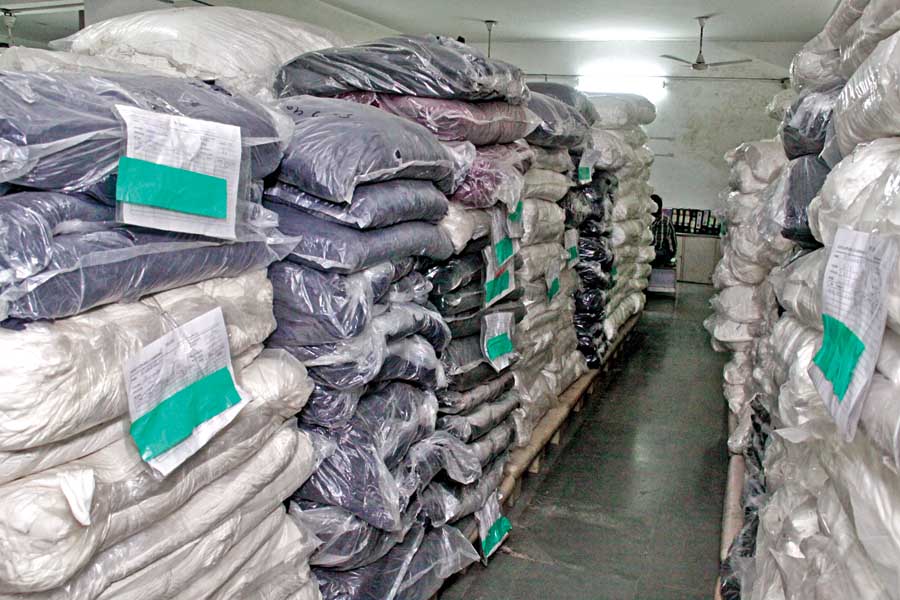
There are many visual aids present on the cutting floor like 5S zone depicting the various initiatives done to implement 5S, benefits of 5S written in Hindi, man-machine waiting chart for identifying both the man and machine idle time, outsourcing status and put in line status depicting the style numbers which are in the process of cutting. Another highlight is the company’s fabric storage department where the inspected fabric lots are differentiated from the yet to be checked fabric, by simply sticking a green tape on the bin cards, an error proofing measure, clearing any sort of ambiguity about the fabric status, further avoiding wait for cutting and rechecking by mistake. Moreover, the fabric is automatically loaded in the ‘fabric ready to cut’ racks for the cutting department, maintaining an inventory of 15 days.
Explaining why the company has not installed an automatic cutter yet, Sanjeev shared, “We do a lot of re-cutting as first a basic block is cut which is sent to embroidery section and is then cut in the shape of the original pattern keeping the position of the embroidery under consideration, which increases the cutting SAM on an average by 50%.” For streamlining the same, the company is already in talk with a leading cutting solutions company.

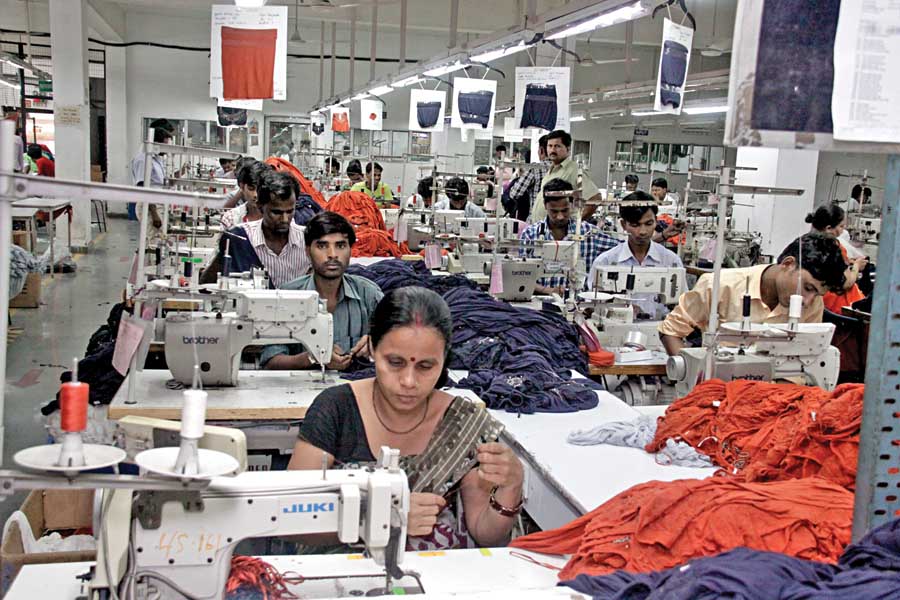
Taking into consideration the type of product that is being manufactured by the company, it is exemplary to see a well-documented and systematized sewing department, working on proper assembly lines, unlike most of the companies which have been working on Make Through Sewing Lines for ages. A complete operations breakdown with the appropriate SAM value of each operation is given to the line in-charge and also communicated to the sewing operators, working on 55% efficiency level. Operations being done by each and every sewing operator are hung on their machines for their perusal. The company only hires trained labour on piece rate, and hence faces a shortage of 5-10%.
Another example of eliminating the wastes of transportation and temporary storage, the hand work lines are setup adjacent to the sewing lines only. Hence as soon as the garments are embroidered they are sent to the sewing lines, without any delay. At the end of the each sewing line there are three compartments, namely rejected, alteration and approved, for giving an idea to the production about the quality and output of a particular sewing line, without asking the line in-charge or the supervisor.
Preparing for growth
A two year journey from US $ 2.50 million to US $ 5.70 million is a successful touchdown; the company has another milestone, set for itself, touching US $ 16 million by 2016. The next agenda for the company besides managing the future growth is to create a strong foundation for sustaining the same through inclusive growth. “Meeting our annual turnover marks year after year adds pressure of performance and increases the chances of chaos, and I don’t want to see a chaos in my organization,” added Amit.
Presently the company manufactures 1,00,000 pieces per month, and 4,000 to 5,000 pieces per style ranging between 25-30 different styles. By next year, plans are to achieve an average of 10,000 pieces per style and the company has recently started working with brands having big volumes per style. “No matter how much styles or pieces you handle, you cannot compromise on timely delivery of the shipment and we are continuously working on the same,” asserted Sanjeev. The company gives a common date to all employees and continuous meetings are conducted to ensure that the delivery happens on or before that date. The date given to the merchandising department for submitting their production file to the production department is also communicated to the fabric, accessories and production department.
While the growth till now has been achieved by total utilization of the in-house capacities coupled with certain amount of outsourcing, Genus Apparels would be setting up a facility with 300 sewing machines, which is expected to be ready later this year with a total investment of US $ 4.34 million. The highlights of this facility would be the LEED certified green factory. “We have well thought out reasons for going green,” informs Amit. The green factory will reduce the operating costs giving the ROI in a year or two only because of the savings enabled due to energy conservation and recycling.
As far as the investment is concerned, the total cost would be 5-6% more than what would be for establishing a normal building, and more than that intangible benefits in terms of brand image and buyer preferences are also there. The company is using fly ash bricks in the building, due to which the in-house temperature will remain 4-50 C lower in summers and significantly warmer in winters.
The upcoming green factory is not a first sustainable initiative by the company. Genus has collaborated with Coolearth to measure its carbon footprint and has already converted all its incandescent lamps to more energy-efficient system, further reducing the electricity consumption. Moreover the company has also replaced all sewing machines with lesser power and thread consuming sewing machines. As a part of the company’s CSR initiatives, it has been supporting the education of under-privileged girls, under the initiative Nanhi Kali. The project has been made possible due to the efforts of K. C. Mahindra Education Trust (KCMET).
For helping its employees maintain a peaceful, healthy, positive and joyous lifestyle, from time to time the company also organizes lectures on cancer awareness by the Indian Cancer Society and meditation camps for its employees.



 Bharat Tex Special Report 2026