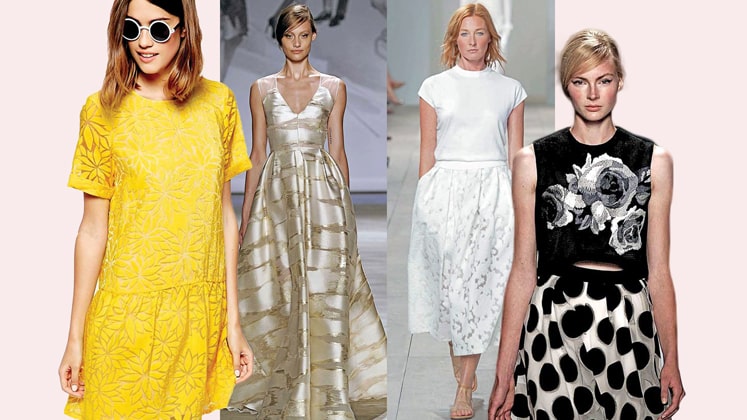
Mimicking the looks of a lace and construction of a jacquard through the medium of print, Brasso/Burnout fabrics have stepped out from the vicinities of the domestic market to enter the runways in a big way. Being an exquisite amalgamation of a 2-D base and a 3-D effect, brasso fabrics have the ability to create a balanced and premeditated depiction of transparency and opacity. Easily obtainable on a rotary machine, brasso fabrics are able to deliver high quality design forms in comparatively cheaper prices. Inspired by its regal, dramatic and sophisticated visual appeal, designers and subsequently exporters have now moved towards incorporating this fabric in their upcoming collections for A/W’15-16…
Being an economical replacement to net appliqués and crochets, brasso started getting noticed as an innovative way of depicting transparency last season. Attained by the process of coating the base fabric with a specific type and amount of chemical, brasso/burnout or devour (as called in the case of velvets) fabric is the result of layers of fibres getting burned to form a design. When the chemical (chosen according to the composition of the base) is applied on the fabric, the composite fibres get burned in the pattern required. The fabric picked is mostly a blend of two different types of fibres, like, rayon/silk, hemp/silk, cotton/poly, etc. therefore the chemical applied reacts and burns only one of the two giving out an interplay of see-through and obscure.
Being almost negligible in the last few seasons, suddenly exports and buying houses have been noticing the growth of brasso in the upcoming season. Joyline, a buying house dealing with brands like Dunnes, River Island, Zero, M&Co, Penneys and Primark, has been receiving enquiries about using brasso fabrics in the A/W collections. “We are in the process of sampling for A/W’15-16 season, and till now, all the mood boards we have come across, have one thing in common in terms of fabric options – burnout. As the season is moving away from crochets to find a better replacement in terms of cost, burnout is the technique to look out for, along with brilliant aesthetics”, says Shalini Singh, Assistant Merchandiser, Joyline.
Tweaking the basic brasso technique to suit their collections, designers surfaced a wide range of garments in magnificent interpretations. Getting mixed with other surface ornamentations, brasso fabrics were seen as collection staples in the runways of A/W’14-15, Resort’15 and the recently concluded S/S’15. Proudly hosting the presence of burnout in his A/W’14-15 collection, Jason Wu created an illusion of velvet flock over nets. In the S/S’15 collections, Lela Rose, showcased a variety of polka dots and ikat striped motifs in brasso on floor-length dresses and skirts. Michael Kors presented a range of skits in brasso which created the trompe-l’oil effect of embroidery, whereas, Prabal Gurung, showcased dresses, skirts and blouses with an interesting effect of layering amalgamated together in distinct assortments of brasso techniques.


With surface ornamentations, fabric manipulations and digital prints getting popular, print fabric manufacturers are also looking for opportunities to develop styles which no longer keep prints in the back seat, and the boom of brasso fabrics, and its usage by designers has done exactly that. Gaurav Chopra, Owner, RG International, elaborating on the growth of brasso said, “Prints have been ruling the domestic and export markets for a longer period of time now, but the scenario seems to be changing. With 3-D fabric manipulations being pushed to the forefront season on season, prints are taking a back seat and to keep the impact of print still alive, fabric manufacturers are printing brasso fabrics to achieve 3-D effect by changing the application paste on the fabric. We are seeing a massive growth in the burnout segment. All the sarees and dupattas that you see in the domestic fabric hubs like, Chandni Chowk and Gandhi Nagar are 80% developed in brasso effects. Presently, the demand of burnout fabrics is much higher in the domestic segment, but we are noticing a steady growth in the export market as well.”
Brasso technique can not only be produced in large quantities with the use of rotary printers, but smaller quantities and panel wise productions can also take place by screen printing techniques. This is one of the major reasons behind the increase in demand of brasso, as it can not only be used as base fabrics in garments but it can also get integrated in styles as details and trims. “We are mostly catering to Jabong and their collaboration with Rohit Bal. For Rohit Bal, we are developing A/W’14 collection and for Jabong we are working on A/W’15-16 developments. We are not producing entire styles made out of burnout fabrics, instead we are using burnout laces,” shares Anima Singh, Assistant Designer, Sult Exports. As consumers are getting bored of the standard net designs and crochet is definitely an expensive option, brasso as a technique comes to the rescue. “The method of developing laces and fabrics is exactly the same in brasso. As the laces cover only detail parts of the entire garment, we are allowed to take the liberty of experimenting with designs and mixing, which only increases the trim cost to an acceptable level. We incorporate brasso laces in necklines in different shapes,” adds, Anima.
With surface ornamentations, fabric manipulations and digital prints getting popular, print fabric manufacturers are also looking for opportunities to develop styles which no longer keep prints in the back seat, and the boom of brasso fabrics, and its usage by designers has done exactly that.
Amid the growth in demand of the fabric, there are ongoing developments happening in terms of design interventions. Moving ahead of the archetypical floral, triangles, stripes and splatter prints, designs have adapted themselves to suit the market trends. Shalini explaining about the motifs, added, “For womenswear, we are making shorts, bomber jackets and blazers, whereas for kidswear we are assembling a range of dresses and frocks under the Christmas collection. The motifs being used are mostly asymmetric in nature. Now no longer are we witnessing the clichéd intricate floral motifs and even if there is a demand of florals, the design has gone bigger in shape and become naïve. The composition we normally used for developing brasso styles was mostly poly blends, but now we are also using Devore (velvet burnout), jacquards and suedes.”
Brasso already has a number of features that set it apart from other printing techniques, but now exporters have started to experiment brasso fabric by decorating it with other printing and embellishing techniques as well. Abhishek Kochhar, CEO, Diamond Overseas (India), explaining further on the developments said, “We have been developing kimonos in brasso fabrics printed with flowers in silver and golden foil for our buyers. Nowadays, brasso fabrics are not being used as is and the forms on it are highlighted with sequins and beadings to enhance the look of the garment.”