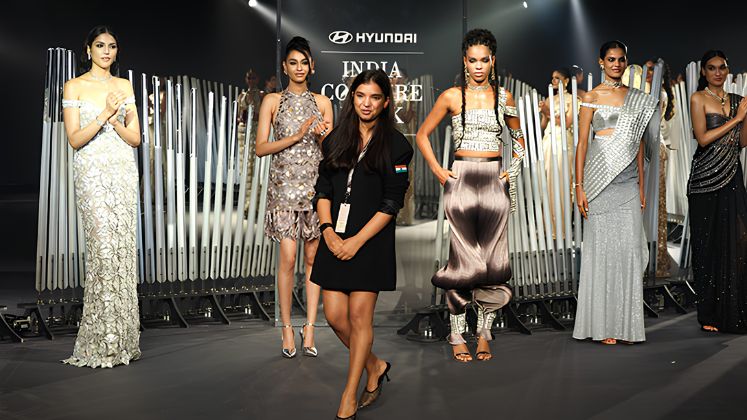
Rimzim Dadu unveiled INLAE at Hyundai India Couture Week 2026, a collection centered on a groundbreaking material innovation inspired by Mother-of-Pearl, or nacre; the iridescent inner layer of oyster, mussel, and abalone shells. Naturally smooth, durable, and luminescent, nacre has long been valued in decorative arts, with freshwater rough shell blanks typically wholesaling for ₹800–₹1,000 per kilogram or piece. Reimagining this inherently rigid material, Dadu transformed its signature sheen into a flexible, textile-like surface, translating the age-old craft of shell inlay into an entirely new fabric language that bridges traditional craftsmanship with contemporary couture.
Rather than treating mother-of-pearl as surface decoration, Dadu reimagined it as the very fabric of the garment, drawing on the craftsmanship of historic Indian jewellery. Months of material research went into developing techniques that let individually cut pieces of mother-of-pearl become part of the textile itself, engineered into grid-like structures that bend with the body instead of against it. These structures were embedded into the label’s signature steel wire textiles and metallic cords, a material vocabulary Dadu has spent years developing.
The collection translated into Dadu’s now-familiar silhouettes of structured sarees, sculptural fringe skirts, cropped bandhgalas and tailored bombers.The palette stayed deliberately restrained, with pearl whites, soft metallics and neutral tones, keeping focus on the surface and the way it caught light.
INLAE reinforces a broader shift towards material R&D in Indian couture. Dadu, who has built her label’s identity on engineering unconventional materials like steel, metal and cord, is an example of how designers are experimenting in converting unconventional materials into wearable textiles
For Indian ateliers competing globally, this signals a maturing craft economy where months-long material development is positioned as intellectual property, not just craftsmanship, a distinction that matters as Indian couture houses look to command premium pricing and recognition alongside international maisons known for proprietary textile innovation.