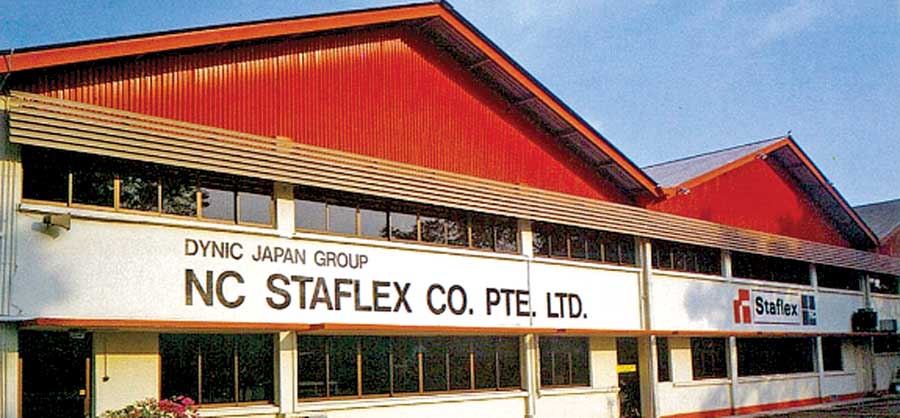
 Having its roots in the first interlining company in the world that manufactured fusible interlining, NC Staflex Co. Pte. Ltd., a subsidiary of Dynic Corporation, Tokyo was established in 1973 in Singapore to serve the needs of the Asian-Pacific region’s garment industry. As a leader in the field of innovation and production of a variety of interlinings, NC Staflex is the only company in the world that manufactures Net Laminated Interlinings. Talking exclusively with Apparel Online, Ernest V Raj, Managing Director, NC Staflex Co. Pte. Ltd. shares the journey of the company and its fresh initiative to capture a larger share of the Indian market.
A stalwart in the interlining business, having worked with Staflex for more than 40 years, Ernest has seen some remarkable changes in the world of interlining as well as the management of the company. Changing with time, the company entered the Singapore market through a JV with Nippon Cloth, a coating specialist, which later changed ownership and became a holding company called Dynic Corporation. Today, there are five Staflex around the world, in America, South Africa, China, Thailand and Singapore. “100 per cent of Staflex Singapore belongs to the Japanese principals and is exporting to 14 countries,” informs Ernest. The company’s basket of products not only includes the most extensive and versatile range of woven and non-woven fusible interlining, but also clothing care labels, thermal transfer ribbons, etc.

Catering to both, powder dot and net laminated coating needs of the industry, the percentage of the company’s business has fluctuated between the two over the years. “Until China came into the market we were doing 80 per cent of powder and 20 per cent of net, as net is more expensive. But when China and slowly India also started producing powder coating, it became very cheap, so we lost our competitive edge,” informs Ernest. This led Staflex to change its strategy by reducing its powder dot coating production and today the company does 90 per cent net laminated coating and only 10 per cent powder, making net its niche product. Due to this, the company’s net laminated coating production capacity has increased from 2,00,000 metres a month to 7,50,000 metres a month from Singapore.
In fact, today Staflex with its monopoly in net laminated interlining is the only interlining company in the world that exports interlining to China. “China manufactures interlining and so do other international brands, but nobody is exporting interlining into China like we do,” asserts Ernest proudly. Staflex’s interlining right from processing the base cloth till powder H.D.P.E and Net H.D.P.E Laminate coating, are done under one roof in its manufacturing unit in Singapore. The company’s interlinings weigh between 20 to 250 grams/sq.m., and come in an array of colours with Azo-free dyes.
“Initially, the company did not make much effort to enter India due to its heavy duty on imported interlining but of late, it has made a fresh thrust and is selling in the Indian market through its Singapore office. That is not to say that the product was unknown, in fact Four Seasons in Mumbai were the first importers of Staflex in India followed by Libas India in Kolkata and many big brands, more than three decades ago. Though our customer base is currently small in India, we have indications that many big brands that use our labels are looking to source from the country now as other manufacturing bases in Asia, slow down. We hope to penetrate into the Indian market with these brands,” states Ernest.
The company has many esteemed buyers; to some it sells with nominations and to some without nominations. Besides that, many garments designed by internationally acclaimed couture’s in Paris, London, New York and Tokyo and garments manufactured in Europe, the USA as well as Asia utilize the wide range of interlining products manufactured by NC Staflex. The company manufactures on specialized machines using a combination of Japanese and English technology and technical know-how. “We recommend flat-bed fusing machines in comparison to roller press as the pressure of the heater is even throughout,” suggests Ernest. To get a quality product, the interlinings produced by the company are subjected to a thorough process of quality control and continuous testing at all stages of production to ensure that the product is of guaranteed performance. The quality control procedures include adhesion, elongation and yield strength tests as well as adverse treatment and shrinkage tests. Though the company boasts of a R&D department in Japan, but all its quality control testing is done in Singapore.
With various technological innovations and quality products, Staflex interlinings have resulted in the elimination of stitch puckering, ease of sewing, shape & stiffness retention, superb air permeability, reduction in production line rejects, above-average production cost savings and increased profitability and presentation of the finished product.
Very upfront on the technical and chemical norms, the company has recently made an investment of US $ 30,000 for laboratory machines and further plans to invest US $ 1.2 million by mid 2015 to improve the in-house dyeing and finishing machines in an attempt to bring down the Formaldehyde limit. With the latest buzz in market of Formaldehyde limit coming down from 75 ppm to 50-60 ppm, the company aims to bring it down further to 35 ppm. “If you aim at 60, you may not achieve it, so you have to go way down in numbers to achieve the 60 mark,” asserts Ernest. The company is in the midst of getting its systems in place to achieve the 35 ppm mark without effecting its current production. In order to achieve this target, Staflex China and Thailand are helping in the production of powder dot and also the preparation of pre-coated base cloth while Staflex Singapore will only concentrate on the production of net laminated and setting up of the new D&F machineries. “If we start this process in November or December, we will be able to go into full commercial production by April 2015. This will be my last major assignment as I am about to retire and handover my responsibility to a successor who is currently being groomed; therefore I am looking forward to it,” concludes Ernest with a satisfied note of having done a sincere job.