Sewing machine manufacturers and solution providers have always been the centre of attraction at the Garment Technology Expo; this time again the fair saw participation from sewing solution providers from all over the world. Covered in the February issue of StitchWorld as a preview of the fair, companies like Duerkopp Adler, PFAFF, Gemsy, Racing, Loiva, Swantex, AMF Reece and Jack showcased sewing machines and automates for the reviving Indian industry, keeping three concerns in sharp focus – the growing domestic market requiring basic value machines; the rising labour wages; and the slowdown of the world market. While some companies showcased product-centric sewing automates for deskilling operations like sleeve setting, darts, pleats and pocket sewing on trousers, button holing, others were present with computerized and energy-efficient version of regular overlock and lockstitch sewing machines. Both the directions are keeping in line the niche product categories of India and upgraded versions of the basic sewing machines for manufacturing basic products.
In terms of the direction of sewing solution in which the Indian industry is going, Karin Kilian, Area Segment Manager Garment, Duerkopp Adler shared, “Automation is no more an option for the country not only for attaining a higher level of quality in the niche products like suits, trousers and shirts, but also to tackle the ever rising cost of energy, labour and other overheads. Endorsing the thought, Anshuman Dash of Loiva Intech added, “People don’t need to go for automation blindly, they need to understand where it is required and why. No point in installing a machine and expecting it to give you the desired output, it’s about application engineering which is required.”
The growth driver for Chinese sewing machine manufacturers in the competitive Indian market has been the focus on automation of overlock and lockstitch sewing machines, along with energy-efficient motors, less oil consumption, less thread consumption and guarantee of unperturbed after-sales service and support. “Gemsy is the first sewing machine manufacturer to offer a two years warranty on all the electronic parts of its sewing machines and automates,” averred Victor Xu of the company’s International Trade Department. Endorsing the direction, Jimmy, Director International Trade, New Jack Sewing Machine Company added, “Instead of engaging in price wars with our competitors our focus is on giving value to the industry in India, that is why we have come up with our line of energy-efficient motors, saving 71%, which is not only more than any of our competitors, but also our previous models.”
Hikari geared for the Indian market with its range of computerized overlock machines
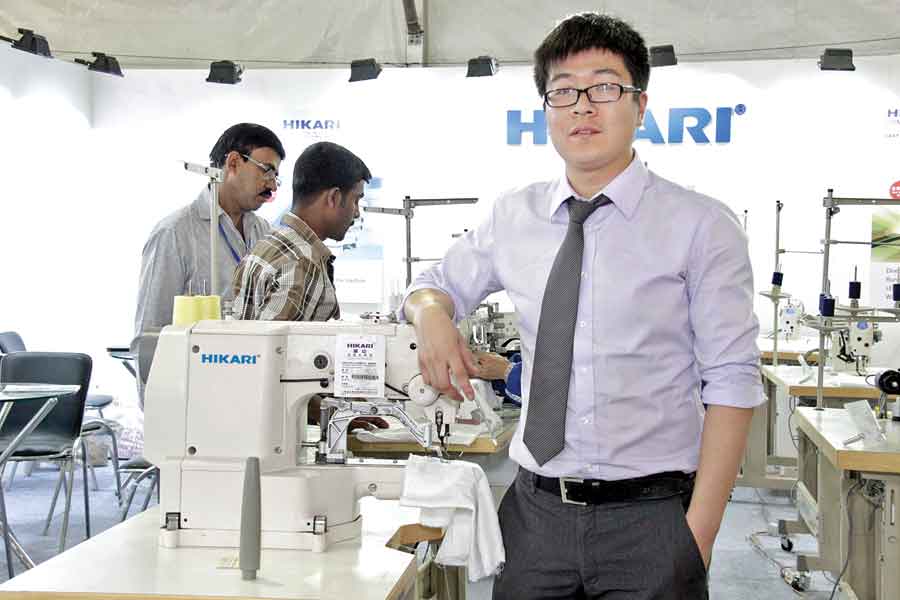
Taiwanese sewing machine manufacturer, Hikari, after earning the title of ‘computerized overlock machine leader’ has entered Indian market with their focus on manufacturers looking for high-end machines. Highlighting the company’s prospects in the Indian market Alex, Regional Manager of International Business Department of the company added, “We have seen that most of the countries around the world are coming out of the slump and we hope the same from India as well. Our technology is widely renowned and we hope it will meet a good response in India as well.”
The computerized overlock machine was introduced by the company in 2007, and by 2012 it had become a symbol of Chinese manufacturing with certification from Chinese Government. Since its inception, the machines have used direct-drives, and have come with sensors. Hikari’s hopes are flying on its most recent innovation, its computerized fully automatic overlock machine – HX6800AK Series. “It increases the productivity from 15-35%, saves power up to 60%, as well as makes the stitching work much easier and saves lot of sewing thread also,” said Alex proudly. The HX6800AK computerized overlock sewing machines was the highlight of Hikari’s varied showcase at the fair. Equipped with automatic features like RUN/STOP, presser foot lifting, thread cutting, suction, puller device, safety device and LED lights, the machine enables production improvement and reduces the working load.
The company is looking for some local partners who are in touch with the ground realities. Meanwhile, the service is being looked after by the principle itself. The idea of service sitting in China might sound unfeasible, but Alex reassures, “Service is the real strength of a Hikari machine, even at the cost of flying in from China to service it. We even train the manufacturer’s operators on how to use and service it. We also leave some spare parts as inventory, to use as replacement if the need arises.”
Indian market seemingly good for Highlead…; expects growth with agent HCA
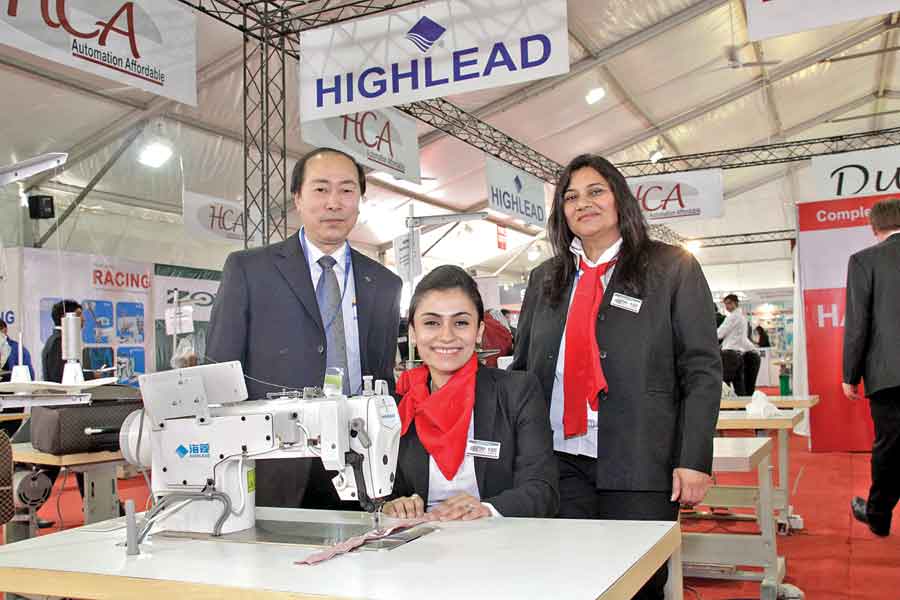
Manufacturing sewing technologies for a wide range of sewn products, Highlead has a strong presence in India for a long time.“Manufacturers in India are slowly increasing their demand for special sewing machines with special features like thread wiper, trimmer, bartack, etc.,” said Xueqin Xu, Manager, International Trade Department, Highlead.
One can see a growing range of products from Highlead starting from single needle under bed trimmer, heavy duty sewing machines with walking foot, top and bottom feed and high speed, cylinder arm heavy duty machines and chainstitch range of machines.
Fully understanding that the companies are focussing on quality aspect of the product more than the price, Highlead has designed its machine GC 1918-MD2 with powerful built-in servo motor for direct-drive with features such as low noise, low vibration and low power consumption. Its special top variable feeding mechanism enables the machine to adjust top feeding amount for equal top and bottom feeding. With functions of auto trimming, auto needle positioning, auto stitch pre-setting and auto presser foot lifting, the machine is suitable for performing shirring and decorative stitch on garments.
The company feels that the Indian market is still not fully prepared to adopt automated machines, although the transition is in progress, but it will take its time. At present the company is focusing on semi-automatic machines. Not that it does not have fully automated products in its portfolio, as the most advanced level of machines from Highlead are used in manufacturing parachutes and suits for astronauts in NASA.
The company is looking at the ‘basics’ segment for growth as it believes that the demand for basic items will always remain, even if there is a slowdown.
Perfect sewing machines for knitwear from Yamato

Upholding Japanese equality, Yamato had been successful in establishing itself as a leading sewing solution providers, carving a niche in sewing knits. Like any other company in the market, the last two years have been tough for the quality machine manufacturers, however the scenario is changing. Yoshihito Maeda, Managing Director, Yamato expressing his optimism said, “Tirupur, which is our biggest market in the country, had been hit by many issues for the last two years. But now the scenario is improving, and the Tirupur industry is standing back on its feet.” The Japanese stalwart received a very good response at the recently concluded GTE.
Yamato’s niche as a sewing manufacturer for knits is the focus on productivity and efficiency of operations rather than the production only. “See, as of now due to the complacent market conditions, the companies are not expanding here, rather the focus has shifted towards improving the productivity and efficiency instead of the production… Wherein we are totally equipped to do the same,” added Maeda. He further said that productivity is the key selling point for a machine in India as that is the only way India can compete with the competition from cheap labour in Bangladesh and quality product in Sri Lanka.
Explaining why the company’s technologies are widely accepted in India, Harish Paliwal, Branch Manager, Yamato added, “If we talk about R&D we don’t innovate on our own whims and fancies, rather we work with knitwear manufacturers from all over the world, in developing machines suitable for their use. That is why our machines are actually perfect for sewing all kinds of knits.”
Yamato’s VT2500, exhibited at the fair, is a feed-of-the-arm interlock machine for sewing heavy weight materials with automatic thread trimmer. The high-lift needle bar mechanism and ideal stitch formation enables smooth feeding for wide range of materials, without having stuck by cross seam with fleece or tunnel seam with single jersey. The vibration free driving mechanism eliminates operator’s fatigue.
Loiva surging ahead with focus on suitable automation for reviving industry

With a USP of providing not sewing machines rather sewing solutions to the apparel industry Loiva has gradually gained a place among the most preferred machine suppliers and manufacturers of the country. The type of machines by Loiva are specialized and automated work stations for deskilling any or the other critical sewing operation, irrespective of the apparel. Loiva Intech, the Indian wing of the Korean pioneer, offers Single Needle Lockstitch machine with Autojig for Making Collar and Cuff (MJ-3400/LV-3500), ST-10 Button Wrapping & Knotting machine, ST-12 Fully Programmable Button Feeder Attachment and LV-6200 Single Needle Lockstitch machine for Hidden/Ditch Stitch.
Adding to the ongoing debate and thrust towards automation in the apparel industry, Anshuman Dash of Loiva Intech added, “Companies do not need to go for automation blindly, they need to understand where it is required and why. No point in installing a machine and expecting it to give you the desired output, it’s about application engineering which is required from machine suppliers today.” He also advices not to go for cheaper automation, rather work out a Return-On-Investment plan with their supplier.
Specializing in sewing collar, flap, shoulder tab, cuff, collar band joining, fly piece making, lapel making, curved waistband and other similar operations, the MJ-3400 Autojig machine from the company, has been specifically developed for corner and curved edge sewing operations. Sewing at the high speed of 3000 RPM, the machine has been designed in such a way that a cycle time of the operation is minimized by using powerful stepping motors and pneumatic systems controlled by the micro processors. The jig is driven by side disk and back puller attached to the two different powerful stepping motors synchronized with each other and controlled digitally. Also the machine is with two different presser foots one with bearing to help in moving the jig with a holding presser on top of the jig. The second presser foot flows air to flatten the fabric towards knife while in operation, which results in smooth cutting and even less margin.



 Bharat Tex Special Report 2026