The crucial sewing production data is the backbone of line balancing, but calculating data on a sewing floor is an arduous task. Traditional manual job ticket or recording systems cannot produce critical production-related data on time. Manual data collection is also laborious and error prone. A Real Time Data Collection System is a mechanism for complete control of the apparel manufacturing unit. It operates on the basis of putting the emphasis of all information collection systems where it matters, at the needlepoint, Team StitchWorld makes a study.
‘Real time’, ‘Online’, ‘Live-feed’ and ‘Continuous’ are different terminologies used in collecting data from the sewing floor. Although real time data collection is an integrated part of all UPS enabled by automated overhea material handling systems, progressive bundle system of work generally depends on manual data collection by supervisor or other designated staff. Manual data collection is basically a batch process; data is collected from all sewing operators in a line either from bundle ticket record sheet or any other form of record maintenance with every sewing operator. Whether data is collected by bar code scanner or simply noting down by pen and pencil, collection of individual production figures (in terms of number of pieces completed) from a sewing line of 30 machines may take 15-20 minutes.
What Data is collected? At what Frequency it is collected? Why Data is collected?
Number of pieces stitched by individual operator in any particular operation is generally collected along with style number and lot number. This production data is collected twice a day (during lunch time and during end of shift), every two hours or on an hourly basis. Data is collected primarily for three reasons: first, record keeping; second, for calculating payment of operators in a piece rate incentivized environment; and third, for dynamically balancing the line. If data is collected for record keeping or payment calculation, then manual data collection is ok; however, if the purpose is for some corrective action to be taken like dynamic line balance, then manual data collection (batch data collection) is ineffective and may give wrong results.
What are the Problems in Manual Data collection?

As operators are continuously working, if production figure from first operator in the line is collected at 9:00 am, by the time production figure of last operator in the line is collected it is already 9:20 am. After data collection, the same has to be analysed (may be through computer) and corrective action decided upon, which takes some more time. So by the time data is analysed and one is ready to take corrective action, it is already 9:40 am. Thus the data upon which action is going to be taken is already incorrect as the production and WIP figure collected from first and last operator are time-lapsed by 20 minutes; secondly time taken between data collection and action taken is another 20 minutes time lapse, while in reality the actual WIP between operations and production by individual operator has changed during this time and therefore corrective action will be outdated as the data collected is already with the elapsed timings. In fact, using the corrective action devised based on the collected data would have transformed into a major blunder.
Why Real Time Data?
It is a continuous method of data collection so that there is zero or negligible time lapse between data collection and corrective action taken, which is basically changing operator allocation from one operation to another to balance the line better. When the data collection was manual, corrective action could be taken only either at the end of the shift, during lunch break or next day. Also time consuming analyses restricted people to collect limited amount of data for processing. However, now once the data is keyed into the computer, varied analyses is possible through spread sheet either for individual operator or for the complete line like efficiency, performance, off-standard time, on-standard time, utilization, etc. (for more details see SW February 2006 issue). Therefore, there is a tendency for managers to collect continuous data from line, analyse them instantly and take corrective action at the earliest.
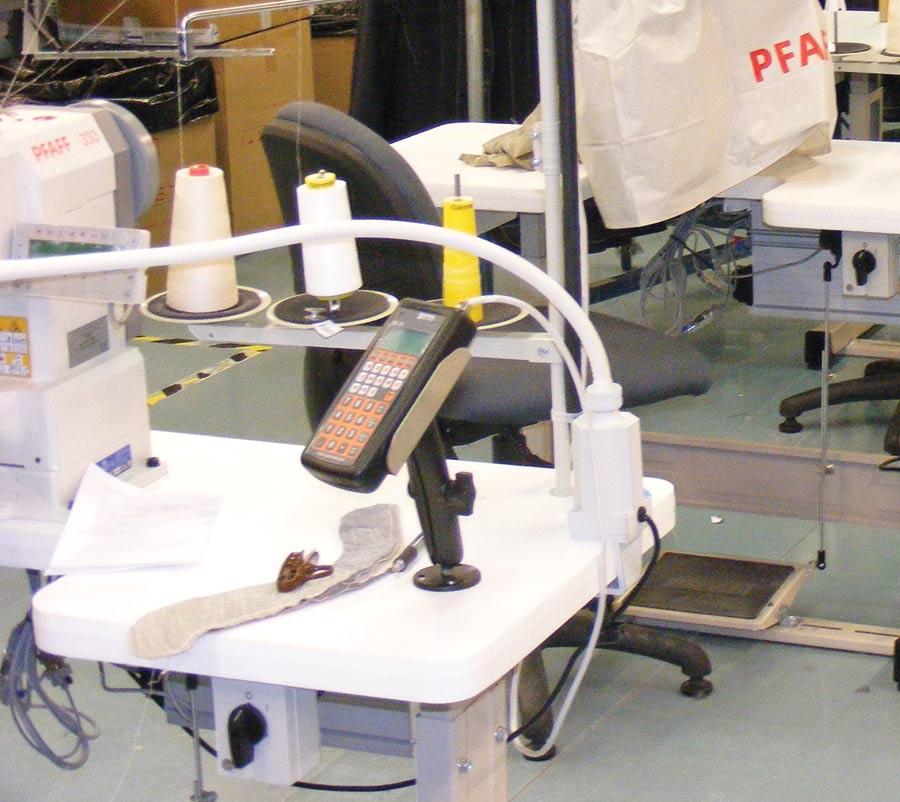
With advancement in technology, data collection method has also improved, bar code scanner, Dallas chip and now RFID have made continuous data collection possible. There are different philosophies of data collection from individual operators; first is voluntary or mandatory disclosure by an operator; and second is automated capture from sewing machine. Initial solution providers used to follow disclosure philosophy, where every operator is provided with one electronic key pad and after completing every piece, the operator was required to press one button which automatically updates the number of pieces produced. In this process, the operator has options to meddle with the system by pressing the button twice or not pressing at all. Overhead material handling system works with mandatory disclosure philosophy, where after completing one piece the operator calls for next piece (by actuating some device), the earlier piece production will be automatically recorded.
All this recordings are mapped against time period to calculate different parameters like performance, efficiency, etc. However, there are problems like machine breakdown and shortage of supply which used to affect the performance parameters.
Developments in the above system followed where operators can actuate different buttons for different problems and that is how off-standard and other parameters were calculated. The voluntary and mandatory disclosure philosophy requires operators to report correctly. It was noticed that production pressure made the operators sometimes follow fraudulent means of misreporting thereby augmenting payment. (For example operators would report machine breakdown, when in fact they were working slowly). This necessitated collection of data directly from the sewing machine. Maximum solution providers today use disclosure philosophy with varying degrees of foolproofing to avoid cheating by operators. The automated data collection technology is still in prototype stage and commercial offerings are awaited.
Advantages of Real Time Data Collection System
It enables single entry point for WIP and piecework payroll through shop floor data capture, that facilitates on-screen enquiries like WIP summary, lagging bundles, etc. It also generates management reports on cut exceptions, attended minutes, down time, SMS, on and off standard, earned pay, off-standard pay, overtime premium WIP in/through operation, WIP in/through department, on-screen graphs of work in progress, in fact, virtually a complete transaction audit trail. By collecting critical performance data directly from the operator, data is transformed into information in real-time, allowing management to optimize manufacturing operations and improve overall throughput time.
Any Real Time System will ensure:
• Gains in operational efficiency, overall productivity and profitability due to the newly achieved process transparency which helps in identifying the bottlenecks and defects in the existing system. This further helps in devising effective error-control mechanisms.
• Improvement in each operator and sewing lines morale as when the piecework is calculated timely and accurately, the payroll and incentives would also be 100% error free.
• Access to daily, weekly, year to date, performance reporting and detailed ‘excess’ cost reporting by: off standard code, line, department, shift and supervisor (section), and individual employee.
• Online WIP Tracking, which provides management with real time work-in-process tracking and reporting without the expense of a real time system, and the ability to process cuts through the factory at optimal efficiency while achieving the lowest possible cost.
• Production Planning tools to manage an apparel manufacturing facility effectively and maximize the plant’s capacity utilization, at the lowest possible cost.
• Access to current and historical time and attendance data by Reason; Employee and Supervisor.
• The ability to work in batch or real time whether it’s piecework, modular or both at the same time.