There have been continuous technology upgradations in machinery and equipments aiming for productivity improvement, quality consistency as well as newer benchmarks towards human safety and environment friendliness, the working mechanism of machines remain more or less same, barring a few operations, the human intervention also remains the same giving no incentive to the workers to continue to work with the industry.
What is needed today is revolutionary developments and automation. To understand the direction of change, it is important to evaluate the small and big developments, inventions or series of inventions behind a commercialized technology for the effort and directions. Often, these inventions are patented. Patents necessitate a greater and deeper understanding of the usable and possible technologies that can be commercialized and also the future course of action.

A series of articles on Advancements in Garment Technology is an effort to highlight the technological upgradations by means of patents and unlocking the mechanisms involved.
In the second article of this series, authors Manoj Tiwari, Assistant Professor, NIFT, Gandhinagar and Dr. Prabir Jana, Professor, NIFT, Delhi have discussed patents in Automatic Button Wrapping Technology.
Button wrapping was a common process of wrapping the strands of threads at the end while sewing button by hand. However, machine sewing of buttons for shirts and blouses generally ends without wrapping, where button stem forming is not felt mandatory. On the other hand, for garments like suits, blazers, and casual trousers, especially with eyelet buttonholes, stem forming after button attach is necessary. Earlier button wrapping was achieved by the same button sewing machine at the end of button sewing operation by clamping the button transversely.
There have been continuous efforts put in this direction to reinforce/securing the buttons in the garments by means of wrapping and knotting. With the advancement of technology, manual button attaching and wrapping has reached to automatic button attach and wrapping. The latter one is obviously faster, more productive and almost error free, giving a guaranteed quality product, whereas the manual one is a slow, inconsistent and insecure method that gives bad and bulgy finish at the back side of fabric, which may be uncomfortable to the skin of the wearer.
Since ages buttons and shanks have been attached manually and for securing the same, manual wrapping and knotting is done followed by manual thread trimming. But this is feasible only for domestic uses (household purpose) where one needs to attach lesser quantities. For bulk production, automatic devices need to be used while keeping the fundamental concept intact.
There are some important points that need to be considered in button wrapping-
1. The method or way of stem wrapping to secure the button.
2. Only winding, or winding and knotting the thread
3. The method of thread cutting after the task is over.
Charles J. Sibbald from USA got the patent (US Patent No. 2013449) in 1935 for button winding machine; this was probably one of the first patents in this area. In this patent, neck formation between the button and the fabric was proposed for winding of thread to secure the button. In the invention the device was developed to tie the free end of thread on the work, do wrapping of thread and neck formation, and fasten the thread after the task is over. The patent suggested the ways to automate the winding and neck formation, prior to this the buttons were attached first to the fabric and a space was purposely left between the underside of the button and the fabric on which button is attached, and later the securing of the button was used to done by winding on the neck manually by hand. This leads to inconsistency and the quality issues while securing the button.
A decade later, in 1945, a patent (US Patent No. 2391378) for button winding machine was awarded to S. W. Avis of Reece Button Hole Machine Company, Boston. The invention was primarily focused for wrapping shank and buttons of varying sizes. At the beginning of the operation the winding thread is passed through the fabric on which button is going to be attached, wherein a thread loop left behind by the needle is firmly held under the fabric. The thread passing from the needle makes inner and outer windings through the up and down movement, respectively. At the end, while going under the fabric the needle thread pulls and ties down the thread loop. The free ends of the winding end are inserted underneath the fabric, which prevents fraying of the thread. This invention was aimed to rectify the defect of piling up or gathering the windings at one place only (as the windings were not able to move along the shank) from the previously developed devices. The invention provided few key improvements like uniform windings along the length, securing free ends of winding thread under the fabric to prevent fraying, capable of variations in number of windings as required.
In 1981, PFAFF got the patent (US Patent No. 4296697) for sewing machine with a work holder for wrapping button shanks. In this arrangement a holder for shank with adjustable length for a variety of shank loops was fitted with one auto thread trimmer.
Two U-shaped strips are attached to the work piece, which works as holding elements for button and the fabric at a desired distance. The gap (web portion of shank) between these strips is kept precisely under the needle. These U-shaped strips (Figure 1) with help of a lever which is pivoted at its fulcrum and connected to the double lever, provides further reciprocating movement to the spreader. When the sewing machine is started, work holder reciprocates and needle works in close proximity to the fabric in the beginning and then advances to the button and so on and the last stitches are made nearer to the fabric.
In 1991, Andre J. Schaerer got patent (US Patent No. 5082151) from Allgemeine Synthetische Gessellschaft Establissement for method and apparatus for winding round the stem of the button sewn on the fabric. In this method an elastomeric winding thread is wrapped at right angle on the bundle of sewing thread between the fabric and button. This gives strong winding with minimum stem thickness. The device is simple in function and can be easily hand operated.
Under this technology, winding the button stem is done by an elastomeric winding thread under tension on to the thread bundle formed by sewing thread between button and the cloth. Once the wrapping is done, the winding thread (original diameter of approx. 0.2 mm with 500% elongation) is pulled at right angle beyond its yield point, this pulling reduces (reduced diameter 0.04 mm) the end diameter of the winding thread, and it gets fixed firmly in the previously placed coil turns.
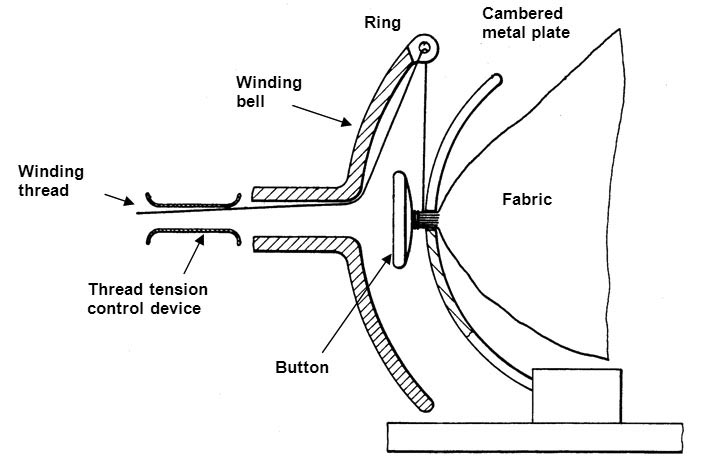
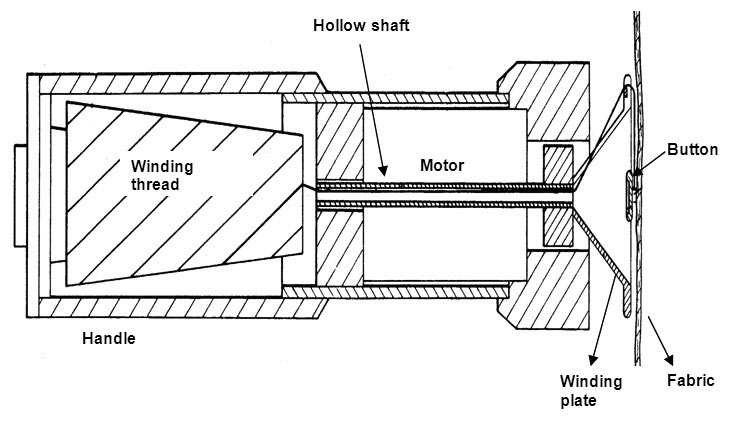
The Figure 2 shows the hand operated apparatus which comprises a winding bell for thread winding, a motor for winding bell, a hollow shaft as winding thread passage, a thread tensioning device and a winding thread package. The apparatus (as shown in Figure 3) can be made handy by arranging an electric motor preferably a DC motor of low voltage, winding bell and the winding thread package are arranged coaxially, and outer cover of winding thread is used as handle.
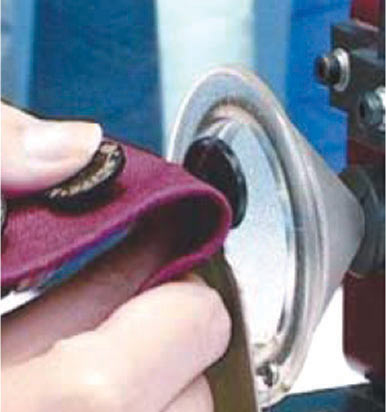
To hold button, a cambered metal plate (as shown in Figure 4) having a V-shape slot, is fixed on an apparatus. This apparatus can be moved forward and backward as required. After fixing the button in the slot of cambered plate, the winding thread is passed through the hollow shaft via a thread tensioning device. After passing out from the hollow shaft, the winding thread is passed through a ring on the edge of the winding bell and loosely inserted in the slot plate. The free end of the winding thread is pressed by the finger on the fabric. Maintaining the centre position of the button, the motor is switched on to get the desired winding thread turns.

In 1993, there was a revolutionary invention which proved to be a significant advancement by eliminating the movements of cams and ROM (Read Only Memory) in button attaching and wrapping. The patent (US Patent No. 5092256) was awarded to Yamato, Japan for the same. It was one of the first efforts to make the operation automatic and electronically controlled. Conventionally the electric sewing machines developed earlier were controlled by cams and programmable ROM which were capable of doing some limited functions. A large quantity of ROM is required, if there are variations in button sewing patterns, kind of buttons as well as the type of materials going to be used. Programming such various combinations of ROM is a cumbersome and time consuming task, adding to it if there is new pattern then the older ROM needs to be replaced with the new one which has its own practical limitation. Furthermore if one needs to change the number of turns for wrapping in a conventional method, cams and other mechanical parts need to be changed. This only adds to cost in terms of labour and time wastages.

In this invention specific data of button sewing patterns are fed to a control unit and steeping motors instead of cams as in conventional machines, reciprocates the table to facilitate different sewing patterns. The CPU (Central Processing Unit) reads the X-Y signals via I/O (Input/Output) port and determines the direction for the table movements. Then signals are sent to the step motor through I/O port and motor get actuated resulting in X-Y table movements as required. For wrapping, the button which is attached to the fabric is moved to the reciprocating needle so that the middle portion or the outside of neck thread is wrapped with thread during this reciprocating movement. Once the wrapping is over, the free end of wrap thread is inserted in the middle portion to prevent fraying.
Uk Jae Lee developed the apparatus for winding round the stem of the button and granted patent (US patent No. 6029867) in 2000. In fact this invention suggested the solution for the problem of frequent thread breakage while operating the machine at faster speed faced in the device for which patent (US patent No. 5082151) was granted. In the earlier patented technology, the winding thread coming from the package gets recoiled and drawn while the tensile force decreases, so during the winding operation at high speed the thread was frequently cut off. The frequent thread breakages led to inefficiencies and quality issues in the button wrapping. This invention comprises a bobbin supplying the winding thread smoothly and capable of rotating on its own axis in accordance with winding and drawing force of the thread without any coiling.
The apparatus for the winding round of the stem comprises a bobbin supporting device with a bobbin supporting member for the bobbin to rotate on its own axis to the unloosening direction of the thread in accordance with winding and drawing force of the thread and a thread guide is placed to the loosening direction of the thread.
Another interesting and simple device named as Button Shank Wrapping Machine was applied for patent (US Patent No. 6257295) by Mason Simon Small in 2001. Wrapping a shank is also known as whipping the shank. Here in this invention the button whipping or wrapping device consists of a support (whipping plate having a slot to hold the shank button) on the machine to hold the button; a winding device rotates thread supplied from a thread package with help of a thread outlet ( a crank tube carrying thread) by controlling the winding tension using a tensioner. During the winding operation the free end of the winding thread is held by a catching element. Once the winding is over fusing of winding thread is done by using a heat fusing or by applying a bonding agent.
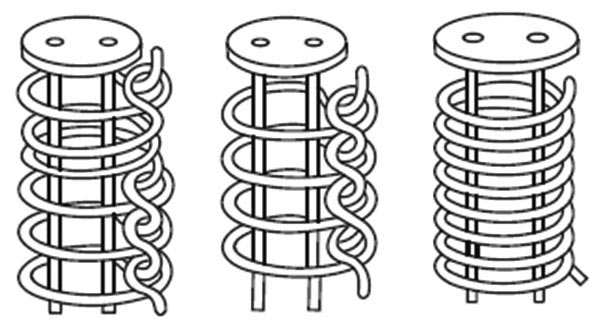
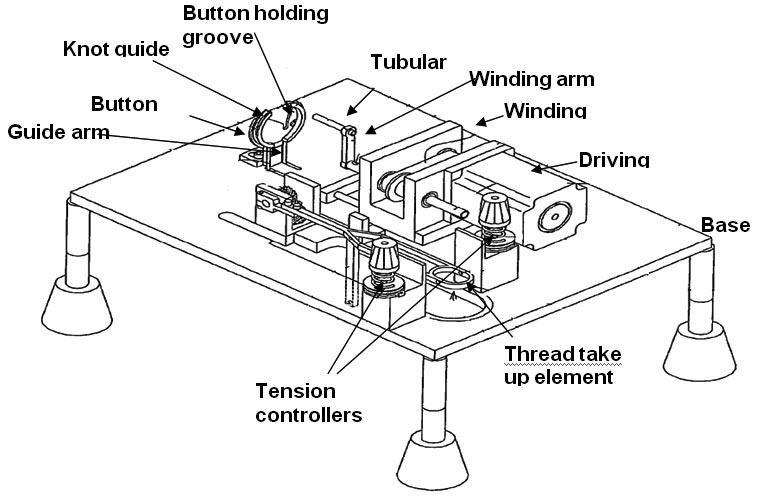
In 2009, Myung-won Seo from South Korea got the patent (US Patent No. 7488011) for Myung Jin S.M. Co. Ltd. for Button wrapping and knotting method and apparatus. The thread which is used for knotting is twisted for at least two times then passes over with the help of guides and winds around the sewing thread and forms firm knots (see Figure 5).
In this mechanism, winding and knotting the thread around sewing thread involves few steps. First is fixing one end of the thread to the sewing thread of the button, and extending it around the button; secondly, further extending the thread to wind 1-2 times around the sewing thread of the button; thirdly, allowing the circular portion of the thread to pass over the sewing thread; and lastly, forming a double twisted knot of the thread by drawing of the other end of the thread.
A similar kind of mechanism is used in LOIVA and AMF Reece’s BSW Automatic Wrapping & Knotting Machine, for knotting the thread, microprocessor controlled individual arms with servo motor make needle free knotting.
Figure 6, shows the perspective view of a apparatus for automatic wrapping & knotting a thread around the sewing thread of the button. A button holding element with a V-shaped groove is fixed on the base. In front of the button holding element a knot guiding with 2 guide arms forming a circle, is fitted for guiding the thread, so that the knot forming thread passing over the button can be held. A winding element consists of a conveying stand capable of to and fro motion towards the button holding element.
The arc shaped ends of the guide arms of the knot guiding face each other in such a way that it makes a circle. The tubular part of the winding element is placed above the sewing thread of the button so that the thread can wind around the sewing thread of the button by the rotation of this tubular part. The drive to the winding arm is provided by the control of the controller (Servo control in case of LOIVA and AMF Reece BSW). After a few predetermined turns the winding operation is over and winding element stops at the backward position. The thread take up fitted on the base for straining the thread when the thread passes over the sewing thread of the button.