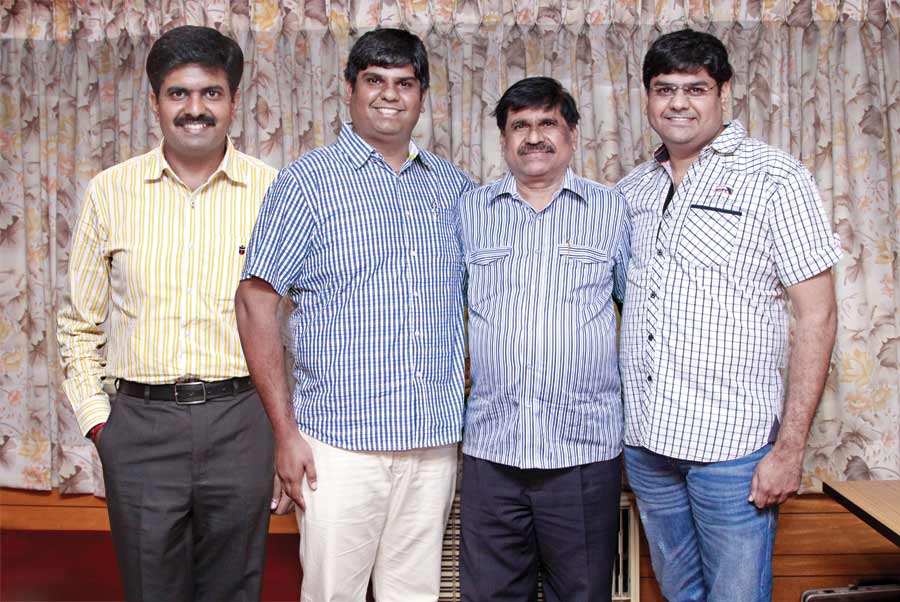
From a humble beginning in a small town of Tamil Nadu to being one of India’s leading technology providers with 17 inland, 2 overseas branch offices and over 400 dedicated dealers, Mehala Machines has come a long way. Today the Founder C. Subramaniam is a respected name in the garment industry, and with his three sons Carthic, Dharani and Bharath now fully involved in the business, Mehala Machines is consolidating on its strengths and working towards a better system-driven organization with a focus on customer service. To implement processes & systems and to take the company to the next level of growth with professionalism, Mehala hired a CEO, Ashim Das who has a chequered background having worked for MNCs in India and overseas. Integral to the growth strategy of the company is the basic desire to ‘take care of its people’ and run the organization professionally. “One of our biggest strengths and also differentiator has been our core team with many people having very long stints with us, taking pride in what we have achieved and also striving to meet evolving industry needs with a sense of ownership,” says C. Subramaniam, Chairman, Mehala Machines. In a freewheeling interaction with the ‘sons’ responsible to take the company up the next growth projectile, Apparel Online discovers the passion which drives the company…

The first thing that hits one when meeting the ‘GenNext’ at Mehala is the utter pride in the culture of the company they have inherited. “The Chairman has always believed in depending on professionals and putting them at a leadership position, this is a legacy we intend to continue and even though we brothers have joined the business, it does not mean that the complete decision making think tank is with the core family group,” reiterates Carthic, the eldest of the three and also the most experienced. The division of roles is well defined and all three are handling what best suits their temperament and education. While Carthic provides strategy, backend support and valuable inputs for growth, Dharani, a doctor by education, is managing the key responsibilities of Finance and Administration. Bharath, an IT engineer, is looking into the IT and marketing needs of the company. The day-to-day functioning of the various divisions of the group is in the hands of professionals who are competent in their area of expertise.
Carthic categorically states that “people can look forward to an exciting career here as there are many people who have joined the company as a small office assistant and have grown to become senior leaders. We have a Director of the company, who started off as a supervisor and another that started as a technician and is now an all-India Head for a product line and so on.” The company not only invests in best of the talent but also puts in great efforts to train and make them future leaders to be ready to face the industry. In fact, one of the vital lessons that the Chairman learnt in his formative years was to be patient with customers and never talk back even if he is wrong. “Our technicians are so sound in their area that sometimes when they know the customer is wrong, they are tempted to argue on points, but we have groomed them to listen and give proper replies that will satisfy the customer, making him a client for life,” says Dharani. This is indeed a unique approach, as most only train their marketing teams’ social skills to get business. New recruits are trained at various branches in different disciplines to understand their core strengths and accordingly positioned.
The emphasis on training and retaining people is obvious from the fact that even when the global recession was at its peak in 2008-09 and many of the technology providers were cutting down on staff and pay packages, Mehala chose to enhance the packages and spend the time in upscaling its training levels, hiring HR companies to teach sales, service and technicians ‘how to handle customers’. “It was important to instil confidence in our people and to believe in our strengths, so we took time off to retrospect and build the company,” says Carthic. He adds that “the way we treat, our people also find reflection in how the industries perceive us as business partners.”
Starting their journey as a ‘repair shop’ for sewing machines in the mid 1970’s, the technical service side of the business has remained till date one of the core specialties of Mehala. No other technology provider can claim to have such a strong technical team that can not only repair machines that they sell, but bring to life machines of any make and series, by practically re-inventing the machine with self-made critical parts. The unique workshop of Mehala in Tirupur is awe-inspiring and the service team headed by R. Selvan, Technical Director, who has been associated with the company for more than two decades, is in constant contact with the industry to understand the changing technical needs. While smaller workshops are operational at all the regional offices, the Tirupur workshop is the nerve centre and all difficult cases are sent here for repair. Each technician is handpicked and trained at the Tirupur headquarters and then sent to other service centres around the country.
Though there was a time initially when the company was not associated with the best brands, but yet based on their high level of after-sales service and goodwill in the market, which spelt ‘trust’, they were the highest selling company in sewing machines in terms of volumes (numbers). Today, not only are they a trusted name, but they also have in their profile some of the best and enviable brands in the global market, with Siruba being their first flagship brand. Duerkopp Adler, Topcut Bullmer, Macpi, Pfaff, INA are only some of the big brands working exclusively in India through Mehala. With this wide range of product offerings, the company is capable of giving complete solutions in setting up a factory and through its consulting division, is supporting the industry on all aspects from layout to machine selection to training of workers. “We don’t look upon the consulting division as a separate entity, it is an extension of our service commitment,” says N. P. Elango, Director Marketing.
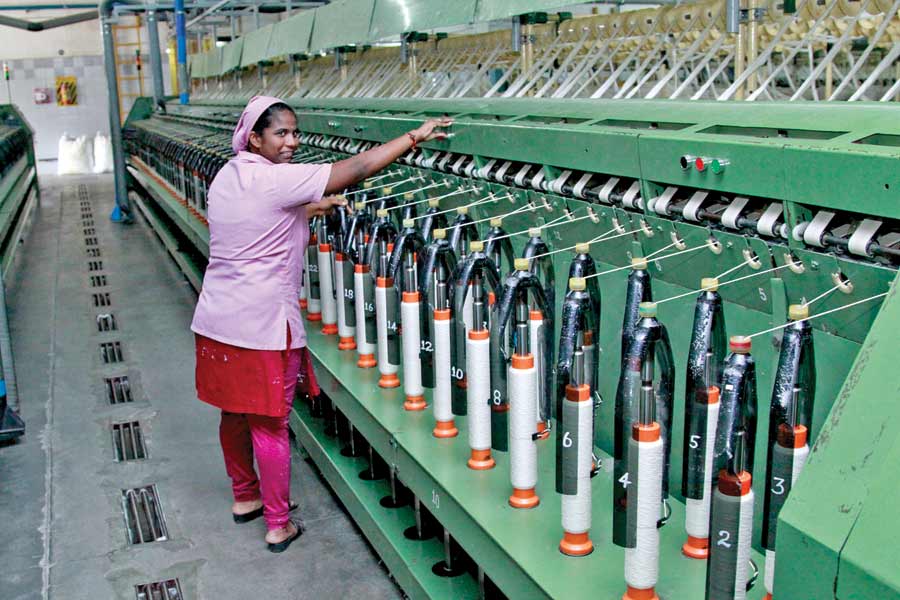
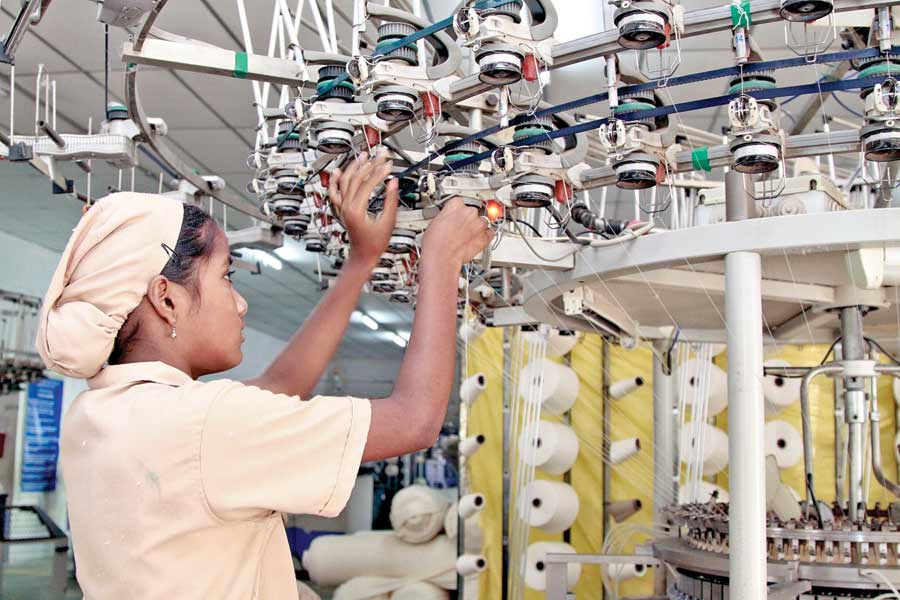
An entrepreneur at heart, Subramaniam diversified the business, setting up the first modern spinning mill in Gobichettipalayam about 32 km from Tirupur in 1996, as the Government of Tamil Nadu was giving incentives to put up spinning mills to generate employment. Today, two units are running round the clock with installed capacity of more than 80,000 spindles. The venture has stood the test of time and has over the years produced yarn in various counts and some knitting has been added to offer grey fabric to the knitwear industry in Tirupur.
The company has forayed into many other businesses including foundry, auto component manufacturing unit and Medical Diagnostics Centres which include radiology, pathology, etc. during the times when the textile industry was in a turmoil.“The revival of the garment industry in 2014 has shifted the focus back on our core garmenting technology business,” admits Bharath. The strategy today is to concentrate on consolidating the position of Mehala as a technology provider for the apparel manufacturing and leather products manufacturing industries. To give wings to the strategy, a new corporate office is coming up in Tirupur which will house the sales, service and a world class workshop, bringing all the core business divisions under one roof.
The team is very excited with the opportunities that are coming up with the revival of the international market and also the strengthening of the domestic manufacturing. “In the last few years, a large part of our business has come from the domestic market, as they upgrade, and that has helped us to also get access to all segments of manufacturing and service the high-end automation market as well as the low end price-sensitive local market,” informs Bharath. For those companies which cannot afford machines of European make, Mehala is offering its in-house brand Orbito sourced through their Singapore office. Though, like many other technology providers, Mehala is also keen to setup a manufacturing unit, but Carthic honestly admits that in the current scenario it is unviable. “There are no ancillary units that can support the industry, if all parts have to be imported then it is better to assemble (manufacture) the machines in another country,” argues Carthic, suggesting that the Maruti model of developing business, wherein the Government created the complete chain before starting production could be replicated.
Going into the future, the company is looking to improve upon its service levels and have even been in talks with many banks to start financing schemes, but as yet no bank is willing to take the plunge. “Historically, credit facilities is a way of business in this trade, but if we could make it more regularized and less risky it would be beneficial to both the customers and us,” says Dharani.
The second focus, which is Bharath’s domain, is to bring the entire Mehala network under a robust ERP system for better management, though a large part of the business is already being monitored online, the effort is to keep upgrading and improving the systems. “We initially had resistance from the staff as it was a new way of working, but now things are settling in and I am looking to make the system more robust and user-friendly,” shares Bharath, who admits that there is still a huge scope for improvement.
While continuously adding new brands the focus is on not only sewing machines, but on technologies for each division of the apparel manufacturing and leather products manufacturing industries, from cutting room to finishing. The vision today is to get into specialized machines for future needs, like technical textiles. “Twenty years ago the goal was to be known, then it was to be the largest distributors of sewing machines, which was fulfilled in 2003, now the vision is to provide high-tech machines and eventually get into training for handling these highly specialized machines,” concludes Ashim Das.