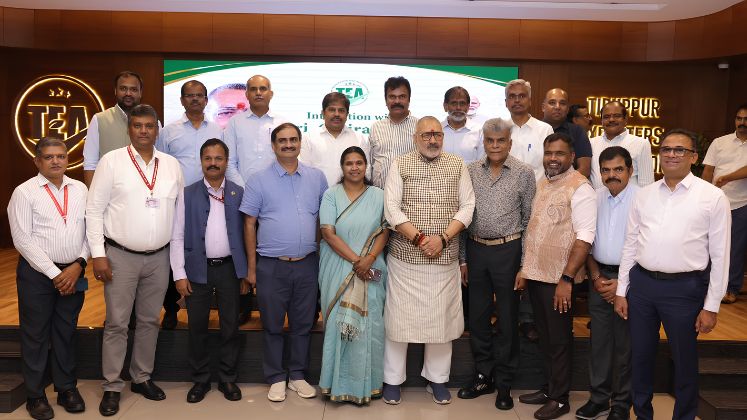
Union Minister of Textiles Giriraj Singh has reaffirmed the Central Government’s commitment to supporting the growth of Tirupur’s textile and garment industry, urging manufacturers to accelerate their transition towards man-made fibre (MMF) production and sustainable manufacturing practices.
During a meeting with representatives of various manufacturers’ associations at the Tiruppur Exporters’ Association (TEA), the minister said the shift from cotton-based manufacturing to blended and MMF-based production was essential to meet evolving global demand.
Singh further assured the industry that the Central Government would extend full support for the development of hostels for women workers, the establishment of new industrial clusters and the adoption of advanced manufacturing technologies to strengthen the textile ecosystem.
TEA President K.M. Subramanian said the Tirupur knitwear cluster recorded exports exceeding Rs. 46,000 crore (US $4.87 billion) during 2025–26, contributing nearly 60% of India’s total knitwear exports while providing employment to more than one million people.
To help the cluster achieve its target of Rs. 1 lakh crore (US $10.59 billion) in knitwear exports by 2030, Subramanian urged the Union Government to introduce worker accommodation and hostel facilities, remove import duty on cotton, extend the Rebate of State and Central Taxes and Levies (RoSCTL) Scheme, and expedite the implementation of the TEEM scheme.
T.N. Venkatesh, IAS, Principal Secretary, Handlooms, Handicrafts, Textiles and Khadi Department, Government of Tamil Nadu, said the state had been assigned a textile export target of US $21 billion under India’s national objective of achieving US $100 billion in textile exports by 2030. He added that Tirupur alone was expected to contribute US $11.5 billion towards the state’s target.
Venkatesh also announced that the Tamil Nadu Government had set a target of achieving Rs. 1 lakh crore (US $10.59 billion) in technical textile production and creating 5,000 specialised jobs by 2031. He said the state had allocated Rs. 1,250 crore (US $132 million) over the next five years to develop hostel facilities for women workers through the Social Welfare Department.
In addition, he announced plans to establish a Centre of Excellence for Activewear in Tirupur to promote innovation and strengthen the state’s position in the rapidly growing activewear segment.
Dr. A. Sakthivel, Chairman of the Apparel Export Promotion Council (AEPC) and Honorary Chairman of TEA, called for the early implementation of the Affordable Housing Scheme, stating that it would significantly support the expansion of Tiruppur’s textile and garment industry.
He also sought a 50% capital subsidy for the MMF processing sector, simplified import procedures and the establishment of a dedicated Centre for Green Processing in Tiruppur. Looking ahead, Sakthivel said the industry’s manufacturing mix would gradually evolve to comprise 50% cotton and 50% MMF-based products, aligning production with future global market requirements.




 Bharat Tex Special Report 2026