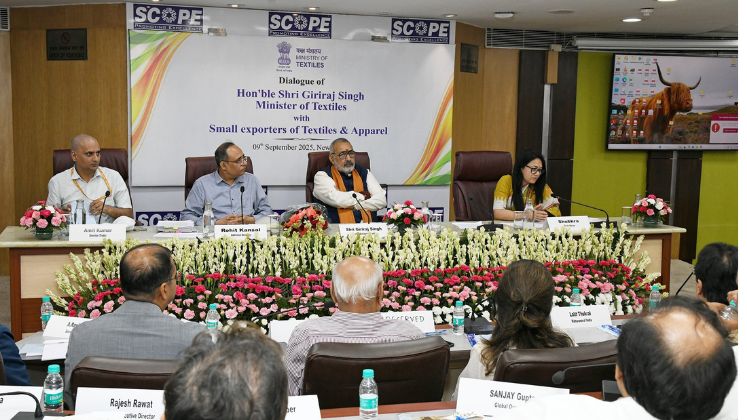
The Ministry of Textiles on Wednesday convened a wide-ranging consultative meeting with micro, small and medium (MSME) textile exporters from across the value chain, chaired by the Union Minister of Textiles. This was the second such meeting, following a national-level consultation with leading exporters held on 13th August 2025. The Additional Secretary (Textiles) and the Trade Advisor also attended the deliberations.
Opening the discussions, the Union Minister said that India’s textile sector, valued at US $ 179 billion with exports worth US $ 37.75 billion, remained one of the proudest symbols of the nation’s economic strength and cultural heritage. Contributing nearly 2% to GDP, the sector sustains India’s position as the sixth-largest exporter globally with a 4.1% share in world trade, with exports reaching more than 220 countries and over 520 districts actively engaged.
Despite global volatility and steep tariffs imposed by certain trading partners, the sector has displayed resilience. Exports in July 2025 grew by 5.37% to US $ 3.10 billion, while April–July 2025 exports stood at US $ 12.18 billion, reflecting year-on-year growth of 3.87%. Segment-wise performance included growth in readymade garments (7.87%), carpets (3.57%), and jute products (15.78%), with handicrafts and man-made fibre textiles maintaining steady momentum. The Minister also noted robust first-quarter growth in exports to key partners such as Japan (17.9%), the United Kingdom (7.39%), the UAE (9.62%), and Australia (1.74%), arguing that these trends reaffirmed India’s ability to capture a greater share of the US $ 590 billion global textile market. He stressed the importance of diversifying into 40 identified global markets while deepening domestic demand, in line with the Prime Minister’s call for “Vocal for Local”.
The Union Minister pointed to the recent 56th GST Council meeting, held on 3 September 2025, which introduced second-generation rationalisation measures across the textile value chain. He said these reforms would reduce distortions, lower costs, stimulate demand and strengthen export competitiveness.
MSME exporters welcomed the reforms and called for continued fiscal support, simplified compliance and stronger global branding of handlooms, handicrafts and GI-tagged Swadeshi products. They also highlighted the need for policies that enhance visibility and market penetration for smaller exporters.
Encouraging exporters to explore new strategies, the Union Minister advocated the creation of warehouses in key global markets such as the EU, the US and other strategic destinations, particularly for handicrafts, handlooms and lifestyle products through e-commerce channels. He said such initiatives would allow Indian producers to reach consumers directly, reduce delivery timelines and enhance competitiveness in premium markets.
Concluding the meeting, the Union Minister reaffirmed the Government’s commitment to Vision 2030, which targets US $ 100 billion in textile exports and a US $ 250 billion domestic market. He said these goals would be realised through diversification, stronger domestic consumption, structural reforms, innovation and a reinvigorated Swadeshi movement that showcases the strength of artisans, weavers, MSMEs and women entrepreneurs.






 Bharat Tex Special Report 2026