Every stakeholder of the textiles industry is of the opinion that there is lot more that needs to be done in technical textiles and that too at various stages. But what is required, what is being done and how it should go further are some questions that were all discussed in length at the two-day long 3rd National Conclave on ‘Standards for Technical Textiles’ in Delhi.
Jointly organized by Federation of Indian Chambers of Commerce and Industry (FICCI) with Ministry of Textiles and Bureau of Indian Standards (BIS), this conclave interestingly touched various aspects of technical textiles’ industry. Experts were of the opinion that if concerned issues get solutions, this industry can grow over annually by up to 20 per cent and even more, importantly enhancing the safety, security and health of its own people.
The event also saw sessions on ‘Standards Required for Health and Hygiene’and on ‘Standards Required for Workplace Safety’ in which top doctors, senior Government officers and industry professionals exchanged their views.
Standardization is a major tool to indigenize the manufacturing of technical textiles’ products. This has been facilitated by the textiles division of BIS which has published more than 1,230 standards so far, and out of which 45 per cent are for technical textiles. In the last three years, more than 100 standards have been published for technical textiles and 45 more such subjects have been identified for standardization. Highlighting such efforts of BIS, its present DG, Surina Rajan further assured that BIS will focus on the outcomes of this conclave in its standards and is further planning to fast track the standards for technical textiles. BIS will also constitute special section-wise committees for various segments of technical textiles.
“We have to revive our processes and we are ready for that. Active participation of all stakeholders is required as BIS can’t be an expert in each and every subject and field.” – JK Gupta, Scientist-D, Textiles, BIS
However, Anant Kumar Singh, Secretary – Textiles, insisted not only to identify and formulate standards, but also streamline the entire process. “If we go at this speed, perhaps by the time we have standards for ourselves, it will be too late,” he stated in a concerned way. The Secretary also highlighted that the industry’s role is not merely the identification of the need for standards, but also extend to the evaluation of the viability of those standards at the micro-economic level. Highlighting the efforts of MoT in this regard, he informed about MoT constituting 8 committees at the Centre of Excellence to help identify the areas in which standards need to be formulated. Moreover, MoT is in the process to initiate a new mission on technical textiles as the earlier mission was completed in its time-frame.
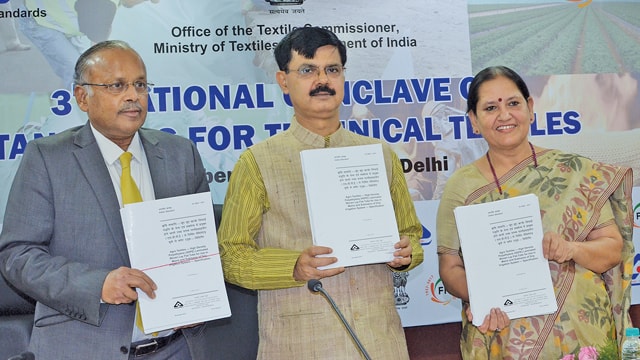
Shishir Jaipuria, Chairman, FICCI Textiles Committee and CMD, Ginni Filament Ltd., insisted that the momentum has been built where the interaction between the user and the manufacturer is gaining ground. It will ultimately lead to more investments and new entrepreneurs into this field.The BIS scientists stressed that with the recent BIS Act 2016, it now has more authority, enabling provision of recall of the substandard material; even penalizing the manufacturers for sub-standard products. But the emphasis is on formulating standards, on the basis of consensus, unlike the situation in international arena where voting is used for the same. JK Gupta, Scientist-D, Textiles, BIS, who voted to speed up the standardization processes said, “Active participation of all stakeholders is required as BIS can’t be an expert in each and every subject and field.” Gupta briefed that the standardization for firefighting suit is in its final stage, and since India doesn’t have its own standardization in this segment, it will be an advantage for the stakeholders.
“We have missed the technical textiles developments in India because Aramid and allied materials were developed between 1960s and 1980s, but at least now the new materials like CNT, Graphene etc., are still being developed the world over. If laboratories and R&D facilities in India can take these challenges, they can scale up mass manufacturing and industrial production, so that we can catch up with the world trend of using new material for body armour.” – Vaibhav Gupta, Director, MKU Limited, Delhi
Defence sector is one of the major customers for technical textiles products. There is increasing opportunity for the Indian industry in the defence sector as Indian Army till recently was sourcing a major share of clothing-related items from Ordnance Factory Board but now Government has offloaded 48 principal items from the Ordnance Factory Board. The Army will therefore gradually switchover in 3-4 years’ time from Ordnance Factory Board to the Indian industry, shared Major-General BV Rao (MGO Branch). He even touched the technical aspects of standardization and informed that gloves and socks are the most difficult products to manufacture with this set standards.
According to Rao, some of the items of this industry division used to be imported earlier, but are now being sourced from Indian companies having been manufactured in India. Rao shared that the Indian Army has an annual budget of approximately Rs. 3,000 crore for clothing and general stores. It has mainly three categories of clothing depending on the altitude and weather conditions where soldiers operate. The other segment of the defence sector, i.e. the Indian Navy, has a budget of nearly Rs. 100 crore and there are 409 items in its clothing inventory. Captain Sankardeep Bharali, Principal Director of Clothing and Victualling, Indian Navy stated that Navy has a very small order size and its procurement is highly decentralized. Apart from many high technical clothing items, polyester-viscose (70:30) uniform fabric is one of the major items (nearly 9 lakh metres on an average basis in 3 colours) sourced by the Navy. These officers expect that the industry or other bodies like FICCI and BIS, should support them by field participation in development activities, partaking in inspections and QA processes, and in facilitating product satisfaction and sharing of expertise.




 Bharat Tex Special Report 2026