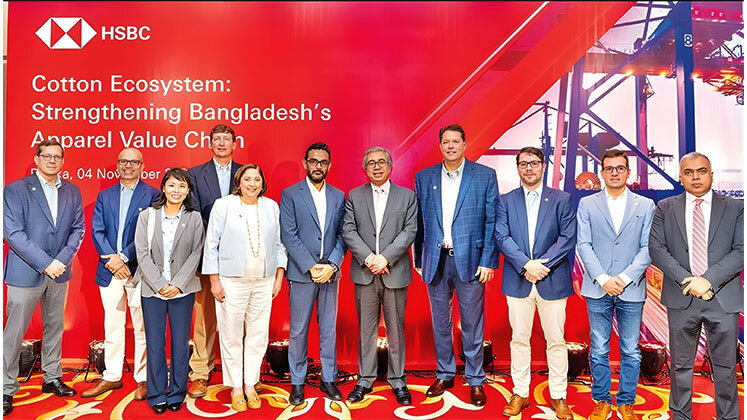
A roundtable discussion titled Cotton Ecosystem: Strengthening Bangladesh’s Apparel Value Chain was recently hosted at a hotel in Dhaka by the Hongkong and Shanghai Banking Corporation Ltd. (HSBC).
Leading cotton suppliers and US cooperatives, international clothing purchasers, top clothing and textile manufacturers, senior BIDA officials, logistics partners and trade associations like BGMEA and BTMA were all represented at the event, which was moderated by Md. Mahbub ur Rahman, CEO of HSBC Bangladesh.
Six US cotton exporters—Louis Dreyfus Company, Olam Cotton, Cargill Cotton, ECOM USA, Staplcotn and Cotton Growers Cooperative—as well as senior representatives from Cotton Council International (CCI) attended the discussion on supply chain resilience and navigating cotton trade dynamics.
Wayne Boseman of Cotton Growers Cooperative and Krista Rickman of Cargill Cotton presented on the global and US cotton landscape and the evolving dynamics of sourcing.
Mahmud Hasan Khan, President of Bangladesh Garment Manufacturers and Exporters Association (BGMEA) said, “Strengthening our cotton sourcing ecosystem is vital for the continued growth of our apparel industry. BGMEA is working closely with regulators to address the challenges and to leverage opportunities, including optimising the benefits of the US cotton content provision.”
“Representing Cotton USA at the roundtable hosted by HSBC Bangladesh on cotton ecosystem, I am encouraged by engagement from mills, garment manufacturers, financial institutions and government leaders,” stated Krista Rickman, Senior Director – Sustainability and Brand Engagement at Cargill Cotton. “Our discussion on the world’s cotton supply and demand brought to light the difficulties facing the industry today as well as the common chances to improve sustainability, quality and openness throughout the cotton value chain.”
Md. Mahbub ur Rahman, stated, “Cotton, a global commodity, is the very heart of Bangladesh’s US $ 40 billion apparel industry.” Cooperation and coordination along the value chain are more crucial than ever as the dynamics of global commerce change.
“Apparel is an important segment for HSBC, and with presence in over 50 markets, the bank is in a unique position to connect cotton suppliers, apparel and textile manufacturers and global apparel buyers,” said Md. Ashfaqur Rahman, Head of Global Apparel Supply Chain, Corporate and Institutional Banking, HSBC Bangladesh. To serve this industry, HSBC has a specialised textile and apparel team in Bangladesh as well as industry experts in important export target markets.
Bangladesh is the world’s biggest importer of cotton and the amount is predicted to rise in tandem with the expansion of clothing exports.
In light of the current state of trade, talks were held between local and international players to establish more robust connections and cooperative frameworks to guarantee traceability, adaptability and sustainability in the procurement of raw materials.





 Bharat Tex Special Report 2026