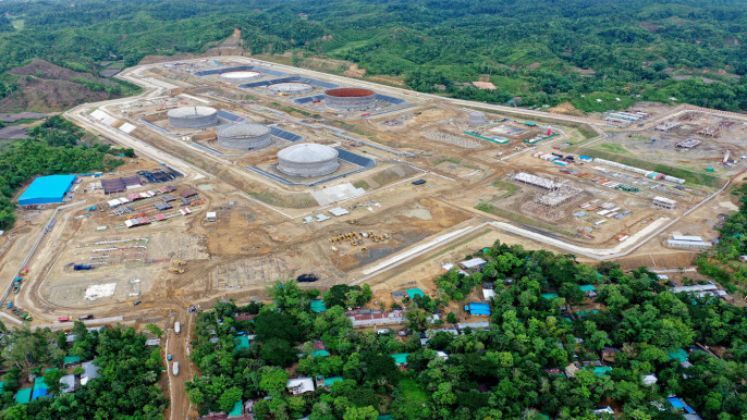
The Government of Bangladesh has announced an ambitious 30-year development plan to transform the Matarbari-Maheshkhali region into a world-class commercial and industrial center, comparable to major ports like Shanghai and Singapore. The initiative aims to create up to 2.5 million jobs and significantly boost the country’s economy by 2055.
Chowdhury Ashik Mahmud Bin Harun, Chairman of the Maheshkhali Integrated Development Authority (Mida), revealed the details of the project during a press conference at the Foreign Service Academy in Dhaka. He emphasised that successful implementation could position Bangladesh as a key player in global trade and logistics.
The project, spanning approximately 33,000 acres, will be carried out in three phases: 2025-2030, 2030-2045 and 2045-2055. The initial phase focuses on establishing a deep-sea port, improving transportation infrastructure through rail and road links and creating a power hub. The subsequent phases will develop a comprehensive ecosystem to attract both domestic and foreign investments, fostering industrial growth and urban development.
A master plan, inspired by the best practices of Singapore and Shanghai ports, is currently being prepared. The authorities aim to complete administrative preparations within 120 days and are actively recruiting experts, including an experienced Bangladeshi expatriate, to lead the project’s implementation.
The government’s vision includes developing a free trade zone, fisheries processing centers, shipbuilding and repair hubs, all designed to catalyse industrialisation and economic diversification. Future power generation will prioritise gas and nuclear energy over coal, aligning with environmental sustainability goals.
Ashik Mahmud also highlighted the project’s economic potential, projecting an addition of US $ 150 billion to Bangladesh’s GDP, US $ 60-65 billion in investment and significant savings in logistics costs by reducing reliance on transit hubs like Singapore and Colombo.
The project also aims to promote eco-tourism and environmental conservation, including forest protection and the establishment of eco-parks. The government emphasises the role of research, academia and international collaboration in fostering a sustainable blue economy, with plans for conferences, institutions and studies tailored to Bangladesh’s unique needs.
The Mida chairman noted that the current team is small but actively expanding, seeking experienced professionals to support the development of this transformative project. The initiative marks a significant step toward positioning Bangladesh as a regional economic powerhouse with a modern, sustainable and globally connected infrastructure.






 Bharat Tex Special Report 2026