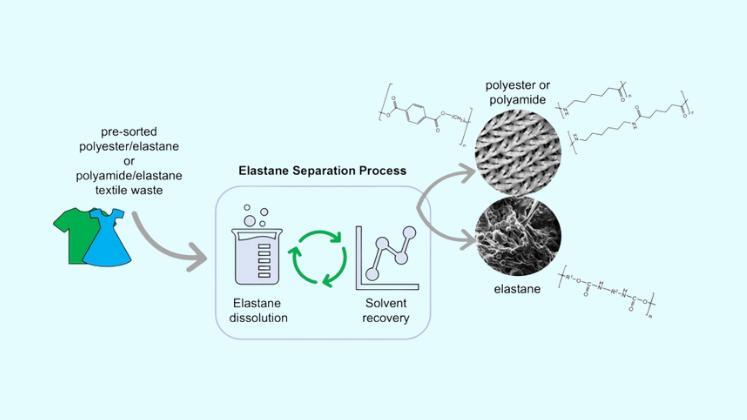
Scientists in Vienna have developed a feasible and up-scalable process for separating elastane, also known as spandex, from textile waste, the first of its kind ever formulated.
After experimenting with six distinct organic solvents, the Vienna University of Technology researchers determined that dimethyl sulfoxide (DMSO), which is non-hazardous, was the most effective. Textile waste samples consisting of polyester/elastane and polyamide/elastane were used in the experiments. It was found that the DMSO, which also runs circular inside a three-step purification process, was the most advantageous.
The results of the studies show that it is feasible to achieve both full recovery and concurrent purification of the solvent employed in a closed loop for elastane separation.
Elastane fibre extraction from textile waste has been the subject of few and unsuccessful experiments up to this point. N,N-Dimethylformamide (DMF), a hazardous organic solvent that has been used in research, is a good solvent but is subject to severe restrictions under the Registration, Evaluation, and Authorization of Chemicals (REACH) regulations.
Additional trials have included treating textiles with solvents and tetrahydrofurfuryl alcohol (THFA), which is harmful to female fertility and unborn foetuses, dissolving cotton blends while leaving the elastane intact, and breaking down elastane in fabric blends and washing them with ethanol. Such successful DMSO experiments may play a major role in transforming the textile industry from a linear to a circular economy.