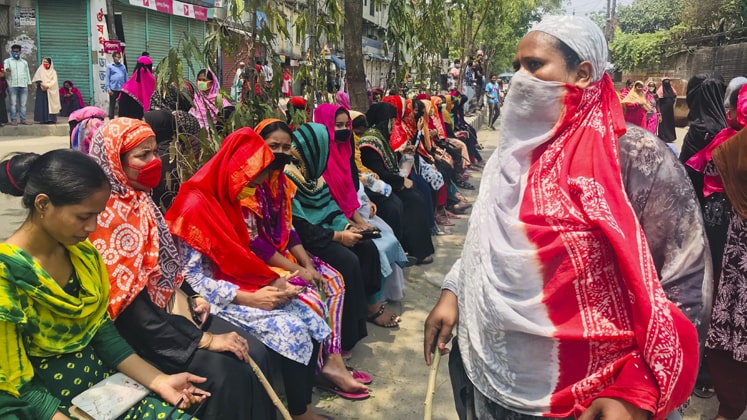
The workers employed in Bangladesh’s readymade garment sector, especially those who have been rendered jobless on account of the COVID-19 pandemic, are in for some positive development after the Bangladesh Government recently decided to provide Taka 3,000 per month for 3 months to the laid-off, disabled, and insolvent workers of export-oriented garment, leather, and footwear manufacturing units.
Backed by the European Union (EU) and Germany, which together paid €113 million to this end, the Labour Department has prepared implementation guidelines for the social safety net programme, as part of which, the Government would pay Taka 3,000 per month to a worker for 3 months under the scheme.
Factory workers that are members of the Bangladesh Garment Manufacturers and Exporters Association (BGMEA), the Bangladesh Knitwear Manufacturers and Exporters Association (BKMEA), the Leathergoods and Footwear Manufacturers & Exporters Association of Bangladesh (LFMEAB), and the Bangladesh Finished Leather, Leathergoods and Footwear Exporters’ Association (BFLLFEA) are eligible for the same.
The Finance Ministry has sent a proposal to the Prime Minister’s Office seeking permission for the scheme.
This move by the Government has been praised by all quarters considering the fact that the Bangladesh’s apparel manufacturing and export sector came under severe pressure because of the pandemic-induced economic disruptions in the major export markets such as the European Union and the USA. As a result, several export-oriented factories were forced to announce temporary layoffs and put production on hold or reduce production, thereby affecting both the owners and the workers.
Even though most of the retrenched garment workers are said to have received compensation under the labour laws of the country, the fallout of the pandemic has rendered many of them still languishing in poverty as the pandemic has persisted, thereby squeezing the scope for alternative employment opportunities.
“As a result, the income-generation capacity has narrowed and the workers are facing economic hardships,” maintained the Labour Department’s guidelines in this direction, adding, “So, the Government has initiated a move to roll out a social protection scheme to provide emergency humanitarian support for the two important sectors.”
The EU and Germany have agreed to provide €113 million in grant to implement the scheme, which would be implemented by the Labour Department through active participation of the owners, under the guidelines in the current and the next fiscal years.
“If the real retrenched workers get Taka 3,000 per month at least for 6 months, they will be able to cope up with the adverse impacts,” stated Nazma Akter, President, Sommilito Garments Sramik Federation, adding that the workers who have not received salaries in June, July, and August were really in trouble.
“It is good that the welfare of the workers is being looked into. We hope it would be implemented properly,” maintained Hossain Zillur Rahman, Executive Chairman of the Power and Participation Research Centre. He went on to add that surveys showed that the Government’s social protection schemes were mostly giving attention to formal sector workers where 87 per cent of the country’s workforce is outside the formal sector.
“We have to address the informal sector. Otherwise, there would be inequality within the working group,” commented Hossain Zillur Rahman, while Tanvir A Mishuk, Director, Nagad, said this was a timely initiative and the right approach to stand beside the employees who have already lost their jobs.
Established in 1996, Power and Participation Research Centre is an independent non-profit centre for research and social action based in Dhaka, Bangladesh, which is focused on issues of public policy, knowledge management, and citizen empowerment, while Nagad is a digital Financial Service in Bangladesh operating under the authority of Bangladesh Post Office (an attached department of the Ministry of Post and Telecommunication) and operated by Third Wave Technologies Limited.
According to reports, the Director General of the Labour Department would lead an eight-member implementation committee for the scheme that would include the Additional Director General of the Labour Department, the Additional Inspector General of the Department of Inspection for Factories and Establishments (DIFE), and the Chief Accounts and Finance Officer of the Labour Ministry.
Representatives of the BGMEA, the BKMEA, LFMEAB and BFLLFEA and the EU will also be there. Besides, a 10-member committee led by the Labour Secretary would monitor and evaluate the scheme.
According to reports, factories under the four trade associations would prepare a primary list of the affected workers and bring relevant information under a management information system (MIS), which will include the names of the affected workers, their addresses, national identification numbers, bank or mobile financial service account numbers, and mobile phone numbers.
The factories would send the data to the associations, which in turn would forward the list to the Labour Department. The Labour Department would then verify the data and place it at a meeting of the implementation committee.
The list recommended by the implementation committee would be approved by the Director General of the Labour Department. A bill would be submitted to the Chief Accounts and Finance Office subsequently.
Workers who were employed until February this year would be eligible for the support. Besides, the workers who tested positive for COVID-19, are suffering from other diseases, or are unable to work are also eligible under this scheme to avail the monetary support from the Government.
It may be mentioned here that the Government has been in the forefront of helping the workers, whose livelihoods have been severely impacted by the pandemic since its outbreak in the country. Under the leadership of Prime Minister Sheikh Hasina, the Government first rolled out Taka 5,000-crore special package to pay the wages and allowances of workers of export-oriented industries for 3 months starting from April. However, as the fund was later found to be inadequate, the Government released another Taka 2,500 crore from the bailout package, rolled out for the large industries affected by the pandemic.
Subsequently, banks disbursed the amount directly to the workers’ bank accounts or mobile financial service (MFS) accounts. As part of it, borrower enterprises got interest-free loan (with a 2 per cent service charge) to be repaid in 18 instalments over 2 years, which include 6 months as grace period.
However, by June, the industry came up with yet another request asking the Government to continue low-cost loans to help them pay wages to workers for another 3 months. A letter jointly written by the BGMEA and the BKMEA was sent to the Finance Minister AHM Mustafa Kamal on 22 June in this regard which pursued another round of financing, a copy of which was sent to the Principal Secretary to the Prime Minister, highlighting the need of such a facility as RMG has been one of the worst-hit sectors after its earnings in the immediate past fiscal year fell to its lowest in a decade of US $ 27.83 billion, which is 18.45 per cent lower than in fiscal 2018-19, consequent to the large-scale order cancellations by global buyers and severe fall in demand for apparels in the Western world.
So, even before the garment makers were to pay the festival bonus and July’s wages to workers ahead of the holy festival of Eid-ul-Azha, the Government on 23 July approved yet another stimulus package worth Taka 3,000 crore for the export-oriented industries to help them provide wages and salaries to their workers for July.
This was the third stimulus package for the export-oriented industries.
To put it in the perspective, one has to accept that considering the importance and significance of the garment industry, the Government has time and again come up to help it, especially the workers, who are the cornerstone of the sector, to help minimise the impact of the pandemic.
However, one also has to accept that stakeholders like the European Union and Germany have been rather proactive in helping the Bangladesh Government in this direction. Germany, in particular, has come forward to help the garment workers, not only of Bangladesh but other countries as well.
Recently, Germany provided €14.5million to ILO’s programme to help garment sector workers. Designed as a multi-donor initiative, the programme will provide cash transfers and personal protective equipment (PPE) and deliver awareness-raising campaigns on occupational safety and health or OSH. It will also provide policy advice on social protection and OSH, with the aim of building peoples’ resilience to future shocks. This approach links work to meet immediate humanitarian needs with that of building long term, sustainable solutions that are part of national policy frameworks.
The restrictions and health measures related to COVID-19 and the accompanying general business uncertainty have had a devastating socio-economic impact on workers and employers in the global garment supply chain. Many producing factories have reduced or temporarily suspended their activities. Some have closed entirely. Consequently, many workers have had their hours reduced or have been laid off, most without any severance pay or unemployment benefits. As a result, a large number of poor workers, primarily women, have lost their income.
The multi-donor programme’s integrated strategy, thus, aims to assist both workers and private sector businesses rebuild their economic activities, mitigate further interruptions in the supply chain, and provide direct support to garment sector workers, especially women in Bangladesh, Cambodia, Ethiopia, Indonesia, Lao People’s Democratic Republic, Madagascar and Vietnam.
The initiative will build on the country level activities of three existing ILO areas of work – the Vision Zero Fund (VZF), social protection, and the Better Work Programme – making use of their existing local networks and operations.
Hopefully, these much-needed efforts by the stakeholders, especially the Bangladesh Government, will go miles towards providing some succour to the garment workers, lives of many of whom, have been hit extremely hard by the pandemic.




 Bharat Tex Special Report 2026