Once known for its adverse environmental impact, the denim washing industry is undergoing a remarkable transformation fuelled by sustainable practices. From water-free laser technology and e-flow systems to eco-washing machines and sustainable dyeing techniques, innovations contribute to monitoring water usage, saving energy and reducing pollution for a cleaner future. It’s not wrong to say that modern technologies have taken over conventional methods of the washing process.
For instance, the replacement of traditional stone-washing techniques with Tonello’s innovative abrasive stainless-steel drums, developed in partnership with Levi Strauss & Co., significantly decrease water usage, washing costs, emissions, waste, processing time and manual labour associated with the NoStone process.
Similarly, ozone technology has taken centre stage in bleaching, replacing older methods and leading to reduced rinse and conversion of excess ozone into harmless oxygen and water. Laser technology is also leading the way in crafting effects like whiskers and sanding, using less water, energy and chemicals compared to traditional methods.
Siddharth Wilson, VP of Production and Washing (Denims), Spykar Lifestyles states, “It is very important to adapt innovations. We as a brand are stepping into the sustainable processes by introducing RE:MINED – an initiative that reduces freshwater consumption by recycling and reusing treated water, low-impact laundry processes using state-of-the-art technology and ecological chemicals promoting a non-hazardous workplace for our labour force, resulting in reduced impact on our environment and people.”
| Prominent companies like Tonello, Ramsons, Dystar and Jeanologia are at the forefront of denim finishing innovation. Tonello’s Laundry (R)Evolution introduces The Laser for creative abrasion and the All-in-One System for reduced water consumption. Jeanologia’s Atmos process achieves aging effects without water or chemicals. Ramsons’ XDrum employs high-pressure systems for enhanced denim quality and appearance, coupled with RFID technology for efficient laundry tracking. |
Implementing sustainable practices helps create a powerful impact on the denim washing industry
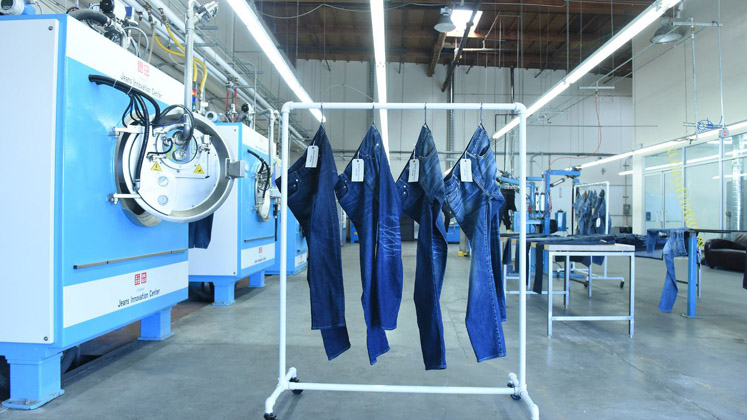
The denim washing industry is experiencing a wave of innovation with exciting developments on the horizon. From laser technologies that replicate authentic distressing patterns to ozone washing methods that eliminate water consumption and chemical usage, global examples abound with revolutionary approaches to denim washing. For instance, Levi’s WaterLess® innovations have conserved a substantial 3.5 billion litres of water during the denim manufacturing finishing stage. UNIQLO’s collaboration with the Jeans Innovation Center (JIC) has resulted in 90 per cent reduction in water wastage through laser engraving, nano-bubble technology, ozone washing and water recycling.
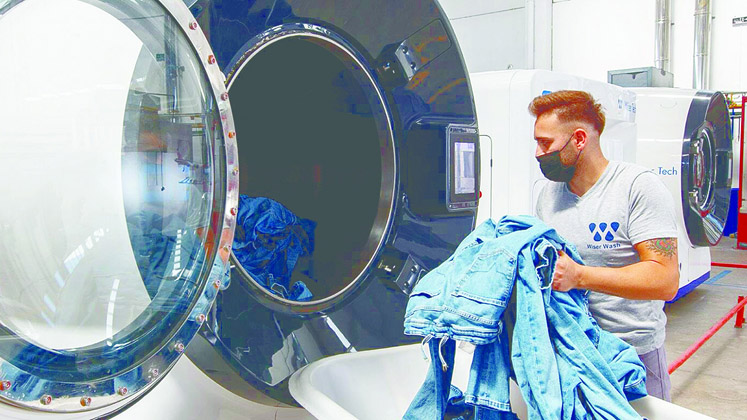
HAMS Group Bangladesh, leading manufacturer which has clients such as H&M, M&S, Kmart, has also adopted varied sustainable practices in its laundry areas, obtaining certificates from GOTS, OCS and ICS for sustainable washing practices. In conversation with Apparel Resources (AR), Akib Rahman, Director, Dhaka Garment and Washing Ltd. HAMS Group, states, “Our commitment to sustainability is demonstrated by our utilisation of the EIM software (Jeanologia), which assesses our sustainability score. In addition, we employ modern front-loading machinery designed for minimal water and chemical usage, reflecting our dedication to eco-friendly washing methods. Our focus on sustainability is further highlighted by our dedicated machines, QC table and rack for sustainable goods. Notably, the usage of an E-flow machine significantly curtails water and chemical consumption. Our adherence to ZDHC-approved chemicals and operation of a biological ETP plant underscores our efforts to responsibly release treated water.”
Not only this, India’s reputed manufacturing stalwart Shahi has embraced e-flow technology, transforming chemicals into nanobubbles to minimise water usage. This approach has achieved an average water saving of 95 per cent for each denim washed. Shahi’s adoption of various technologies, including laser machines, automated chemical dosing and ozone treatment, aligns with its commitment to sustainability.
“Judiciously utilising the four fundamental resources—chemicals, energy, water and our workforce—defines our concept of sustainability. Shahi has embraced the Laundry 5.0 approach, projected to transform the denim industry. We amalgamate state-of-the-art technologies from across the globe to create a product that is not only stylish but also environmentally conscious. Through the incorporation of Laser machines from Jeanologia, automated chemical dosing, ozone treatment, e-flow and other water-efficient innovations, we are taking significant strides towards ensuring utmost sustainability in our processes,” states Nandeesh Gowda, General Manager, Laundry, Shahi Exports.
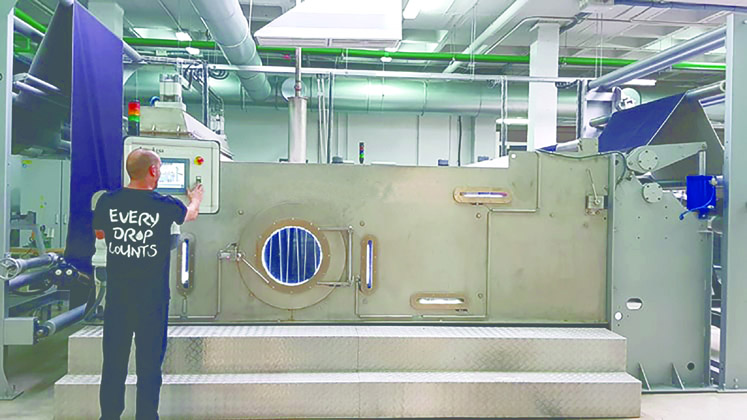
Software is an integral part of measuring sustainability in the washing process
Software integration is a vital component in assessing sustainability in the denim washing process. Environmental Impact Measuring (EIM) software evaluates the environmental effects of laundry processes, while Environmental Score (eScore) software tracks resource consumption by machines for comparative analysis. Additionally, a collaborative effort between Gujarat-based denim manufacturer Avadat Apparels and Nuvate It Solutions has produced the Wash It laundry ERP system that streamlines laundry planning, data management and chemical and water optimisation leveraging the sustainability angle.
Frontiers of denim finishing offer improved choices through ongoing innovation
In the denim-washing ecosystem, there are many companies leading the way in introducing innovative technologies that are reshaping the denim-washing industry and transforming the traditional laundry process. These machines offer an array of techniques that have helped the denim industry to remain sustainable such as replacing manual abrasion techniques and achieving natural bleach effects. With few companies having introduced a mannequin for 360-degree effect and a conveyor belt for seamless processing, these innovative tools replace the conventional manual abrasion technique, granting designers greater creative authority.
Another approach involves an atmospheric washing process that naturally ages garments without relying on water, chemicals or abrasive materials. This solution employs advanced ozone technology to substitute traditional water washers with air washers, enabling controlled levels of abrasion and discoloration for desired effects.

Another example of innovation in the denim washing industry is the use of high-pressure systems to transform water and additives into nano-particles, creating a uniform mist that penetrates fabric surfaces. Also some are working on a nebulising system that creates effects and applies products to the garment, improving performance and decreasing water consumption by up to 96 per cent. This system reduces chemical consumption and energy usage and improves denim quality and appearance. Now companies are working with an all-in-one approach so that all the factors are accounted for and the necessary results are achieved for saving energy and water. Furthermore, tracking systems utilising RFID technology enhance process transparency and efficiency.
| Once notorious for its environmental impact, the denim washing sector is undergoing a sustainable revolution. Innovations like water-free lasers, e-flow systems, and eco-washing machines are reshaping the landscape, saving water, energy, and reducing pollution. Notably, Tonello’s stainless-steel drums and Levi’s partnership are transforming stone-washing. Ozone and laser tech offer efficient bleaching and distressing, using fewer resources. Spykar Lifestyle’s Siddharth Wilson emphasizes innovation adoption, highlighting their initiative RE:MINED, which slashes water use and promotes eco-chemicals for a greener workplace. Similarly, Hams Group Bangladesh and Shahi Exports are leading the change, employing sustainable practices like E-flow technology and EIM software. Innovation is abundant, from air washers for aging effects to nano-particle systems cutting water use. RFID tech boosts transparency. Companies like Dystar, Jeanologia, and Ramsons are trailblazing with laser abrasion, ozone aging, and high-pressure systems, reshaping the industry. |
Reshaping the future one step at a time
With sustainability becoming an increasingly important focus in various sectors, including fashion, the denim washing industry is no exception. Also, the collaborations between fashion brands, textile manufacturers and research institutions pave the way for knowledge exchange and the rapid adoption of sustainable practices throughout the sector. The shift towards eco-friendly processes not only demonstrates the industry’s commitment to the environment but also opens doors to endless possibilities. By embracing these advancements and fostering innovations, the denim washing industry embarks on new standards for sustainable practices across the fashion and textile sectors.




 Bharat Tex Special Report 2026