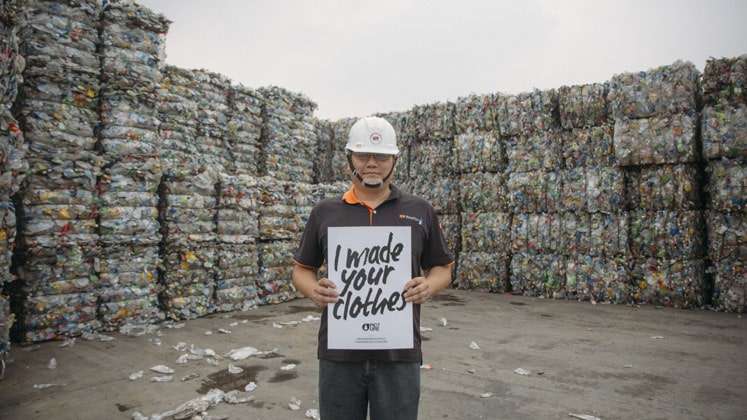
By 2050, half of India’s population will live in cities, and municipal solid waste volume is expected to triple to about 436 million metric tonnes. While the country is committed to the UN Sustainable Development Goals (SDGs), termed the Agenda 2030, several factors and erratic developments across Indian cities and now the pandemic dissuades the country from its true adaptation of the bigger sustainability goals. But, keeping in view the Indian economy’s growth and the environment needs, circularity has been adapted as a viable alternate path by many industries. The apparel industry is no different.
Circularity, when adapted does not only offer economic benefits and reduces a company’s ecological footprint, but also increases both business and community resilience by plummeting dependency on scarce resources and long-distance supply chains. The LYCRA Company, a global leader in sustainable solutions for stretch and performance technologies in the apparel and personal care industries, recently announced the launch of a new campaign aimed at advancing discussions around circularity in textiles. With this campaign, LYCRA puts forth an invitation for customers and industry experts to join The LYCRA Company in using resilient, sustainable materials that ultimately can be recycled at end of life, thus reducing textile waste and ‘closing the loop’ in the value chain.
“Through our ‘Keep in the loop with LYCRA’ campaign, we want to explore a variety of topics related to circularity — from more sustainable raw materials to extending garment wear life to end-of-life solutions,” said Jean Hegedus, Director of Sustainable Business Development at The LYCRA Company. “Our recent introduction of COOLMAX® and THERMOLITE® EcoMade fibres, created from 100 per cent textile waste, is one step in the right direction but there’s much more to do to address these important issues,” she added.
Also Read: Spinning Industry in India is now more than just Cotton Yarns!
Concentrating on circularity
“Circularity is a key focus of The LYCRA Company’s Planet Agenda sustainability platform as we look to advance not just our own sustainability goals, but also those of the industry at large,” said Julien Born, CEO of The LYCRA Company, adding, “Central to achieving this will require a collective effort with the help of industry collaborators so that together, we can maximise impact.”
At the top rung of the pyramid, many groups are working across the world keeping in tow with the UN circularity principles. Then there are corporates which are bringing chemical markers to the market, through which they are defining the path of traceability, thus connecting back to circularity. Then lower down, internationally there are brands like Patagonia, whose existence and USP solely depends on the concept of circularity. So, they can be comfortably regarded as the pioneers in this segment.
On the other hand, there are brands like H&M, which are constantly accused of greenwashing and circularity for them is a milestone that they want to achieve or are trying to achieve on their journey to sustainability. Then there are solution providers which are ready to help brands in both the pre-consumer and post-consumer levels with better traceability, tracking and reuse mechanism. Also, are at play certain business models that directly talk to the consumers and bring them in the conversation. These models help and assist the customers on their journey to circularity and at times these initiatives promote habit changing initiatives and encourage the customer to adapt to the path of circularity.
The idea of circularity is directly linked to the environment. Be it individuals or brands, it is high time that we all understand the concept of environment pollution and thereby adapt to circularity to reduce carbon footprint. “Statutory regulations in the European Union make adaptions to circularity a trending concept. India however, does not have any such regulations in place until now. But, the DNA of the country and we as a nation have been following the trends of circularity for ages now. Traditionally, the Indian economy has been one where reusing, re-purposing and recycling has been of second nature. We do not throw our old garments and majorly pass it on others. Today we do have an informal market that deals with second hand clothing. From the local ones to the growing trend of brands selling vintage and second hand clothes to the ones putting out clothes on rent, we have a new ecosystem in place that supports circularity. However, on the consumer front, people are still not ready to wear used garments and we are still overwhelmed by the ‘choice economy’. We stepped very late into the idea of choices, and this boom of apparel brands in the multiverse of retail is a fairly new concept. So, it will take us time to say no to such exploration and switch to the ‘repair & reuse’ concept so suddenly”, mentioned Pranav Khanna, Business and Creative Head, Frajorden.com.
Mapping circularity
“Circularity in the Indian context isn’t a customer-driven phenomenon,” Nohar Nath, Co-Founder & CEO, KIABZA highlighted. He said that the international audience is conscious and therefore is more demanding when it comes to making apparel purchases. They are ready to spend a little more if need be, in order to buy sustainable clothes. “Circularity is driving the conversation firstly by redefining our earlier approaches to apparel, which was simply make, use and throw. However, now it is more to do with an elaborate path that is make, use, reuse, remake, reuse again, and then throw. The reuse stages within this path need not always be linked to reusing clothes to make apparel, but may actually become a useful trajectory for other industries like carpet. With KIABZA, which is a unique marketplace for people to buy and sell branded authentic and hand-picked pre-owned fashion, we offer a uniform platform for the Sellers, to consign their pre-owned branded clothing and earn easy cash for their products; for the Buyers, to buy the best brands at a great price and look their absolute best. A Seller can put together branded clothing from his/her entire family closet for us and we take care of everything, right from curating a product to delivering it to the buyer and paying the seller for the same”.
Talking about the evolving customer sensibilities that Nohar has closely observed from KIABZA’s point of view, he brings to notice that today 6 per cent of consumers out of the total apparel buyers are dependent on thrift clothing. However, only a minuscule percentage from this segment consciously switch to thrift clothing with the intention to buy meaningful. Sustainable ideas and the concept of reusing clothing is not something that is driving India at the moment. But, he is certainly hopeful and readily points out that we are on the curve and soon will be able to embrace the concept of circularity more wholeheartedly.





 Bharat Tex Special Report 2026