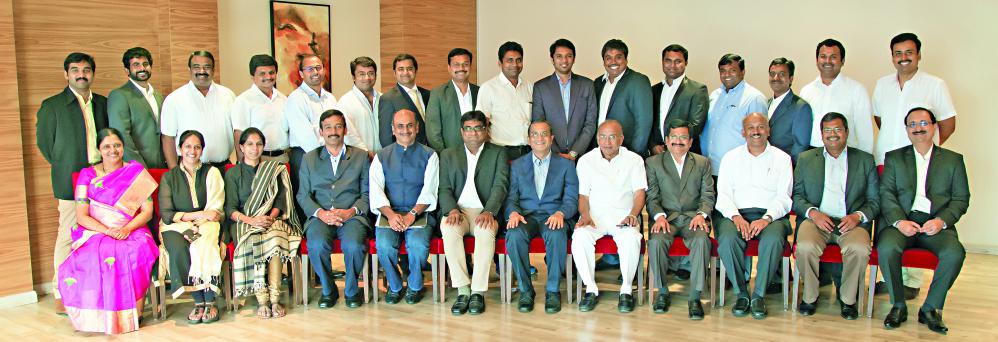
Communication plays a major role in enhancing businesses and while many IT tools are being used to monitor and improve systems within the factory, there are very few times when we see the industry utilising tools such as Whatsapp, effectively. When Whatsapp becomes not just a mode of communication, but also of collaboration, between players of the textile industry of Tamil Nadu, it gives rise to Indian Texpreneurs Federation (ITF). Currently having 3 different groups on Whatsapp consisting of 200 young entrepreneurs, ITF is bringing together collective intelligence and inclusive growth between all its members along the textile value chain. In an exclusive interaction with some core members of the group, Team AO discovered a unique model of ‘collaborative competitiveness’.
Through constant engagement, the newly instated association of like-minded companies, ITF is bringing impactful solutions to problems facing the textile industry of Tamil Nadu, specifically to spinning mills. The solutions are widespread and options for further engagement are immense. Formally initiated a year back, ITF has 32 members in its board, with a total membership of 240 with one secretary, governed by the board. The areas of collaboration are many and the results more than encouraging. ITF is truly a benchmark initiative for all regions and industry players to follow and get value.
Energy Saving…
Increasingly, the member companies are working on energy consumption, trading the age old bulb with LED and changing from traditional ways of working to more progressive ways for greater efficiencies. “Tamil Nadu’s spinning mills can save Rs. 60 crores per year, only by changing the bulbs,” reveals Prabhu Dhamodharan, Secretary, ITF. By working together, this group has brought down the price of one LED bulb from Rs. 1000+ to less than Rs. 700 for 2 lakh orders, making it accessible to mills in Tamil Nadu and thereby lowering the energy consumption at the mills. Also, they have initiated another venture using thermal imaging camera, an instrument used in several heavy engineering industries, to measure heat or temperature in processing or spinning for comfortable working environment and energy savings.
By implementing a comprehensive energy management system (EMS), the association aims to continuously evaluate the machine health and operating practices through the hardware and software installed as part of the EMS to monitor energy consumption round-the-clock. This ensures that every machine is fitted with a metre that is capable of reading various parameters like voltage, current, load consumed and other power factors and the data generated is sent to a common server in the unit for monitoring using a software programme. “It’s one way of saving electricity scientifically. A normal 25,000 spindle mill consumes 1.75 megawatt of power, during a mill trial we saved 7 per cent energy through close monitoring of the heat, so imagine how much saving is possible…It’s huge. So this kind of monitoring will help,” informs Prabhu. Through this system, a standard for each machine’s power consumption is set and if something goes wrong, even a 2 per cent variation, then the electrical engineer or manager gets an sms as well as e-mail alert for immediate action.
Currently in the first phase, the EMS is being implemented in 71 mills in Tamil Nadu. To take charge of the EMS, the association has formed a small panel of members to work with the software and hardware suppliers, hoping to take the count from 71 mills to 250 member mills within the next one year. By collaboration with EMS companies, innovating in design and also because of parallel implementation in more units, ITF is able to bring down the cost of the project by one third.
“We have engaged CRISIL to make a report, which they have submitted independently. In the report, for Rs. 10 lakh of any new investment, textile is generating 14 new employment opportunities. This is the second highest, sector wise.” Prabhu Dhamodharan, Secretary, ITF
More impact at Government platforms…
Most importantly, the Association works with the Central and State Government towards achieving the vision of ‘Make in India’. The Association believes that with a large domestic population and a big export market, India is definitely poised to achieve the vision. But it is crucial to identify the main scope or areas for growth. “Approaching non-traditional market is one area of growth as we are already strong in Europe and the US. For example, Russia’s net worth of apparel textiles is Rs. 85,000 crores, which it is importing from across the world, and our share is just Rs. 450 crores, which is a fraction, and negligible in fact,” claims Prabhu. Luckily, with the IndiaRussia FTA talks in progress, the Association is hopeful that things will move forward and through constant engagement with the Government, Indian textile industry will continue to progress.
Another area where the Association is working on is Regional Comprehensive Economic Partnership (RCEP), between 16 countries, of which India is also a member. “Once the RCEP comes into practice, cotton textiles will get an advantage because China is imposing duty on yarn and fabric from India till now, which we are expecting will come down to zero. We are definitely more competitive in cotton textiles than China. Through ITF, we are representing the whole value chain, so that we can come together for a common programme and speak in a single cohesive language to the world and the Government,” adds Prabhu.
Constantly communicating with the Government in regard to trade pacts, ITF is content with the response of the Government as it is keen to listen and address the challenges facing the textile industry. One such being, the weakness of South India to process synthetics! Globally synthetics are growing and blends are in fashion, due to which the Tamil Nadu textile Industry is somehow missing the growth opportunity. “We are missing the big bus. Three areas that need a relook are: basic raw material price, which are too expensive; our mindsets and the processing capabilities, because south is weak in processing synthetics. So, these are the three areas we have to attack,” maintains Prabhu. The Association has submitted 3 exclusive reports in this regard, and is happy with the way things are moving. “Now the system is changing, becoming more responsive and the government is ready for collaborations. This industry can only move forward on trade pacts (Countries such as Vietnam don’t produce cotton or viscose, but they still have taken over India because they focus on trade pacts. So the Commerce Ministry should emphasis more on trade pacts for export growth and Textile Ministry should impress upon the Commerce Ministry and work together to give priority to the textile sector in all trade pacts.) The industry and the Government should work together. We should provide data and work with the Government,” reiterates Prabhu.
“All my HR heads are ladies and we have 50 per cent females and within this 50 per cent, close to 80 per cent are from North India.” Srihari Balakrishnan, President KG Fabriks
Implementing schemes on larger scale…
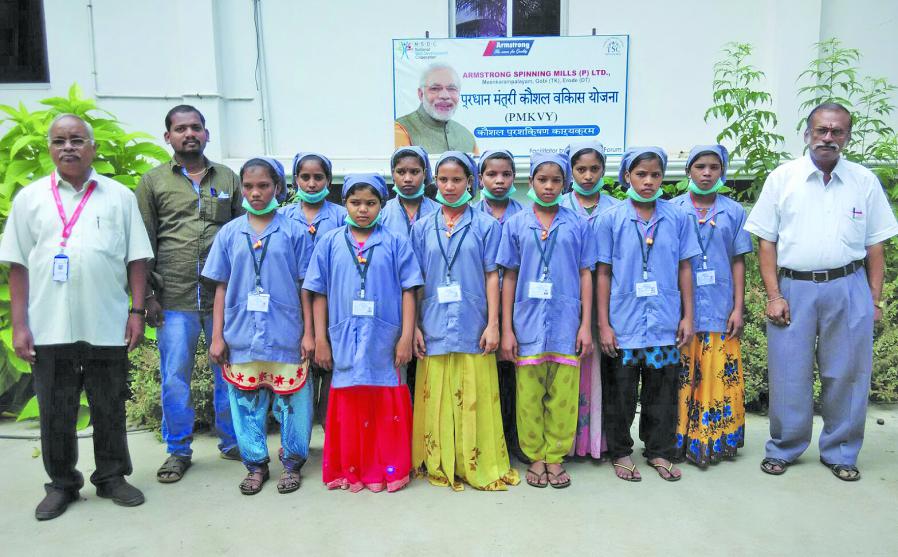
The Association is proud to be the first to effectively work on the Government’s Skill Development Mission, the PMKVY programme, which for the first time in the history of India is standardising job roles and work methodologies. With the help of the Textile Sector Skill Council, the Associations’ 110 member mills are involved in this programme. So far, 5000 workers are undergoing trainings, out of which 1500-1700 have already completed their training. “It is a record. It’s a 100 per cent assessment clearance in the first attempt. Out of the 100 per cent, 80 per cent are women. We have an internal target of training 1 lakh people in the coming FY,” asserts Manoj Jhajharia, Joint MD Salona Cotspin Ltd. Another programme launched by ITF is the Texpreneurs Apprentice Programme for Engineers, employing them as fresh graduates and inducting them into the member mills. These apprentices are given a stipend, while undergoing on-job practical work and attending 3 days of theory class in a month at their institutes. “We are filling the talent gap and creating a pool of engineers over a period of time, a segment that was missing,” informs Prabhu, while Manoj adds, “When we advertised about this programme we received 400 applications in 3 days time.” Involving and motivating mainline engineers into the textile industry is a real achievement for an industry that finds it difficult to even retain textile engineers.
Advantage of collective bargaining and collective intelligence…
In addition to the numerous initiatives, the Association is working in the most predominant of all verticals, i.e. e-commerce. Recently, when Flipkart announced its sale, the majority of buyers were from Coimbatore. “We want to be the sourcing point. We are making different products in Tamil Nadu, which are being sold to top brands in Europe and US. The only problem is that the companies are small in size, SMEs or midsize. Through our awareness programme in Coimbatore, 90 of our co-associates have started selling online,” claims Prabhu. Also, the association is finding cost-effective solutions for innovative products such as compact yarn. “We have invited a brand familiar to this technology in China and have formed a consortium to buy the attachments. We all are working with each other to set it to the Indian working conditions. There is a vast expanse of knowledge within the association and we know that a company wouldn’t mind making changes if they see huge quantities being rolled out,” maintains R. Elango, MD, Sangeeth Textiles Ltd and Director of ITF.
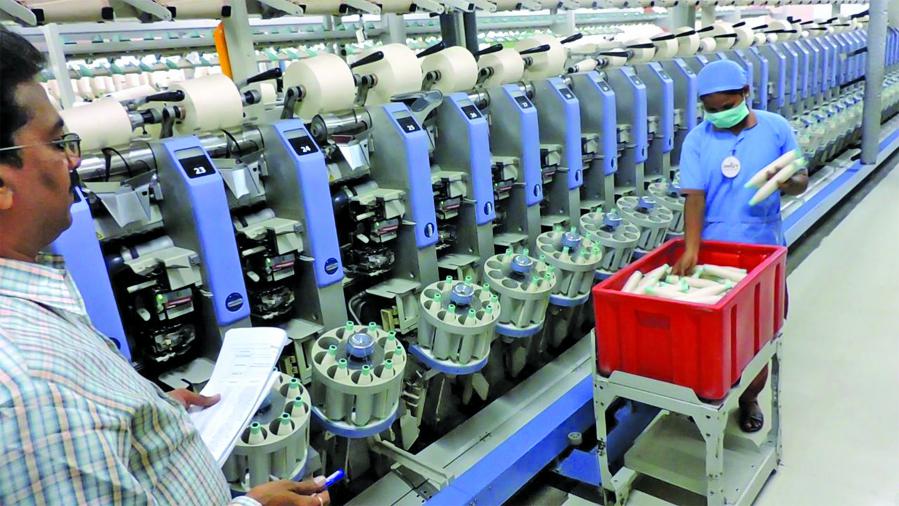
Only focusing on scientific methodology to address issues, ITF innovates various ways to be competitive. In Tirupur, particularly the knitting yarn prices are fixed on the 1st of every month, irrespective of the demand and supply. So the mills face problem as the demand comes down after 10-15 days, for which the Association is using a scientific way of initiating a survey every week, where everyone post their prices without giving any names and at the end of the day, the results are visible in graphical format. “For instance, if Rs. 200 is the benchmark, then how many mills sold it for Rs. 205 or 198, can help in formulating strategies,” reasons R. Dhanapal, JMD, Best Corporation Ltd and Director of ITF. “Here we are trying to be selfsustainable and use everybody’s intelligence to sustain in a cooperative competition,” adds Srihari Balakrishnan, President KG Fabriks Ltd.
Many more milestones ahead…
Bringing together different people on to a single platform though seems like a challenge, but ITF has successfully done it. Although on day 1 of initiation, ITF saw a mere 10 per cent involvement, but gradually it is improving with 50 per cent involvement now. “The next generation coming into business has made a major change and are open to new ideas. Earlier everybody was concerned about themselves, but now it is a collective intelligence. Today, the mindset has changed and people do not hesitate in sharing,” asserts Manoj.
Through a collaborative initiative like ITF, social challenges such as Sumangali that mars the reputation of the South Indian textile industry, are being addressed. “Sumagali is a wrong concept. These girls are extremely happy! We teach them how to live healthy and independently, because we believe that if a lady is empowered, then the family is empowered, and if the family is empowered, the whole nation is empowered,” claims Srihari. In Tamil Nadu, there is a huge shift being witnessed, as majority of the labour force is coming from Orissa, Bihar, Jharkhand, etc. “Twenty years later when you come back to Tamil Nadu, you will see North Indian children settled down here, who will speak Tamil. Sumangali is false, there is a social revolution happening, where families are getting resettled in empty villages and giving a rent of Rs. 2000 for the empty houses,” states Srihari, while Manoj adds, “The rural economy is also growing as so much of money is being put in rehabitation. The posters in my factory are in Tamil, Hindi and Oriya.”
With a core focus on moving up the value chain, motivating all standalone spinning mills to get into finished garments, getting efficiencies in spinning while being cost effective, giving importance to trade pacts and synthetics, ITF is setting its vision of growth for the Tamil Nadu industry. The list of initiatives that the group is targeting is getting longer by the day, and the Association is surely making a mark in the industry, proving the fact that collaborations instead of noncooperation is taking is business to new heights. “Our business is like our DNA. At the end of the day, no one can copy my DNA and I cannot copy anyone else’s, so where is the fear? For me, it has been a learning experience. We are learning from each other and together, we represent huge numbers,” concludes Srihari.



 Bharat Tex Special Report 2026