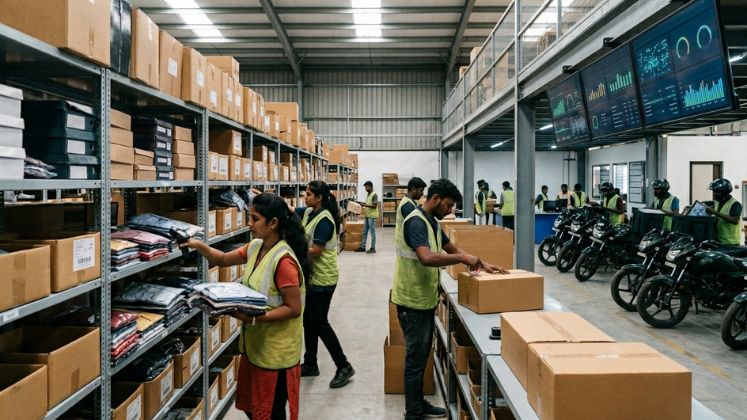
Third-party logistics (3PL) companies are increasingly focusing on vertical quick commerce as they seek new avenues for growth, with specialised categories such as fashion and direct-to-consumer brands driving demand for rapid delivery services.
The growing importance of the segment is becoming evident in the financial performance of logistics providers.
Praharsh Chandra, Co-founder and Chief Business Officer of logistics company Shadowfax, said that vertical quick commerce platforms typically operate at lower order densities, making in-house logistics infrastructure economically unviable. He noted that third-party logistics providers therefore become the preferred solution, similar to the role they played in the growth of horizontal e-commerce.
Unlike grocery-led quick commerce, where a small number of large players dominate the market, vertical quick commerce remains relatively fragmented, creating a more profitable opportunity for logistics providers. To capitalise on this trend, Shadowfax plans to add 100 dark stores during FY ’27 to support faster deliveries.
Established logistics companies are also expanding their presence in the segment. Allcargo Logistics reported a 41% increase in operational profit during Q4 FY ’26, driven by growth in its express distribution and contract logistics businesses. Meanwhile, Amazon recently launched Amazon Shipping in India, enabling direct-to-consumer brands to leverage the company’s logistics network for their own deliveries.
Industry participants believe vertical commerce businesses are structurally more inclined to partner with 3PL providers, as many lack the scale required to develop independent supply chains.
The shift is also expected to support the industry’s move towards sustainable profitability. Delhivery Chief Executive Officer Sahil Barua said that companies in the segment are unlikely to return to an environment characterised by heavy operating losses.
The expansion of vertical quick commerce is generating demand for managed dark stores, inventory management services and dedicated last-mile delivery fleets. Paramdeep Singh, Founder of Long Tail Ventures and an early investor in quick-commerce logistics startup Zippee, said that logistics providers are increasingly evolving from delivery partners into infrastructure providers with higher monetisation opportunities.
Zippee, which enables direct-to-consumer brands to offer same-day and sub-two-hour deliveries through their own websites, recently announced that it processed 900,000 orders in February 2026 alone. The company currently operates across 21 cities through a network of 125 dark stores.
Singh said that vertical commerce presents a significant opportunity for logistics companies, as brands increasingly seek quick-commerce capabilities without investing in their own dark-store networks and delivery fleets.
Market observers expect more logistics providers to pivot towards express delivery services in the coming years. According to Mordor Intelligence, India’s third-party logistics market is estimated to be worth US $38.18 billion in 2026 and is projected to reach US $50.55 billion by 2031, growing at a compound annual growth rate of 5.78%.